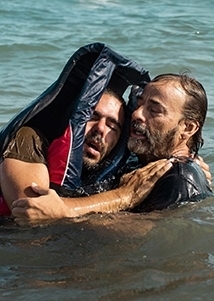
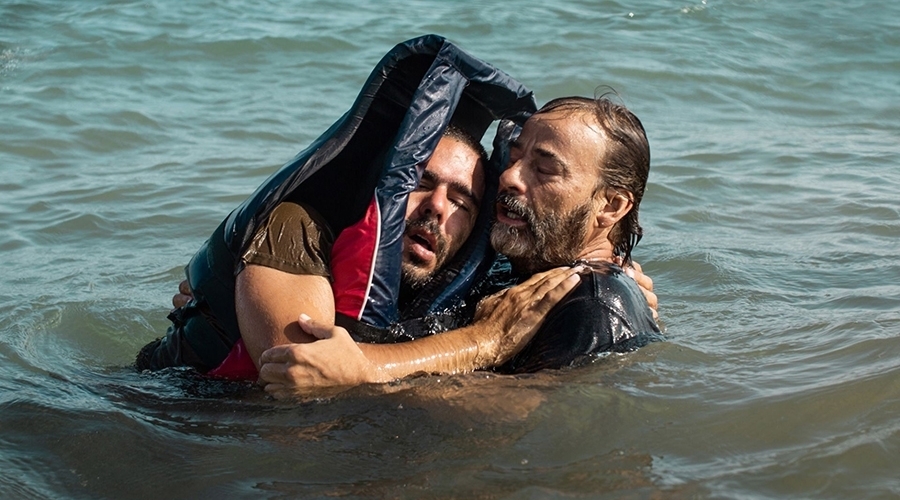
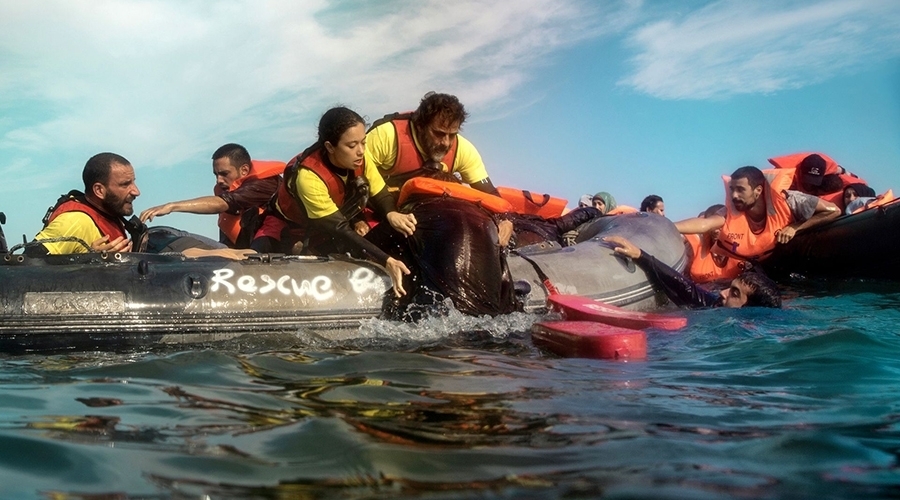
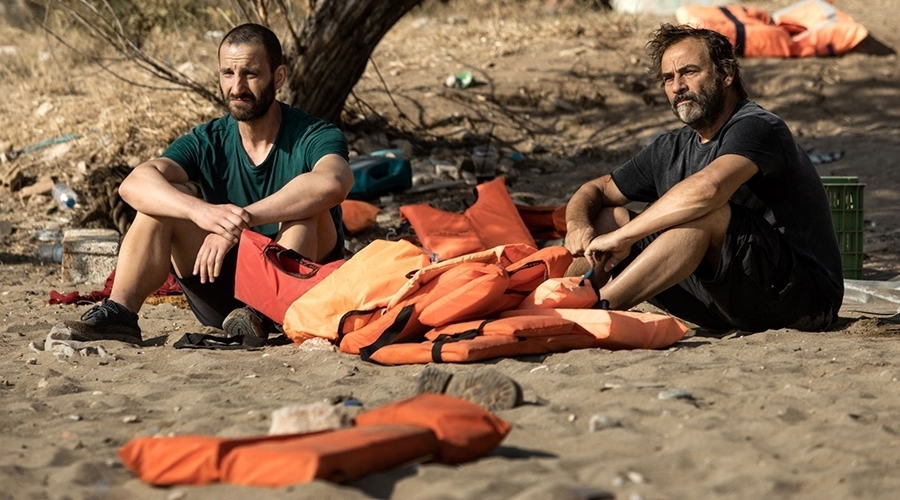
We are in the year 2015. Televisions around the world broadcast a shocking image. Given the passivity of local authorities and the international community, the body of a child 10 years old lies dead on a beach on the island of Lesbos, in Greece. He is one more victim of the Syrian war that is pushing thousands of refugees to Europe.. Alarmed by these images, Oscar, a mature man working as a lifeguard, make a decision. Given the passivity of the Greek and European institutions, decides to go to Lesbos to lend a hand. Oscar does not want to solve the immigration problem. He is also aware that he will not be able to solve the lives of the thousands of people who arrive on the coasts every day.. But you can do something: comply with the law of the sea. This law forces men like Oscar to help anyone who falls into the water and whose life is in danger.. Against the opinion of his colleagues and partners in the lifeguard company where he works, bypassing local authorities, start watching the beach. As soon as you arrive you must put your abilities to the test.. Overflowing with men, women and children, The first boats appear before your eyes and the life jackets are not enough support to reach the shore safely..
Based on real events, this is the story he tells Mediterranean, third full-length work by director Marcel Barrena, with whom we chatted after the presentation of his film at the Lys cinemas in Valencia. Mediterranean It premiered in commercial theaters last Friday 1 October and has in its cast actors such as Eduard Fernández, Dani Rovira, Anna Castillo or Sergi López, among others.
How does this project come to your hands??
The project comes into my hands when Dani Rovira and I are working on another story. But when I find out that there is a Spanish lifeguard who went with everything he was wearing to Lesbos and ended up saving more than 60.000 people only with their hands, I couldn't resist and went for it. I called Dani and told her that we had to drop everything to tell this story. He saw it as clearly as I did and we got. The next day, We meet to eat with the royal character, Oscar Camps, and we convinced him to let us do it. And that's how this all started five years ago. At first, Oscar was a little insecure because he didn't want to have an important presence in the media or anywhere else., but, little by little, It was understanding that we wanted to do something with respect, with dignity and putting the conflict at the forefront. Oscar saw that the important thing was not him, but the cause, and then he joined the script revisions, to everything. And until today.
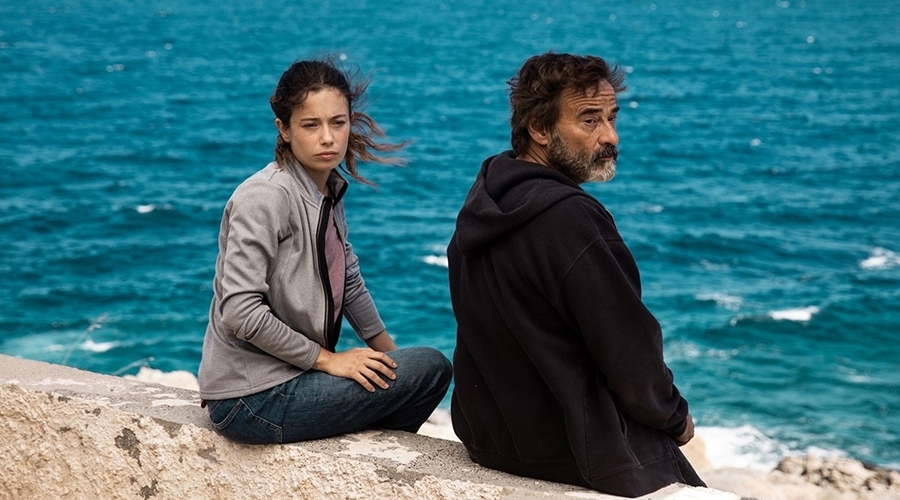
The project comes from your relationship with Dani Rovira, to which other well-known actors would later join. To what extent is the support of a poster like this necessary to raise a film like Mediterranean?
Dani was in the loop from the beginning because he and I had done 100 metros and we get along very well, we understand each other. Then, the other actors entered, especially because of the strength of the theme, of the project, and how we wanted to approach it. The presence of important actors is essential for the financing of a project. If you do not access them, it is more difficult for investors to validate it for you.; the chains, the televisions, cultural institutes, all that needs strength. It is possible to do it with unknown actors, there are thousands of examples, but the more name power you have, more equipment, more flash you attract, and with it more investment, with which you have a larger film with better muscles. So, Yeah, it is important. Another thing is for smaller or more artistic films., in which other elements prevail or, sometimes, It is even better to have unknown actors to give it more verisimilitude. But here we also try to give it as much realism as possible while having great actors.. Added to this is the fact that I am quite a film buff and I have a deep admiration for the profession of the actor and actress., so I try to have the best or the ones I like the most. In my case, I have been lucky that in the two films I have done, everyone I wanted said yes..
Putting yourself in the shoes of people who have led such an intense life in the face of such complicated problems must cause you a certain amount of modesty., although you can't stop thinking about the fiction you want to make. What was the biggest difficulty in this regard??
The biggest complication is being rigorous., be credible, be fair and respond to a tremendous responsibility, because here the challenge was not Oscar or Gerard, the real characters, but the refugees, how they appeared, how we gave dignity and realism to all of this while structuring a large film, commercial and hope. There was no need to fall into corniness, in too much whiteness, but, in turn, we had to be rigorous with the theme and the characters, That's why what I did was surround myself with them., surround myself with Oscar, de Gerard, by Esther… Oscar was filming, we filmed in their facilities, with your material, everything we use in the movie is the actual material they used in those days. In the end, It is a collaborative work between you and the real characters, either Oscar, like with refugees. You have to earn their trust, his affection and his willingness to tell the story and that, at once, understand that you have to tell it from the perspective of a commercial movie, which is what we wanted to do.
One of the things the film raises is the difference between what we see on the news and the reality on the ground.. The film was shot in the spaces where the events occurred, with those affected themselves. What is the difference? What did you learn from all of this??
The truth is that I was already quite prepared for the filming.. It was a topic that I had done a lot of research on., who had worked side by side with Oscar. I made many trips to Lesvos, to the refugee camps, to the beaches, to all the places where everything had happened, So it didn't really take me by surprise.. What it was is gradual. One thing is reality through a screen and another is being there. It's one thing when they talk to you about numbers., of so many refugees, of so many victims, and another to give them names, Talk to them. It wasn't something from the filming, but of the process, from pre-production, of the documentation. For example, What surprised me the most was seeing that there is no difference between what is Spanish and what is Syrian. Obviously, every culture is different. We had six languages on the set, but then you see refugees looking at their i-pads, or playing with their cell phones or watching series in the fields, series that are the same ones you are watching. Suddenly, You see a Syrian girl who is watching Friends in a field, and that's where you realize there's no difference, that we are all human. You go with that as a base, but, when you see it, It overwhelms you and you think: What would happen to us if there was a war in Spain, If there were a major crisis of any kind? Well, we would have to look for any place. That puts into perspective how lucky you are and your own responsibility..
Oscar is obliged to be the media protagonist of this story so that it transcends his work and, So, also transcend the problem you are facing. Is it necessary to appear on TV for a problem to become relevant??
Bueno, Yeah. The media is the basis of communication. There is no more. You can do something great and no one will find out., and serve very little. For us it's the same. If we don't talk to the press, if we don't tell the movie, If we don't do a thousand colloquiums or a thousand programs or a thousand interviews, people are not going to find out that there is a movie that is very good. The same thing happened to him. At first he was very reticent., I didn't want to talk to the press, He didn't feel like he was the protagonist of anything., the prominence was for the cause. But there came a time when he understood that, if I didn't count it, it was not known. The problem with information is overinformation and, with this one, the dehumanization of that information. We all have to be rigorous, not only the one who does the work, whatever, but who counts and that is something we should take a little more care of.
On the other hand, Television itself is not interested in a problem until it tells a personal and morbid story.. Isn't this a little hypocritical? How do you see the role of the media in this regard??
Television seeks impact and emotional impact. The overload of information has accustomed us to putting numbers and not names, to talk about the bad and not the good. We try to explain that in the movie through the character Santi Palacios., the journalist, who exposes a resounding truth when he tells them: “if you talk about poverty, People aren't going to read it because poverty is scary., not interested; but if we talk about the Spanish lifeguards who are doing this, so, yes we can identify ourselves”. This is exactly what happened with the boy who appears on the beach. It was a dead child on a beach, that has a lot of impact, but the next day passes because they are going to talk to you about something else. What happened with Aylan Kurdi is that he was given a first and last name and his story was told.. The moment you humanize, What do you personify?, That's when people connect with it.. And this is how the press works. The film also launches this idea.
In coexistence with the refugees of Lesbos, What have you learned that you didn't know about your situation??
Connects a little with the previous one. It's about seeing them not as a number, labeled “refugees”, of “foreigners”, but as people with names and surnames, to listen to their stories. For example, There was a high school teacher there who had participated in the film because in Syria, in Aleppo, He had been a theater teacher and liked cinema. When you hear the stories, when you meet people, Everything changes. They stop being the “Syrians”, the “refugees”, the “poor things”, and they are normal and ordinary people who, when you meet her, you see they are very similar to us, that could be us. You have to think that the first people to leave Syria were upper class and middle class people., because they were the first who could pay the toll and leave. With which, regardless of one's religion or language, the links are the same, the same cultural references. They watch our movies, they talk about our series, They were looking for day care for their children... you don't see the others anymore, you see “us”.
To what extent is cinema a vehicle for public awareness of certain problems?? Do you think this situation can be repeated??
Cinema has always served as entertainment, which is the great cinema that I like. It's the one I enjoy the most, the one I most want to see. But, in turn, Cinema has also served to put in the viewer, in the community, things we didn't know. It is a great empathy tool, perhaps the greatest empathy tool that exists, especially fiction cinema. It is a direct vehicle to emotion because you connect directly with these characters, you live the story through them. For example, when no one talked about AIDS or it was taboo, Tom Hanks y Philadelphia He told us how he lived, we empathize with it. This has happened with all things in society, from political issues, social, humans, diseases… I already lived it with 100 metros, that touched on a topic that was not talked about in the cinema, what was multiple sclerosis. not only, but fiction also works for this. Everything is super-important, both entertainment and information, and we have tried to do both things in one: a great commercial film, but also tell a theme.