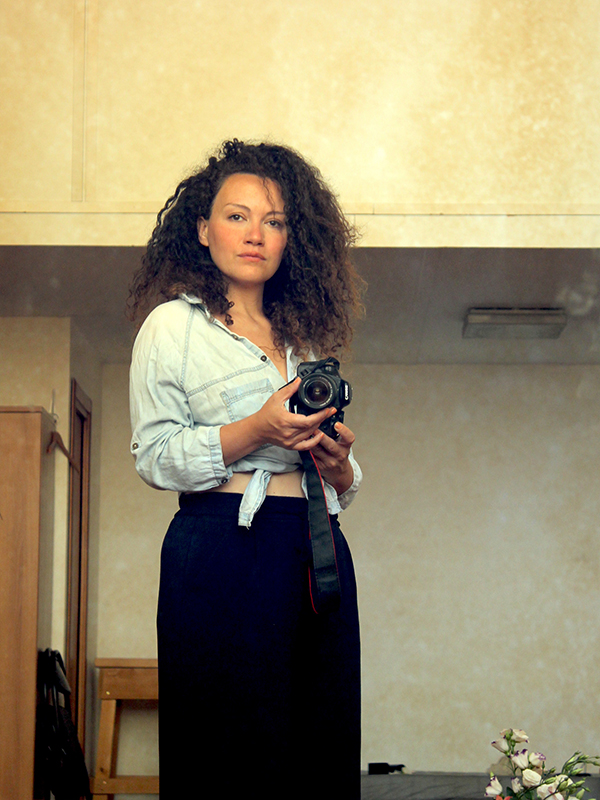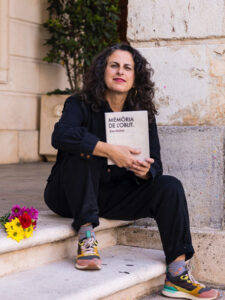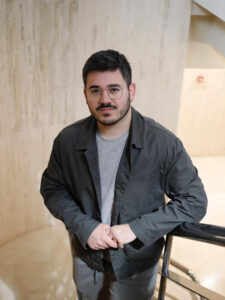
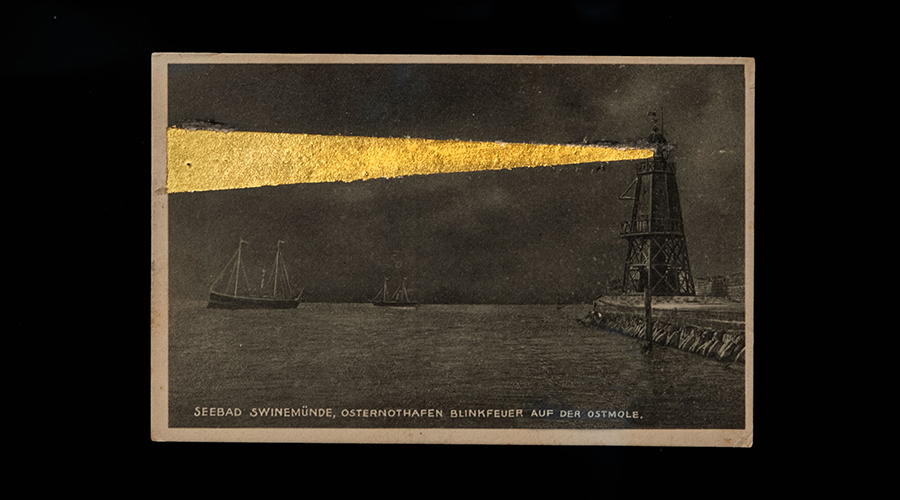
Anna Talens' art is captivatingly simple and elegant. With tiny specks of gold leaf and subtle silver lines on old postcards, it is able to evoke like no other, horizons and shipwrecks full of enchantment. The Carcassonne artist has started, together with Mallorcan Mar Guerrero, the new exhibition cycle Territories in transit, where the IVAM invites two artists from different areas to mix their personal languages. We talked to her about textiles, the light and the objects that give life to his artistic work, straddling Berlin and Ribera Alta.
The IVAM has another show open right now, In half light, which puts the focus on collaborative work, craftsmanship and "poor" materials. There are similarities with your exhibition Between the lighthouse and the abyss, truth?
Yes, there are, and besides, I think it's no coincidence that they live together at the same time. Both offer the viewer the possibility of learning about the diversity of developed languages, especially for women, during the last years, which combine the basics of art povera with the arts and crafts. Languages that tell us about artisanal production, the reuse, the leisurely pace and the intangible heritage, with a conceptual background. An approach that contrasts with the present in which we live, with an open war for the exploitation of the Planet's resources. I think both exhibitions work as a refuge, remember i hope.
Both Mar Guerrero and you pivot around the sea in the show and both are fetishists, in the sense of giving a second artistic life to found objects. With everything, you work with very different aesthetics. O no tant?
We work differently on the found object. The pieces coexist well because they take the viewer to two ways of doing things; that's why Alicia Ventura, the commissioner, he thought about the dialogue. Sea transforms marine finds into new beings, which he embodies through techniques such as 3D printing with oyster or seaweed filament, or with cyanotypes. And I rescue objects found in traces that have been forgotten by chance and that become sacralized, in a certain way, combining with others and taking on new symbolic meanings. It is the case, for example, d’Allegory of transience, where two Christmas balls meet a shell, a little vanity which takes as reference the work of Karel Dujardin Kid blowing soap bubbles. Allegory of the transitory and short nature of life (1663).
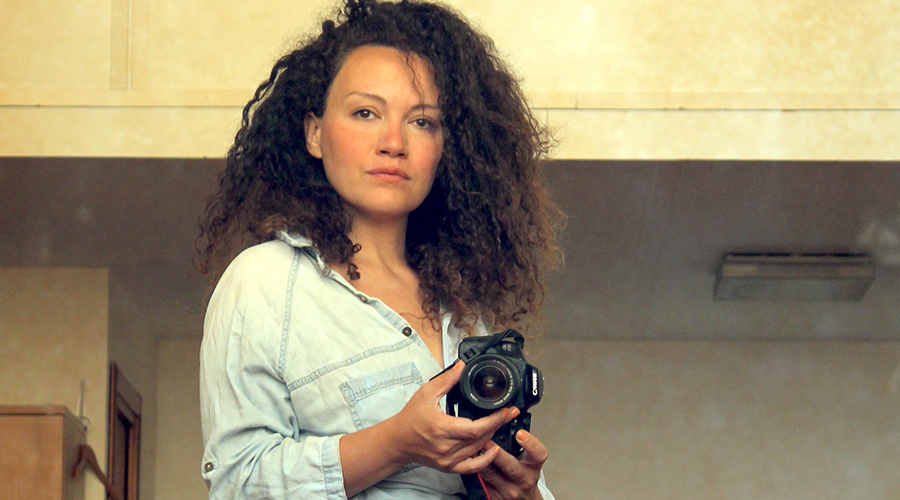
The exhibition presents several of your textile pieces. How has the sewing tradition of the women in your family influenced you??
I don't think I was aware until a few years ago, perhaps because the visibility of female textile practice in contemporary art is quite recent. I learned to knit and sew from a young age: the women in my maternal family were dressmakers and survived in times of precariousness thanks to this trade. I have always used fabric as a language, although at first more automatically and, with time, more consciously and abstractly. In recent years, I think that its conceptual dimension is being recognized more and more. We are not only fabric creators, but we also contribute to making visible the textile practice of many women who were relegated to the domestic sphere, because it was considered a minor art for a long time. Hi ha, Besides, a strong textile tradition in contemporary art, with artists like Anni Albers, Olga de Amaral, Chiharu Shiota, Ghada Amer, Teresa Lanceta or Ernesto Neto, that approach this language from very different perspectives. A few days ago I visited the Museo del Traje in Madrid and I felt that my relationship with fabric connected in a deeper way with this memory, not only as an artistic practice, but also as a cultural and emotional heritage.
You were an elegant and very synthetic artist. This minimalism is brought in or worked? That is to say, you have to make an effort not to add more than you need?
Minimalism is often not the result of a precise and intuitive action, but rather the ability to do without what is unnecessary to stay with the essence. In my case, I have worked on it. my tendency, also for my culture, it is more baroque, but the contact with the aesthetics of northern Europe has influenced me in this sense. In the end, your language is a hybridization of everything you experience and observe. The minimal intervention on old postcards tracing a golden horizon line tries to stop the storm. It is a constant search for the horizon, that makes us move forward and that, at the same time, it is unattainable. The force of life that keeps us alive despite difficulties. A The exhibition, my approach to the sea is existential. I stop in some of its depths to talk about fear, help, drifts, far i stratigraphy. Concepts not only linked to the sea, but also to the complexity of life.
Light is important in your work: the sculpture Palafit de CaixaForum reflects the light on the water; the installation Alba Mobile that you exhibit at the IVAM recreates the light that crept into your room in Rome. What interests you about her?? You have found its charm in the light of Berlin or like the Mediterranean, cap?
It makes me especially happy to show Alba Mobile in all its splendor at the exhibition. The height of the room 7 of IVAM has allowed me. This piece was waiting since the 2019 to be seen, even for me. I understand it as an antecedent of the Palafit. I've always thought that my window to Rome, through which the sun entered and cast its light on the walls incessantly, marking the days and the rotation of the Earth around the sun, it became sculpture and shelter. Palafit, the small building designed to be erected on the waters of the CaixaForum, it is nothing more than a way to connect with nature, with agriculture, with the solar cycles and with the passage of time, not counted but felt. And it works like those temples where the reflection of the sun was programmed as a magical moment. The Mediterranean light is yellow and in Berlin we have a whiter light. I think both are beautiful and have contributed things that surely led to the birth of two different cultures.
I am fascinated by sea creatures (polyps, anemones and urchins) of bright colors that you draw with micro-perforations on flat surfaces. They give off an ecological message? How important nature and its cycles are in your work and in your thinking?
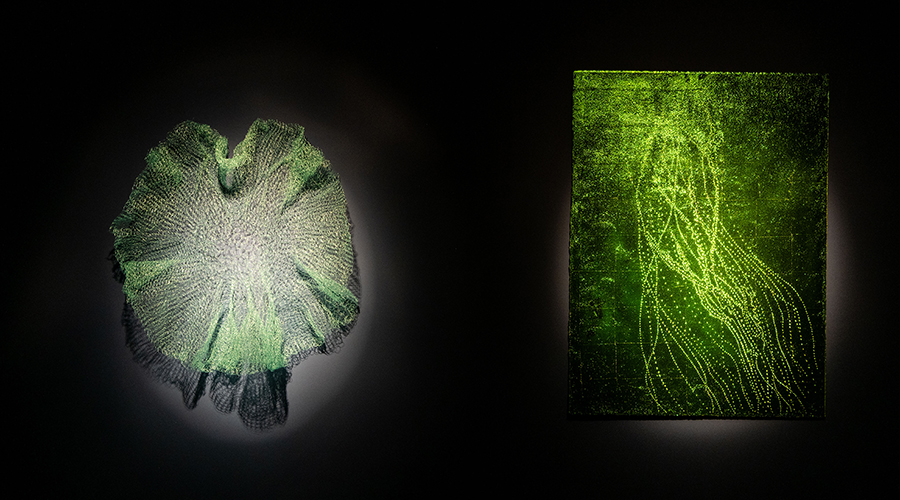
The energy of nature is a great artist and a great craftswoman, works tirelessly to preserve life through the creation of an immense variety of beings with fascinating shapes and colors. They live with us, but they rarely receive the attention they deserve. This new series of perforations is born from a previous group of works where he stuck thousands of needles on a silk surface; you can see one at the exhibition. During the process, I realized that the action of drilling was lost in the search for the final result. So I decided to focus on that part of the process and use it as a language. By closely observing the sea creatures, I discovered a repeating pattern in the micro world: an imperfect repetition that is reflected in its shapes and colors. The series is composed of a group of works on paper with vibrant colors, which are close to the same sensations that the colors of the underwater bottom bring us, and that are lost when taken to the surface.
The ecological background of my work is based on a material and aesthetic basis; this idea is not just an attraction to the surfaces of things, but a deep interest and fascination to understand its origin and protect its diversity. Love for its beauty is one of the possible triggers for its protection.
You have worked with wilting flowers in a kind of baroque vanitas, you resignify objects as Duchamp did at the beginning of the 20th century and use theLOST AND FOUND in many pieces. How important is the history of art in your work??
I like to link my work with mythology and symbolism, two concepts that seem already from the past, but that defined the world before the hegemony of science and the search for truth. I think that's why I often travel back in time, because I believe that other ways of seeing and knowing are still valid in our present. The piece Still life, to which you refer, it speaks to us in a direct and non-representative way about the transience of life. In addition to Duchamp, m'interessen molt Meret Oppenheim, Rebecca Horn i Louise Bourgeois. I use old objects in my assemblages to make them seem from another time, or even because they don't have a specific time. The object is a carrier of meaning for itself and for the life it has lived before being found.
You have opened a studio in Valencia? What do you miss about Valencia when you are in Berlin?? And from Berlin when you are in Valencia?
I have a studio in Carcaixent and another in Berlin. I tried to add and not subtract. It's not easy to live like this, but I manage to have the best of both places. They are two very different realities, but both define me. When I'm in Berlin, I miss the joy of people, praying, the sea, the sun and the markets. But when I'm in Valencia, miss Berlin its museums and galleries, its cosmopolitan identity, the trees, the gardens and that way of testing me and pushing me to overcome myself.
Which place in Valencia do you find inspiring?? And from Carcaixent? Why?
In Valencia I really like going to the Llotja de la Seda, sit in the cloister of the University of Valencia and tour the Central Market. A little further north, I am particularly interested in the spur production workshops in Garín 1820. From Carcaixent I stay with the place of Realenc, the route of the historic gardens, the smell of orange blossoms on spring nights and the modernist heritage of some of its houses. I, especially, with my grandparents' house, where I had my study and refuge. I think all these places reconnect me with my emotional landscape, the one that is built during the first years of our life, with which you find yourself in a very intense way after the search for other worlds.