
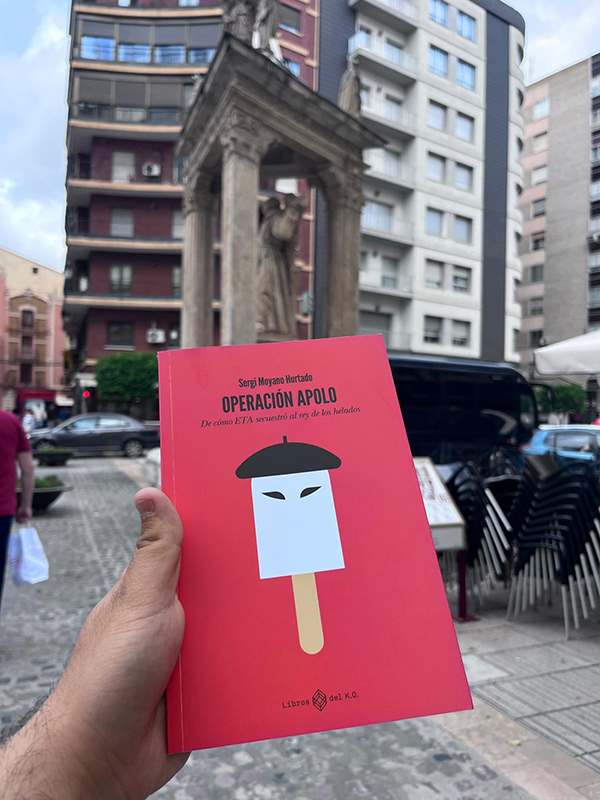
Hijacking an ice cream maker in winter is risky, in the middle of low season. But ETA did it in the Valencian Country in the eighties and it was one of the most profitable kidnappings in the history of the terrorist band. The first and the last that was produced around here. The target was the Algerian Luis Suñer, a Juan Roig of the time who became so rich that he appeared in the list published by the Spanish Treasury with the names of the country's biggest taxpayers. This is when ETA notices him. shortly before, three young Valencians and one from Madrid with a revolutionary spirit had offered themselves to the politico-military ETA to integrate a new Valencian commando that would last only one year. Pulling here and there, RTVE journalist Sergi Moyano found the enigmatic man from Madrid and was able to interview him to find out Operation Apollo, a book of narrative journalism, —fruit of the scholarship Josep Torrent of the Union of Valencian Journalists— which takes us clandestinely from the Gallinera valley to Iparralde on the back of an exciting and surreal story. S.M.
As Valencian readers, we enjoy reading an old story among orange trees, falleras and places as close as Casella d'Alzira or the Gallinera valley. As an author born in the Ribera Alta, what kind of feelings crossed your mind while writing it?
it's home. You feel at home. Because La Ribera is my life scene and the corner where I keep mine. Your emotional universe is always rooted under a specific landscape. And these stories are part of our collective identity. They contain universal elements but the protagonists share a specific world which is that of Xúquer. But it has also been an exit trip, to discover the Basque Country and its mysteries, with a desire to bring the Basque spirit closer to the Valencian and the Valencian to the Basque.
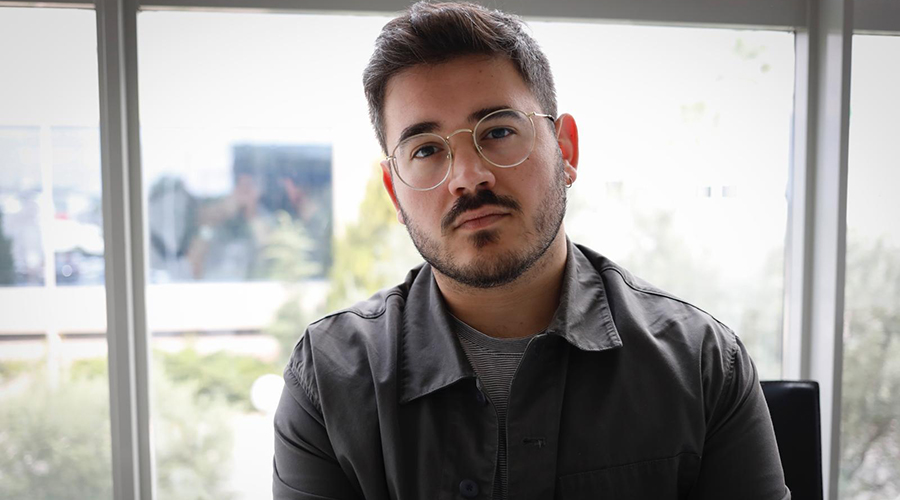
The documentary jewel of the book is the six-hour interview with Xavi, the Madrid kidnapper of Luis Suñer. What was his attitude regarding the facts in which he participated? He regrets it? What did he think of the most violent branch of ETA (AND military)?
Xavi places his foray into terrorism in a specific context, which is that of the Transition. He lived through the hardest years of the fight against the last breath of Francoism and started a process of radicalization that led him to join ETA-politico-military which was - in fact - the least violent branch and which dissolved itself in the year 1982. He was part of that process of abandonment along with three hundred other former women who realized that the use of violence made no sense in a democracy. With today's eyes, Xavi would hardly support the idea of kidnapping a person. He always rejected the activity of ETA-military and, in fact, they blacklisted him to pay a fee, years later, to a group that defended peace and was against terrorism.
Xavi still speaks Valencian? In which language did you conduct the interview??
Clar, although he had stopped talking about it a long time ago and the interview helped him put it into practice again.
Suñer was held in a hole in the Safor region, but you never specify in which town or within which establishment. Xavi didn't tell you or ask you not to publish it?
These are data that I do not publish to respect anonymity. The exact place where Luis Suñer spent most of the kidnapping has never been known because the police never identified those directly responsible. Forty-four years later, I was able to find out through Xavi's testimony.
 We are used to the epic of cinematic stories, but ETA moved Suñer inside a refrigerator box in an unlocked van, with a red cloth, and the Civil Guard went so far as to ask a python about the whereabouts of the kidnapped. We can say that there is a certain cutrerio in this story?
totally. There are stories that condense stories that are as exciting as they are extravagant. And this is the case. I was very surprised by the way they worked, but precisely that "cutrerío" served them to go unnoticed. They knew how to dilute themselves as much as possible among society, act as any resident of the area would, and this is the main detail that explains why the police will never be able to track them down. The fact that they paid attention to a python shows how lost they were...
Those who first watch over Suñer during his captivity are a Valencian and Xavi, who maintain a loving relationship. You have an idea of how homosexuality was seen within ETA in the eighties?
In principle, in the environments of the radical left - we came from a context of claiming rights for LGTBI people - it was fully normalized. However, in the internal microcosm of an organization as masculinized as ETA was in the eighties, probably the atmosphere was different. In any case, Xavi also did not live life in hiding because he did not stay in the flats in the French Basque Country where the illegal commandos resided. He lives the stage in ETA in the Safor and leads a normal life like a kid of the time.
After the kidnapping, Suñer tried to write off the payment of his release as an expense in his annual accounts. He also sent vans loaded with ice cream and chicken to the prison for his captors, as he had promised them. It was a peculiar home, no?
He is a very interesting character. For many generations of boys and girls, is the Valencian Willy Wonka. Avidesa ice creams, like chocolate, they were elements of illusion and magic for childhood. Apollo, the pink panther… But beyond the romantic part, Luis Suñer was the Juan Roig of the seventies and eighties, the most powerful man in the business field in our territory. With a hard character and at the same time sly, very markedly Valencian, and close, with a grasping and generous point, authoritarian but sensitive. I fell in love with getting to know all the faces of Luis Suñer, a gentleman with a very multifaceted personality that helps to understand an era and a society, where we are and where we come from.
The story does not end with the end of the kidnapping. Also stories of how the Basque people cross the border again to take refuge in Iparralde, or how the money collected from the kidnappings was laundered (the soñerdólars). You had to leave out of the book some event that you regret not having included?
You always have to sift through the information and there are elements that you inevitably have to leave out. The volume of documentation has been spectacular and chaotic. Two hundred more pages could be written but you always have to put the end point somewhere.
In an interview, in June, Gemma Nierga asked you if you had offers to make a film about the book and you said no. Eight months later… not yet?
I have received some proposals. I hope they like the idea because it's a movie story and it would be great if it got a movie adaptation.
This is an incredible story that happened here, at our house. You were from Carcaixent: Can you think of a story from your town that would make for another narrative journalism book like this one??
There are many stories left to tell. Starting with the retaliation for Francoism or the republicans deported to Mauthausen. You don't have to go far to find impressive stories like Luis Suñer's. You just have to look at them. We have them nearby.
You were a journalist for the territorial news of RTVE. The last year, in addition to publishing your first book, you have covered the ravages of the dana del 29 of October and you brought to light the controversial audio of À Punt's video about the Cecopi meeting. We can say that 2025 it's been a year intensito?
Yeah, the truth is that writing Operation Apollo and DANA coverage have been my professional master's degree. Juicier than any learning I could have dreamed of or wished for. I learned a lot from both investigations. I plow, with the judicial instruction of the flood I was able to get into another cross-country race. The publication of the Cecopi audios changed the course of the case. That role of interceding in reality, without looking for it, and the fact of having received the support of the judge and colleagues, it was a recognition of a task that began six months ago when the management of the Territorial Center of RTVE in the Valencian Community created the DANA research group and gave me the opportunity to do background journalism. Still needing answers, remain unknowns to solve, and journalism is showing that it is playing its role.