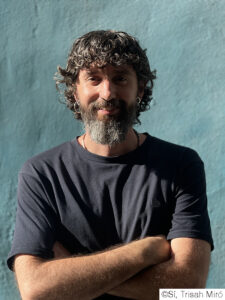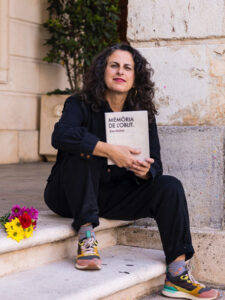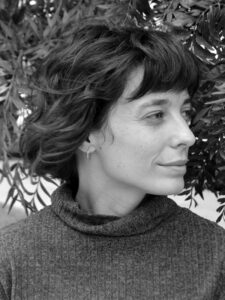

It is always a pleasure to talk and interview with Rosario Raro (Segorbe, Castellon, 1971). As on previous occasions, after the publication of his latest novel, Missing in Siboney (Planet), He has opened a space in his schedule to grant me an interview. Rosario Raro is a doctor in Hispanic Philology, Postgraduate in Business Communication and Pedagogy, in addition to being a professor of Creative Writing at the Universitat Jaume I. For more than twenty years he has been teaching literary courses and workshops for numerous institutions.. He lived for a decade in Lima, Peru. From his novel Return to Canfranc (Planet), Seven editions have been published and it has been a finalist for the Valencian critics' awards.. With his second novel, The imprint of a letter (Planet) once again gained the support of critics and the public. GINÉS J. VERA
The first crush between this novel and you is in a large house in Cantabria. Tell us about that beginning before sitting down to write, along with the fact that the north of Spain also comes to light in your novel because in its historical context those wave baths in Santander they were the most for the bourgeoisie of the time.
I discovered who I called in my novel Mauricio Sargal in El Capricho (That's why his house is called The Prodigy). His real name was Máximo Díaz de Quijano, I began to pull the thread, seduced by the gaze she held in a portrait of what was her home for a too brief period... and thus I reached the other end of this true story., to the relationship between two brothers-in-law on one side of the ocean and the other. There is also a moment when Delia, one of the characters who has had the most success due to the continuous confusion of language in which he incurs, he says about his daughter: “With the excitement that the Cantabrian Sea gives Carola!!”.
In the documentation phase for Missing in Siboney Apparently you discovered incredible things about current fortunes with somewhat shady pasts. Evidence that has been saved and others that were erased although there were people who raised their voices to end the “triangular trade”. Tell us a little about it.
A war is the perfect alibi for burning files. In many cases it seems that in this country some burned by “spontaneous combustion.”. Yeah, many tests have been deleted: cargo records of slave ships because the descendants of the families that were dedicated to the slave trade are ashamed of it. At least this already distinguishes them from their predecessors. In my novel there is a telegram from Alfonso XII that contains the keys to revealing the true identity of the protagonists.. Many current politicians and businessmen descend from families that dedicated themselves to human trafficking.. I think it is something that should lead us to deep reflection., to think in whose hands we are.
Let's go with the female characters in your novel, Romi's strength soon emerges in search of her mother, by Dulce Sargal, almost as the emotional engine of the novel; We also observe the antipathy of Delia and Carola towards Manón. Romi herself comes to think that if she had been born a boy, her father's attitude towards her would be different.. Tell us about these characters with marked personalities moving between interests and conflicts, making up the most intense part of the novel..
The lives of women at that time moved between exploitation, in the case of the lower class, and the confinement, in the upper class. Manón is thrown into the street by the relatives of the man who was going to be her husband, They tell her that Celso preferred to die rather than marry her., Mauricio buys her to return her freedom, This way they don't take her to America against her will to prostitute her.. Not only the black population was trafficked. Deva is also a marked woman, even physically because he has a scar on his cheek. Her, a soldier at a dance, She says she is a woman of balance. Abuses in factories and other workplaces were the order of the day and the extreme case was among slaves., Since they were not even considered people until very late in the 19th century, there was no responsibility for anyone if they disappeared.. I was also interested that Dulce Sargal was an absent character, at least when the novel begins. That everything we know about her is through how the other characters saw her and that her portrait is configured with the positive impressions of some and negative impressions of others., like her husband.
It's time to talk about the great theme of the novel: the fight for freedom, that of the abolitionist cry and the shameful inheritance amassed by some fortunes based on blood and slavery. Mauricio promised himself that he would always be on the side of those who suffered after seeing a terrible scene of a person caged in the sun. Can you tell us in your words this revulsion going through the novel?? You include at the end of the book a Chronology headed by the year 1837, year in which slavery was 'partially' abolished in our country.
As you say, on that date it was only partially abolished because until 1880 (four days ago in the case of Spain) remained in the territories (not colonies) overseas. And I say it that way because Cuba was a Spanish province, the richest at that time, mainly due to the enormous benefits that slave labor produced. The abolitionist movement began to gain strength in these years that I recount, before had been silenced in one way or another, every time it had sprung up with some force.
I would like to remember Isidoro de Antillón, from here near, of Santa Eulalia, in Teruel, who, in addition to being a doctor of law, geographer, and historian was a politician. This man was a deputy in the courts of Cádiz for the liberal party. It seems that when he left there one day they beat him up for saying something similar to slavery being an outrage., a display of barbarism inappropriate for enlightened societies. Died in 1814 and he was not allowed to rest even dead because his remains were desecrated and burned in a bonfire.. All to defend the freedom of those who he also considered human beings.
In the non-fiction part of the book I collect information from the Slavery Index of the Walk Free Foundation, in which a chilling figure appears regarding slavery.: Currently there are more than 40 millions of slaves in the world. Therefore, We cannot think that this is a topic of the past but very present and that it reflects that man is not a wolf to man but something much worse..