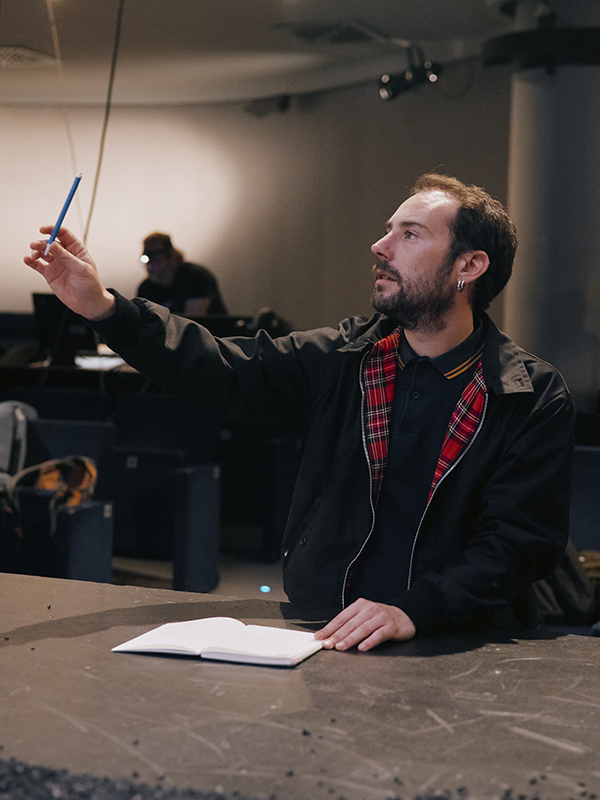

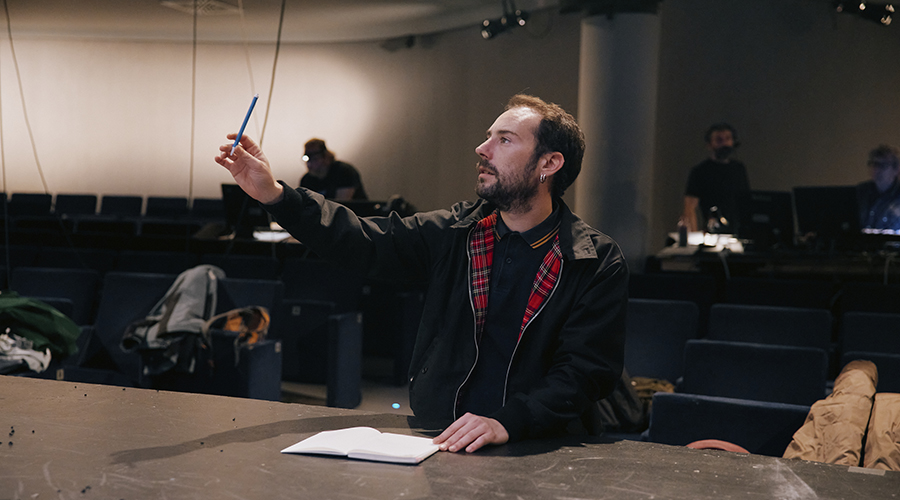
A new production from the Institut Valencià de Cultura finally arrives on the billboards of public theaters (IVC). Is called The stain, he wrote it Sergio Serrano in 2022 and you can see it until December 8th at the Rialto Theater. Everything starts with an anecdote: A family discovers a small stain on their kitchen wall. It is the hook that Serrano uses to tell us about the fears and desires of this family., about lack of communication and absence of future, about what we hide as a society and as individuals. The Segorbino combines his work for film and television with production work in El Gatopardo and La Zafirina, companies that have received the attention of the prestigious Max awards thanks to the works The artifact y Mutt. We talk to him about his new creature, of the precariousness in the sector and the catastrophic DANA that devastated several Valencian regions in October.
tell us, what is it about The Mancha?
The stain is a comedy about a family that lives isolated in a town and that, upon discovering a strange stain on his kitchen wall, its members dare, for a moment, to talk about the things they never talked about and to show each other their wounds. The stain It is also a theatrical game where the actors and actresses play with the story itself and alter it to tell this story to the audience and to themselves., with the intention of understanding and being a reflection of the society in which we live.
What can we read in the subtext?
The fable “hides” many topics that interest me. When I started writing the text, I asked myself what the word “stain” meant and I tried to develop it in several layers that remain hidden in the work.. The stain as part of our human desires and fears, stain as a classic family concept and stain as all those things that we should pay attention to as a society, with the wish that someday they will be different. Somehow, These concepts or these ideas appear in the middle of the fable, sometimes through characters who come to this house where the play takes place, and others as wishes of the protagonists.
Is it a pessimistic work or is there some hope in it?
The stain It is a work that appeals directly to hope. The characters believe in the game they have established and take charge of their own fiction to be able to contemplate all our contemporary fears., hoping that things will be different. As one of the characters says “the stain is a mirror that will open our eyes.”
It is not the first time that you put together a work using a simple anecdote to start. In The artifact you build the plot around an ancient hand grenade and, now, from a stain. Do small details help talk about universal themes? How do you use them?
A very simple anecdote can be the trigger to talk about complex topics. The fable is simply the rail that takes us in a clear direction. All the topics and questions raised are elsewhere. I am very interested in the wounds of the characters and how they are shown through these simple facts..
Both The artifact, as The Mancha, They develop in indeterminate spaces. In this last case, in a vaguely defined house in who knows what town. What are you looking for with this lack of definition??
This lack of definition has to do with the theatrical game. The space becomes a small playground, so that the characters, together with the public, through text and imagination, can play freely with the story they are telling. In this case, The play takes place in a small house and the characters tell the places they visit.. In this indefinition, They guide us and the public completes that empty picture. Sometimes they say they are in the bedroom and other times in the kitchen, but we do not support scenographically these actions that they do, but it is the viewer who completes the picture. I am very interested in these types of devices to tell stories..
In The stain you have surrounded yourself with colleagues At Zafirina y The Leopard as Mafalda Bellido (in the distribution) y Marcos Sproston (in the direction). What have they contributed to the work??
I have been working for many years with many of the people involved in the assembly.. There is a mutual understanding about the theater that interests us and about the way of working. In the case of Marcos, I was interested, as author, that there was another director with a look that was not soaked by the directing ideas that I already had established. We have worked on other montages, always with great understanding, and we are interested in the same theater time. I knew that I had to co-direct the staging with him because he also knew what the stage base was from which we were going to start and he has contributed a lot to the process.. In the case of Mafalda, the character was written for her since Insula Dramataria. She knew the project perfectly from the beginning.. Her work as an actress is very powerful and she has a great knowledge of textual theater and, specifically, about the way my works are written. She has given this character an incredible flight on stage. I couldn't imagine the project, not even with another actress playing the role of the mother, nor with another person at the address.
In the last year you have won awards from Rambleta and the magazine Scenic Network, and you have been selected to participate in the SGAE Foundation's Theatrical Writing Laboratory and the New Dramaturgies Program of San Sebastián. The artifact you developed it in a dramaturgy laboratory at the Cuarta pared room in Madrid and The Mancha at the Ínsula Dramataria Writing Laboratory. It seems that there is aid for theater writing, Or do you take them all??
Playwriting is extremely precarious and, thanks to these laboratories that are committed to contemporary authorship, Authors can have space and resources to develop our works.. I have been very lucky to be able to participate with various projects in almost all the laboratories in the state.. If it weren't for these spaces, surely, I would not have been able to write theater or I would not have been able to dedicate the time that I have dedicated to it.. Even so, unfortunately, The aids and laboratories that exist are not that many, and there are many projects that fall by the wayside and will never be written due to lack of resources..
I know of some Valencian actor who, still working regularly, having trouble making ends meet. Is precariousness an endemic evil of the Valencian theater ecosystem? What would be your demands to improve the conditions of all those who live there??
I know of more than one. Virtually everyone I know. “Precariousness is the nurse of fear”, what Paco Zarzoso says in his wonderful Querencia. On the one hand, I believe that there is no formula with which to survive in most private companies., without having to perform endless tasks. We try to write and put on our shows, investing a lot of time and resources, but then, this is hardly seen as minimally “rewarding” or “amortizing”. The world we live in, it leaves less and less space for things that are not economically profitable. Everything happens in the interest of the markets. What Most Stage Companies Do, in any other sector, would be completely incompressible due to the level of precariousness. I believe that this world in which we have had to live should leave much more space for the collective and thinking from the public sector.. Nobody requires a school or hospital to be economically profitable because, clearly, the need for these in society is understood; but when we talk about culture, it seems that it is not understood. More resources should be allocated, but, unfortunately, it is not done. Regarding private companies, tours are short or non-existent, and private productions do not have the necessary resources to work with dignity.
Characters of Valencian culture such as Mª Ángeles Fayos (Olympia), Xavi Castillo (Lead pot), Pilar Almeria (Micalet Theatre) or Francis López (TAMA) They asked that cultural shows not be canceled by DANA in Valencia and the municipalities that were not affected. What is your position? Should events be stopped as a sign of mourning and respect or should culture continue despite the disaster?
I copy, I paste and sign the statement Stage Committees, of which I am part, to talk about this issue: Stage Committees request that programming be maintained in theaters, cultural centers and festivals or municipal cycles. Since these theaters are not within the legal causes of suspension. Suspending functions means increasing the damage caused by DANA. There are other ways to help municipalities and affected people, beyond suspending functions. (Surely the spectators of the city of Valencia who cannot physically help, They would be grateful to help by attending a charity function., For example.) Yes still, they decide to suspend, We demand municipal theaters to pay the caches and the relevant compensation established by law in the case of suspending without any reason.
All of us of a certain age know what we were doing last year. 11 September 2001, and from now on, It's going to be part of the public conversation about what we were doing 29 October 2024 when the Poio rambla overflowed, destroying Horta Sud. What were you doing? How have you experienced the catastrophe? How has your sector experienced it??
I was in Madrid at the last session of the Sgae Foundation's Theater Writing Laboratory. I left late, I went to take the AVE to come back and go to the rehearsal the next day and they wouldn't let me return. In Chamartín I started to find out everything. The first days of DANA I was away and I lived them from a distance, with the information that was, learning the magnitude of what was happening here, with great uncertainty and with the anger of the management that was being done. Finally, When I was able to return I went to the affected areas to try to help.. In the specific case of “The stain”, part of the team that was directly affected. Many colleagues in the theater sector have lost equipment, scenery, etc. The tragedy transcends any sector. It has been an absolute disaster in every way.. Above all, in deaths that could have been avoided. It is a great disappointment to see how, Whose turn is it to take responsibility?, does not want to assume them. And if, I'm talking about Mazón.