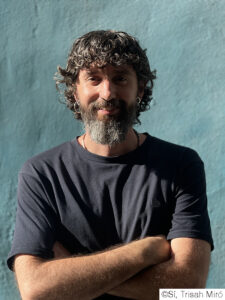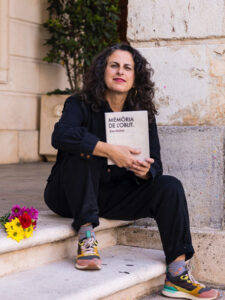

Susana López Rubio is one of the most renowned screenwriters of the moment. He has extensive professional experience in the audiovisual sector.. He has participated in series such as Police: in the heart of the street, Hospital Central, Yesterday's girl y Physics or chemistry, among many others. She is responsible for the television adaptation of the miniseries The time between seams and has been the creator of Acacias 38. in cinema, He has been co-writer of the feature film How to survive a goodbye y, among others, He has signed the scripts for short films such as Juan and the cloud (Goya Award 2015 for Best Animated Short Film). She is the author of two children's books: The best family in the world y Martin in the world of lost things. He is part of the teaching team of the Master's Degree in Cinema and Television at the Carlos III University of Madrid and DAMA.. These days he is promoting his second novel Flor de sal (Sword) After the public and critical success of The charm, his first novel. GINÉS J. VERA.
How did the idea to write come about? Flor de sal?
It really all started with the Salar de Uyuni. Because it is a very special place that I have not seen almost anywhere else... You tell people that and they just stare at you like that., but when you show them a photo and tell them, they are never forgotten. The germ was this place and from there the story grew almost without control.
There is more than one metaphorical element in this novel. Of them I want to ask you about one that is very alive., that hummingbird so symbolic already in Bolivian lands.
How funny. I believe that the great symbol of the novel is the hummingbird.. The Salar de Uyuni is specifically a salt desert, but in the rainy season, when the water falls, becomes like a mirror. People consider it the largest mirror in the world. It was fun for me to take Julieta out, to the protagonist, she is a good girl, from Madrid, completely from her environment and take her to look at herself in the biggest mirror in the world and from there she can look at herself and find herself curiously.. And the other thing you say is true., it's funny. The thing is that the hummingbird theme cannot be told much without revealing part of the plot..
I would have a hard time deciding whether to say yes Flor de salIt is an adventure novel with a powerful love story or vice versa. I leave it up to the readers.. Although as for love, to say that there are loves that are impossible or almost. As far as you can tell us, Tell the readers about Julieta Carrión's forced return to Madrid for love.
It is a complicated return because she travels to Bolivia being a girl well in Madrid, comes from a world that upon arriving in Bolivia knows a very different one, and suddenly, the return that happens to all of us, that opens your mind, you go back to the places before and tell yourself: my mother. And she also comes back very changed because she is a married woman when she has no desire to return.. It is a complicated return because there is a love story with Siwar who is another of the protagonists, another man in the novel with a strong personality to clash with her, It's always very interesting when love stories start by throwing things at each other's heads.. Cooler. If it's not a bummer.
Another theme that beats in this novel is spirituality.. Life always ends up winning over death, I have read on some page. Tell us about that enclave so prone to legends and how spiritual the Salar de Uyuni is..
Well, spirituality comes back to the fact that the Salar is a place so special and so magical in itself that it seems that magical or mysterious things can happen., It gives you the feeling that anything can happen there.. What seemed strange to me was not putting some more magical or spiritual element in this place.. In the documentation phase I was talking to several historians and I began to discover stories like Salar himself, which is incredible.. The strange thing is that the place did not have its own stories about the formation of the Salar and incredible legends.. If there are already incredible legends in less spectacular places, here already…
I also believe that there is a spear in favor of miscegenation and indigenism in this great story of contrasts. I wanted you to talk to me about it.
Of course, I was also very interested in turning it around., the contrast, since the story takes place a few years before the First World War and it seems that everything had to revolve around Europe, and in part it was, since Europe was a powder keg, but I really liked the contrast. Suddenly, in a lost town in the Salar or Potosí, It seemed like they were isolated but not, because in the end they were also going to suffer because of the war, although I really liked that, the contrast, the points of view. At first she is prejudiced towards Siwar because he comes from where he comes from and so on., But the fact that he also had prejudices towards her was a game that made me laugh..