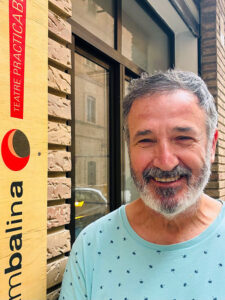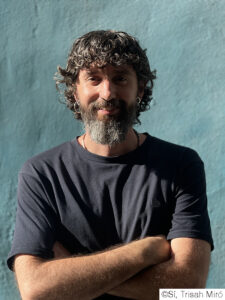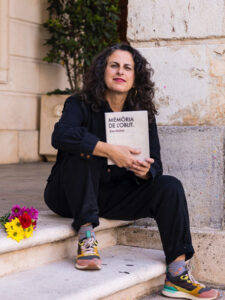
This week the interview is double. It is granted to us by Juan Llorca who, in collaboration with Melisa Gómez, have published Without teeth and bites (Vergara editorial). Juan Llorca is a Chef with more 22 years of career and passionate about nutrition and infant feeding. For the last seven years he has been responsible for Valencia Montessori School, first school 100% Montessori in Valencia and the first in Spain with a KM0 Chef with the slow food seal. Melisa Gómez is a nutritionist dietitian specializing in clinical nutrition in pediatrics.. For years he has been dedicated to the nutritional dietary treatment of both healthy children and children with associated conditions such as diabetes., allergies and intolerances or obesity. He is a member of the College of Dietitians and Nutritionists of the Valencian Community and the Latin American Nutrition Society., and ambassador of Food Revolution Valencia. GINÉS J. VERA
How did the idea of writing this book come about?, besides, four hands with Melisa Gómez?
Juan Llorca: I would tell you that the idea comes from both of us., definitely, I hope Melisa sees it the same… hahaha, but without a doubt, for two main reasons. One of them is that the offer of books intended for BLW (method Baby Led Weaning)It was of great content but in my humble and subjective opinion it seemed a little boring, and in the end, like everything, It also has to enter us through sight. And the second was to resolve the number of doubts that were sent to us through the RRSS regarding this topic.. So we join the two parts, We came up with this cool title and we got to it, but we never thought at all that it would be so well received at the time..
The mBLW method (o Baby Led Weaning), which is talked about in Without teeth and in bitesIt may seem like a fashion from abroad to some parents, perhaps more so for those who themselves had as parents a generation in which a babyhealthy was the one who ate a lot: babyit's chubby, babyands happy. ¿ThatI would tell those parents about BLW?
J.L.. That they see it as a complementary diet to breast milk or formula milk, but without a doubt they see it as a unique opportunity to paint a blank canvas, fill it with colors, shapes, textures, and flavors that make the present and future relationship with food and your little ones incredible.
Among the benefits of BLW, the fact that it is aimed at preparing a single meal for the entire family is significant., that the habit of eating together be promoted, by example. Do you agree with me that, especially at these ages, this habit should be reinforced?, the importance of the little ones seeing us eating and, besides, make it healthy, In the same way - later - the habit of reading can be, spaghettiby imitation within the family?
J.L.. Man, of course!! Imagine, Would you like to be with your family and have each of you have dinner at a different time and what each of you wants?? The best thing about sharing the table is not only being an example for them., but also being able to spend some time with the family, no electronic devices, bodies, talk, and generate essential bonds in childhood.
One of the recommendations we see is to wait 1 a 3 days between trials of a different food in the child's diet. This way possible signs or symptoms of allergies can be better detected.. In fact, I think this topic, allergy, along with choking, are the two that worry parents the most when starting AC and, therefore, to implement the BLW method. Does it happen like this?
Melisa Gomez: In the event that the family wishes to start Complementary Feeding through the BLW, and taking into account my experience with them, the fear of possible choking far exceeds the fear of developing allergies, perhaps because there is a false belief that the BLW method predisposes the child more to possible choking than starting with crushed foods., even though we have studies that deny it, while in the case of food allergies, regardless of the startup method, They will feel equally exposed.
I commented on the issue of allergies when introducing certain foods., One of the tips we read in the book is that we start with foods with low allergenicity. Could you tell us what foods these are??
M.G. I'm sure I'll finish sooner if I mention the allergens that will be: gluten and derivatives (wheat content, centeno, barley and oats), egg, dairy and derivatives, fish, soy and derivatives, nuts and seeds (like sesame) and some fruits like strawberries, peach or kiwi. Everyone else, except for foods that are recommended to be avoided before 12 months (sugar, Honey, sal, started, large fish, seafood, ultra-processed, soft drinks, rice drink and rice pancakes, skimmed dairy, spinach, chard, borage and game meat) may be considered suitable to be offered from the 6 months, although in many cases it will be necessary to modify them before offering them (cut them, steam them, etc.)