
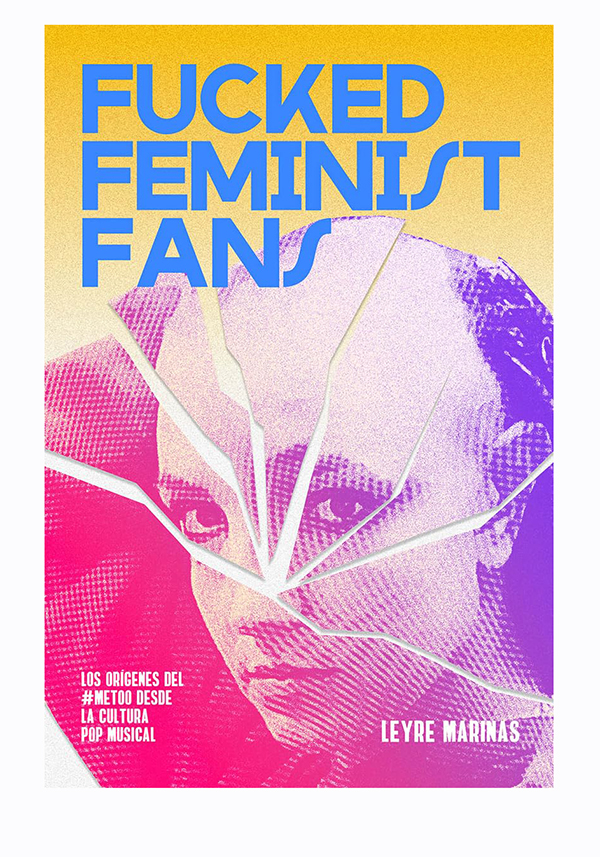
The music industry at the end of the 20th century was condescending towards the fans and malicious towards the artists of the time who were successful singing their rage openly.. They are conclusions that are drawn Fucked Feminist Fans, an essay in which Leyre Marinas analyzes the perverse dynamics of the specialized press of the time. We talked to her about the groupies, of the girl power embodied by the Spice Girls, and the role of MTV and other cultural products in the foundation of heteropatriarchy.
You say that he fan phenomenon was defined, with a paternalistic smell, like groups of hysterical teenage girls who lived for and for a platonic love. If you change “teenage girls” to “men” and “platonic love” to “football”, the phrase still works. Why are they hysterical and they are amateurs??
It is a question of sexism and machismo. It is a discriminatory issue, because of the paternalism with which women are treated. There is a supremacy that has been tried to create, above all, from industries cultural. The aggressiveness, violence and fanaticism are allowed to men, but not to women, and even less if these are teenagers. For a fifteen-year-old kid to punch the wall because his team lost is considered normal., but that a girl is crying because her idol has separated from the boy band, that's why she's a little girl, a child or a hysterical. It is a question of what behaviors and what emotions are allowed and have legitimacy for some., and not for the others.
Explain to us the sexist aftertaste that the invention of the concept has groupie from the specialized press. With what intention was it coined and what effects did it have??
That term was coined by three journalists from the [magazine] Rolling Stone In the year 1969 to legitimize sexuality and desire. They gave fans permission to sexuality and desire, and so they went from being hysterical girls to being groupies. The concept of groupie legitimizes being able to sleep with them, because they are a specific profile of a fan who puts their body in a sexual way. Besides, for them there were no groupiesmen. If they existed, they were more like camels. There are a lot of discriminations that cross the body of the groupie.
During the first decade of the 20th century, he girl power exploded as a kind of pop feminism that bothered little. Was it another example of capitalism appropriating dissent to make money with it?
Yeah, Yeah, Yeah, absolutely. It's what you say: he girl power It was something that did not bother. It was a feminism to perpetuate totally heteropatriarchal behaviors, but less explicit than those that had been consumed so far. They appropriated, besides, from a term that came from the Riot Grrrls. The Riot Grrrls were annoying because feminisms have to bother. We are not here to be nice, protest always bothers. The Riot Grrls, with his performances, his letters, your interviews, even, They bothered a part of society and the music industry, las Spice Girls no. What the Spice manager on duty did was take the idea of power, of feminine power—which is a juicy idea in itself—and projecting it through a more hedonistic feminism.
Although her feminism was more banal, fun and heterocentric, Do you think Spice contributed in their own way to the feminist cause??
Yeah, I do see it. I see perfectly that they contributed, because any cultural product that makes you rethink what happens in your context, in your life and in yourself, I think it works. They were saying something as simple—which is not simple for everyone—like that your boyfriend can't forbid you from going out with your friends.. Those affected by this message, which made them look inside themselves and analyze the relationship they were having, and say "they can't do this to me", The Spice Girls were useful to him.
 I am very aware of Karol G's bawdy lyrics that the girls sing, but I hadn't stopped to think about lyrics like “Get Down” by The Backstreet Boys until reading your book. Do you think we are more critical of the lyrics of the reggaeton now than with the soft pop of then?
Yes and it is a question of racism. From a totally white and western perspective, you put your finger on music like reggaeton, but check out the indies, you revise a las boy bands, You revise Guns N’ Roses. And then, of course, There is more focus on the lyrics that women make because they are more dangerous; or those of the LGTBIQ+ group. They put their hands on their heads more for something that Samantha Hudson can sing, Chappell Roan from Billie Eilish, that anything Izal can sing, For example.
The industry invented a musical category to frame those women who expressed anger or disappointment in their songs.. Singers like Alanis Morissette, Meredith Brooks or PJ Harvey were put in the sack of Angry Young Women. What was sought with the creation of this label??
Typecast and discredit. Discredit female singer-songwriters. Also discredit female rage and spite. These journalists did not want to listen to how they sang alone, with those rhythms and with those screams, that they had been dumped or cheated on. They didn't want. Besides, las Angry Young Women They were very successful among a majority white audience, of course, but of women. And they were starting to join together at some festivals. They also wanted to discredit the singer-songwriter's image.. The singer-songwriter had always been considered the GENIUS: [Bob] Dylan, Leonard Cohen… They are great, but of course, There was no one like Alanis Morissette or Meredith Brooks who expressed their rage and violence in such an explicit way., as women who were suffering from heteropatriarchy. women who, besides, such a large sector of the public will like them so much. When the music journalists saw it, the alarms went off.
Where are we at now?? What does the power acquired by women like Beyoncé tell us?, Taylor Swift, Two lipa, Miley Cyrus, Billie Eilish is Lady Gaga?
Well look, Dua Lipa does a lot of things, For example, from his book podcast. The participation that these artists have outside of music seems more relevant to me.. For example, now it takes a lot sapphic o lesbian era, with these artists who have come out as bisexual or lesbian: Renee Rapp, your partner, Billie Eilish herself… I think that what is most important right now, It's not just the music, but how they behave outside of it. Many times I get closer to the idol for their protests, because of how your attitude towards life is. Beyoncé when she came out with “feminist”, the allegations in favor of the LGBTIQ+ collective made by Lady Gaga or Dua Lipa herself… Now we have so much proximity through social networks that our ídolas They have already transcended the musical question.
In the Woodstock documentary 1999 HBO shows an uptick in toxic masculinity in straight white men angry that MTV was no longer for them, and her little sisters had appropriated it. Did MTV help spread heteropatriarchy and in turn did it end up getting angry with MTV??
It's a bit contradictory, Of course, because MTV was seen as a pure and simple entertainment channel: with video clips in the eighties, the awards after, the series… But it is important what type of behavior occurs in the awards, what kind of silences occur at the awards, What censorship can occur in awards?. Everything starts to go wrong: what starts as a musical entertainment channel, ends up being a particularly political channel. Just like you had Ad Rock [de Beastie Boys] and other artists who positioned themselves, you found Eminem saying nonsense and no one censored him, o al Robin Thicke este, who was the one who did the dance with Miley Cyrus. Or Puff Daddy without going any further. Everyone knew what Puff Daddy was doing and what Marilyn Manson had done. MTV participated in spreading camouflaged machismo through entertainment and, sometimes, without camouflage.
That conservative and sexist turn of the cultural industries and the media at the beginning of the 2000 What is explained to us in the documentary is being replicated today?
It is not so much that it is replicated in the cultural industries, but in society. The extreme right has never gone away, simply, has been normalized or calm while everything has been under its hegemonic order. But feminisms appear, complaints of sexual assault, awareness of what rape is… And we begin to know who they have been, how to report, who to go to, who not to trust, etc.. Besides, Racialized people are beginning to have more and more power within the cultural industries and that does not matter, exactly the same as with the LGTBIQ+ group. When straight white CIS men feel threatened, they react. However, From what I see with all the LGTBIQ+ artists that are coming out, At this point, that representation is unstoppable and that fandom.