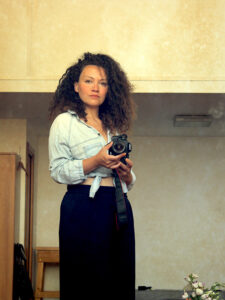

Padise Hills is the feature debut of director Alice Waddington. After studying advertising in the Basque Country, Waddington begins her career in the world of advertising as a creative and editor, collaborating, besides, in different written media. In 2015 would make his first short film, Disco Inferno, which would earn him participation in dozens of international festivals such as Springs, Fancy, Sitges (where I would win the Noves Visions award), o he Austin's Fantastic Fest. with only 26 years co-writes with Sofia Cuenca the story that gave rise to his first feature, and whose script will later be written by four hands between the director Nacho Vigalondo (Chronocrimes, Colossal) y Brian Deeleuw.
Paradise Hills It places us in a Victorian fantasy world and tells the story of Uma (Emma Roberts), a young woman from a wealthy family, belonging to the caste of uppers, whose mother has arranged her marriage with a man of the same social class. But Uma refuses to accept that agreement. To “correct” their behavior, Her mother sends her to a youth home on a small island., far from the influence of the world. Over there, Uma will meet The Duchess (Milla Jovovich), the seemingly affable principal of this school where she will be “re-educated” according to social rules. To Alice Waddington, Paradise Hills “It is a film that tells us that we should not change because of the idea that other people have of us, But what we have to do is find those people around us who will accept us and love us for everything we are.”. We were chatting with Waddington on the occasion of the preview of his film within the program Lys multiplex cinema club from Valencia. The premiere of this film will be next Friday 11.

Milla Jovovich, Emma Roberts, Danielle Macdonald… You have chosen an international casting of actresses for your first film. What is the reason for this choice??
Bueno, on the one hand, is the context of the residence. It is an international residence for women from all over the world, So the most logical thing was that they spoke in English among themselves., as a more or less universal language. There were also many references from the movie such as, For example, The Abominable Doctor Phibes until Logan's Escape, passing through The prisoner what, in the end, They are Anglophile references that come from the years 60 y 70, or in some cases of the 80, as inside the labyrinth Jim Henson. They are films that produce a lot of nostalgia and I feel included in that idea.. Being a tribute to some of them, It made more sense to do it in English.. Having said that, the entire film team is national, except the actresses.
One of the things that attracts attention about the film is the artistic construction of characters and settings.. What was the process like to design this fantasy world??
Paradise Hills It is a complex film that draws from many sources. In addition to what I have already said before, we have since the Grace Jones video clips from the years 80 and contemporary video games such as Final Fantasy in the locker room, to other films that may not be so obvious within genre cinema, as Picnic in Hanging Rock o Daughters of the dust. In the costumes we used references that ranged from the 14th century to the 19th century.. We use cropped Victorian nightgowns to give that retro-futuristic look. At the production level there is a mix of influences between the architectural brutalism of Corberó, the catalan architect, until modernism, passing through the Mozarabic style. The locations are in Gran Canarias and Barcelona, with which the architectures are typical of those areas.

I don't know if it has an intention but, regardless of the extent to which these aesthetic questions may interest you personally, What relationship do they have with the story that the film addresses??
Yeah, This question is very interesting and I never get asked it., the truth. Indeed, aesthetics are also narrative in this film. I think that if you just look at it, without thinking about it, may keep the sweet part, with sugar, but not with the protein that history can provide. For example, the notion of “the golden cage”, which is repeated in the film. It's everywhere, from obvious elements, What are the shoulders of the girls' uniforms like?, which are practically bars, even the grill that the protagonist wears at her wedding, which is also as if it had an iron mask to limit it, going through the corsets and the way they suffocate and repress them. But there are other elements that are less obvious., but they represent history, like the fact that the island, whose walls are golden because they are part of the Mediterranean coast, It is also a very beautiful place, but there is no way out. The protagonists run to the end of the cliff, which is a peak cut that falls on the sea, and they can't run away. Therefore, there is a repetition of the notion of suburban space, beautiful in the day, but threatening at night, For example. That is one of the narrative motifs of the film.. In the same way, there are references to artistic currents, from German expressionism to colonial propaganda posters, For example. The very motifs of the clothes that The Duchess wears are all colonial., and she is the villain of the story. If you start to analyze, you draw very interesting conclusions. There is a very interesting one that has to do with the rose, which is an important element of the film. The rose is the American national flower, but it is also the symbol of purity and the fact that the protagonists are dressed in white, as if they were flowers, and that the white roses change to red (for a series of issues that appear in the film that cannot be revealed without spoilers), It also has to do with the breakdown of the idea of purity. And so there are a thousand more things.

I understand that, to be a science fiction movie with so many set elements and special effects, you haven't had much budget. What has been the greatest difficulty when it comes to making these budgetary limitations coexist with your intentions when developing the story??
It's hard to believe this is an independent film., but it is. It is a film that has been made for around six million euros. Which may seem like a lot for a debut film., however, when compared to international productions, especially with the studio superhero movies they have about the 200 o 300 million budget, I think it could hold up well in visual comparison and from a production design point of view.. And we are very proud of it. I would say that the way to do this process has been to have a large number of production meetings in which we very openly discussed financial issues that are usually removed from the director's gaze so that he does not have one more element to worry about during the process.. However, every time I made a visual proposal, The only way we were going to get the movie I wanted was for us to have honest conversations about it with the producers.. For example, I made a proposal and they told me, of what I proposed, what could be done. That kind of budget control, as in a mutual responsibility, It has been very important to have the film with the design that currently exists. And then there's the challenge of creating a world from scratch using real locations.. We have filmed from brutalist architectural locations to parking lots, passing through Mozarabic palaces, with which there has been a very intelligent use of money. There are scenes that have not been done the way you imagine when you see them.. For example, There is a scene in which one of the protagonists goes to a cave to smoke because it is far from the main center., and the reality is that it was a cave in Gran Canaria that was on the edge of a road with a chroma in the background. Then, For example, the first moment in which the protagonist gets up in the residence, It is a parking lot where we put artificial grass, some trompe-l'oeil modernist motifs and we rolled (laughter).

Your film is set I don't know if in a dystopian future or in a fantasy world, but somehow it is understood that, with your story, you speak to the social present. What did placing it in that world contribute to what the film tells??
I think that the good thing about stories in general is that we know them and we can subvert them., that there are a series of stereotypes that we can reuse or recycle. We have the princess who doesn't want to get married, we have the evil stepmother, we have the monster... And something similar happens with dystopias, We have seen so many that we imagine a series of specific outcomes. That also means that we imagine a series of specific protagonists. I wanted to give the film protagonists who had never been in the circumstances of a fantastic science fiction thriller.. And it was more the illusion of seeing myself and my group of friends from when I was thirteen or fourteen years old in those stories than a political decision because, in the end, It's an entertainment movie. I have said several times that, when I was that age I'm talking about, I liked it a lot The Lord of the Rings, I liked it a lot The never ending story, I liked it a lot Ender's Game, But I didn't find myself in those narratives the way I see myself here..
And how do you find yourself here that you didn't find in those stories??
Well, I would say that the difference is the agency that is given to the protagonists., in the sense that they are princesses who do not need to be saved by a prince, although they have men in their lives who are very positive people. The most positive figure in the protagonist's life is her father, who is a fifty year old white man. The most negative figure in our history is a woman, what is the villain (What is Milla Jovovich's character?). That is to say, that even trying to escape from the clichés, We have also tried to create a new narrative.

I was wondering if you're not afraid that the protagonist's approach to the conflict, coupled with a certain aesthetic, make the speech fall into a certain anachronism. That is to say, You talk about a time reminiscent of that Victorian past with a conflict that is difficult to sustain today..
The thing is that there are so many places in the world where organized marriages still exist with people who have no agency that it is a totally present conflict.. Another thing is that it catches our attention to see it in a completely Caucasian protagonist.. But it is a totally current conflict.
as you say, Curiously, the female characters are the ones who assume the role of bad guy and subject other women to what they do not want to do..
This is what we mentioned before, I think that if you have many female characters in a movie, (in the same way as if you have male characters, how is it here), There are going to be some who are wonderful people and others who are horrible people., regardless of gender. And in this movie there are men who are horrible and men who are wonderful, and there are women who are fantastic and women who are tremendous villains. I think we should be considered equal., but we must also consider the full spectrum of human personality and human goodness and evil., simply because we are telling a story about people who have ways of relating to the world that correspond to reality, even if it's a fantasy movie. And there are women who hurt other women, in the same way that there are men who hurt other men. I think it's part of reality, whether we like it or not.

In the script you collaborate with Nacho Vigalondo. Why did you contact him and what has been his contribution to the story??
This script development structure is very common in the United States. It doesn't attract attention there, but here the opposite happens, and it is because in Spain directors often write their own films and then direct them. Or the scriptwriters are included in the entire process, not only in fragments. In that sense, I decided to work with people who had more experience than me and who could teach me things. I wrote together with Sofía Cuenca, with which I also wrote the treatment of Shrews, produced by Alex de la Iglesia, a treatment for the story with which we went to the people of Nostromo Pictures in Barcelona. They asked me who my ideal scriptwriters would be for this project and I told them that, how I knew Nacho Vigalondo for seven years, was my friend, and he was the person who had encouraged me to make my first short film, What has given me the career I have now?, I decided that what made the most sense was to collaborate with him narratively, and he agreed to develop the script with Brian Deleeuw.
The film addresses, like you said, women's roles in society, but at the same time it seems to me that the crux of the story is found in the theme of class struggle. I don't know to what extent it was a central question for you..
Bueno, I'm always excited when they ask me that question because of course it's about class struggle.. There is a disappearance of the middle class in the film that accentuates these conflicts.. Again it is not a political film, It's a pure entertainment movie., but like other movies for teenagers it is reflective and thinks about the world we live in. There are several characters in the film, What is Yu's character like?, What is Markus's character like?, even as the character of Uma's own father, who is a craftsman, They come from a less economically advantaged background and each of them has their arguments as to why they have felt mistreated by the uppers, which is a social class in the style of the hunger games, who spend their lives partying and making big expenses when they don't even have enough to eat. So those contrasts do exist.. Yu's character says he doesn't want to inherit his uncles' family business uppers because his parents are part of that less privileged caste and he does not want to advance by stepping on others. Again, without being political, It is positioned around what makes each character happy..