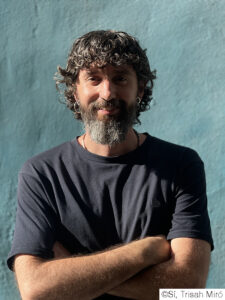

“Two better than one”, says the saying. If so, This book I am like that (Zenith) You already have a point in your favor. It is written four hands by Fernando Trías de Bes and Tomás Navarro. Economist the first, Psychologist the second, Both writers, Navarro has had the kindness of granting me a few minutes from his promotional agenda to tell me about his last book. Tomás Navarro has extensive international experience as a psychologist, Consultant and writer, They have become a reference in resilience, well -being and psychology. His areas of interest are the humanization of the companies and the well -being of their employees. It also collaborates with different media in addition to serving individuals in the mountain, Forestry, walking or skiing in the heart of the Pyrenees, place where it resides. He is an author in addition to emotional strength books, KINTSUKUROI Y Wabi-Sabi. GINÉS J. VERA
Accustomed to your books alone, I was surprised (pleasantly) that in this we read you by the hand of another great communicator and author of excellent stories such as Fernando Trías de Bes. My curiosity is to know how you have distributed the work in I am like that, What part or task has each one undertaken before sending this book to print?
Well, Fernando had some compiled stories that had been writing for years. My editor sent me a couple and analyzed them. I saw that they had many possibilities of analysis since they portrayed usual situations taken to the extreme. Then we made a selection of stories and proposed that he wrote some more about some or interesting profile that was not reflected in his initial stories. Once selected, I proceeded to write my analysis of a pull with the same tone with which I usually give my talks.
Let's start in order or ... with order, since it is the first story and mania. I thought that psychologists extracted brave conclusions about the individual's personality based on how ordered we are. If you are more creative, more rational, etc. But it turns out that we stigmatize order and disorder. The environment and its rules seems to be the key. Do you explain it to us?
Certainly the environment can condition our order level as well as our fatigue, tiredness or time available but on the other hand we confuse something contextual with something stable. In the book we differentiate between state and feature. With the issue of order, We usually raise something that is very mundane, We raise what a state can be and we associate it with our identity believing that it defines us. Undoubtedly, order can coexist with any personality trait, But it doesn't have to have a causal relationship
“Feeling jealous is neither good nor bad, It is human, And like everything human, normal”, We read. That phrase attributed to San Agustín comes to mind: "He who is not jealous, is not in love ". Did the saint lie? We can use jealousy with love, We read too. Y, apparently, In the background they are nothing more than a sample of fear. What should not be confused are jealousy with a celotypal delusional disorder. tell us.
Jealousy are human and animals, Our children, dogs and cats are jealous. Jealousy is a kind of barometer that gives us feedback in that uncertain love. I remember a situation in which I felt jealous of a masseuse who was giving a massage to my wife. Imagine how I could have reacted based on my personality. I insist the problem are not jealousy, but where they land. If I am possibly creative that same night I gave you a better massage, If I am insecure, I would be going around what I have to do a massage course, If it were dominant, he had requested a change from male masseuse to a female, If it were a manipulator, I would have made it guilty, If it were aggressive, I would have given the masseuse a cake and if it had been aggressive passive, it may have given it to my wife. I insist, Your personality determines the expression of your jealousy. Yes indeed, Another thing is a disorder, That is the red line that marks the normal of the pathological. In Celotypal Delirious Disorder the person thinks badly, See things where there are no and reacts in line. Those thoughts are delusions that seem real but they are not.
Sometimes we blame the loneliness of problems that have nothing to do with it, We confuse our fears by raising them to the category of fears or we do not feel satisfied with ourselves. I think that self -esteem problems are behind many of these seventeen maniah, could be?
Again as in the case of jealousy, It depends on where each mania falls. Self -esteem conditions much of our life that determines something as important as our attribution style before what happens to us and does not happen to us. However, each mania responds to a different mechanism regardless of the degree of self -esteem we have. What is true is that low self -esteem usually generates more anxiety and in the face of a high degree of anxiety, more compensatory routines and mania.