
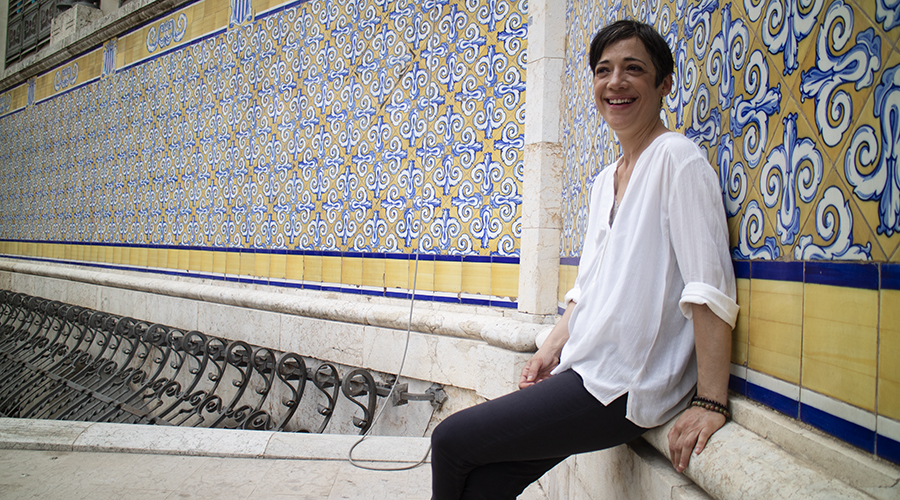
In our territory we have great culinary chefs and star dishes that are jewels of our gastronomy. (rice mainly) internationally known. But around the corner we find more chefs, more raw materials and more star dishes that a priori play in another league: the league of organic products, proximity, under the sensible parameters of slow food, of the wild herbs and plants that sprout in the fields of our regions. Concepts such as knowledge-experience are fundamental axes, real economy, subsistence, adaptability or creativity. They configure a more intelligent way of approaching contemporary cuisine, threatened in the form of ultra-processed, preservatives and artificial flavors, and by the impositions of the prevailing socioeconomic system. Vanesa Bustos is a cook, advisor, promoter, teacher and expert in healthy cooking with wild plants and herbs and we have spoken with her to shed new light on these issues and help us treat them from a more accurate perspective. SERGIO BELLO
Because, in general, It costs us so much to buy in our municipal or neighborhood market? Schedules, comfort, ignorance, lack of interest in ours, the indolence of the urbanite?
Our role as consumers is important and what we do individually has a lot of weight when we add up.. Every time we decide what, how and where to buy we are tipping the balance to one side or the other. It is true that, as a society, we have a certain tendency to look for what is most comfortable for us, and the schedules and rhythm that we often follow do not help. Hence, it is very easy and tempting to take the car and go to a large store and load the trunk with the shopping for the whole week.. On one side, I have the feeling that people are rediscovering the markets, that there are young people who are starting to go shopping at the market in some neighborhoods. But on the other hand, I see how in some they are closing stops (and also some market) and it saddens me that it is like this. There is a generation that has stopped going to the market and that is where there is still a lot to do to bring them closer to consumers..
If you look, the markets have something more: They give us much more, They have always been a meeting place and place for the transmission of popular culture, and that is something that we do not always take into account. This type of traditional commerce favors the circular economy, and the relationship established with the sellers is very close. They are not just selling us food, but they can also give advice on how to use it, how to cook it to get the most out of it. I think that in the markets, unlike in large stores, We find a great variety of vegetables that have been grown just around the corner, in the garden, and in many cases they are self-produced. In the fishmongers, They buy the goods directly at the markets. Therefore, These are very fresh products.,that have traveled a few kilometers to reach our baskets and that, in the case of vegetables, They have been collected when they were at their best without having to travel long distances and mature in chambers.. Besides, We can find a wide variety of specialized stores within the same premises, from traditional stops such as those for salting, eggs or spices, to others with products of international gastronomy. For years we have been detaching ourselves and detaching ourselves from what reminds us that we are a city that looks at the garden, perhaps because of that indolence of the urbanite that you speak of.
Tell us about the movement slow food and your interest in local and edible wild plants and herbs.
The first time I heard about slow food It was when I was finishing cooking studies., and it immediately caught my attention. From there, I started reading and getting interested in this movement. From slow food a diet that must be good is promoted, Clean and Fair, and that is very consistent with the way I understand cooking.. Buena, because a food must be good in every way: It must meet our needs and be healthy, but also pleasant and rich from an organoleptic point of view. Clean, because its production must be respectful of the environment and animal welfare. fair, because it must also be respectful of the work of those who produce those foods and of cultural diversity and culinary traditions.. It is a network that has allowed me to meet people from other parts of the world whose way of understanding food is in line with mine.. Thanks to slow food, When I have traveled to other countries I have been able to contact and meet producers, chefs or other people who simply feel this same enthusiasm for gastronomy. I am interested in knowing the origin of the ingredients, know who is behind, What story is behind a food?. From there, one thing leads to another, The concern of wanting to continue learning has made me train myself through courses, but also through long conversations with older people, It has taken me to travel to other places where working I have shared what I know, but I have also learned a lot. All of this led me to want to investigate ancient varieties of vegetables., edible wild plants (the adventitious or incorrectly called weeds), to know what uses they have traditionally been given and ,thus, to be able to incorporate them into our recipe book. Above all, to make them known and bring this plant world closer to younger people. Don't let this knowledge be lost, these references.
There are excellent dissemination projects for our vegetable varieties., fish, rice, etc. and its multiple elaborations, How to taste it from here. But, besides, rescue the grandmothers' recipe book and allow ourselves to be advised by those who serve us in the market. Wouldn't that be the way to educate ourselves about home cooking and the territory??
A while ago I read a news story that said that about seven out of every ten traditional cooking recipes are at risk of disappearing.. That is something very alarming, but it seems that we don't give it too much importance. Gastronomy is culture, cooking is culture, It is an identifying element of our popular culture. Perhaps due to the fact that, luckily, most of us can eat at least a few times a day, It seems irrelevant to us that this legacy is lost. And we don't realize that we are letting part of our culinary heritage be lost.. There are initiatives such as groups of traditional cooks, or conferences like Féminas (International Gastronomy Congress, Women and Rural Environment) who work on this task of gastronomic cultural protection. Or like Tasta'l d'acci, which is a very close example of a project that works to publicize traditional varieties, dishes, preparations and products of Valencian gastronomy. And returning to the markets, Nothing like a walk through a market with your eyes and ears wide open to realize the variety of products available in each season..
What troubles are your hands currently in?? What are your short-medium term projects??
Shortly after finishing studying I had the opportunity to teach my first cooking workshop and I immediately realized that I loved it.. Although for years I combined the work of being a cook with teaching classes occasionally., As time went by, it was confirmed that I liked the training more.. I think it's the act of sharing that excites me with people.. That makes me want to ask myself questions.. I have been lucky enough to be able to teach and teach courses in different places such as cooking schools., universities and other training centers here and abroad, as was the case of Mexico, whose experience marked me. So my plans are to continue doing what I like, continue working on training and disseminating and making known the local and sustainable product. Not only make it known, but rather bring it closer to the people by giving them tools, ideas on what to do with these products, how to cook them and introduce them into the daily diet. All this information must be put into practice and it is of little use for consumers to know the products we have and their benefits if they are not going to use them later and for this we must do dissemination work.. And that's something that I love. Approach a product and “crumble it”, ask myself what an ingredient tastes like, how it smells, what texture does it have, how can it be cooked, and once I asked myself all those questions, play with the possibilities it offers me, with the possible flavor combinations and with the different cooking techniques that I can apply. I use social networks to share recipes, some facts and information about foods that I find interesting. The recipes I share are simple, with the intention that people are encouraged and do them at home. I think less is more, in almost all fields, but in the kitchen I see it clearer every day. I tend to enjoy this simplicity more and believe that the less you touch a product, more can be perceived from him. And this is another part of my job, creating recipes and cookbooks, What do I do for some restaurants?, companies and other entities.