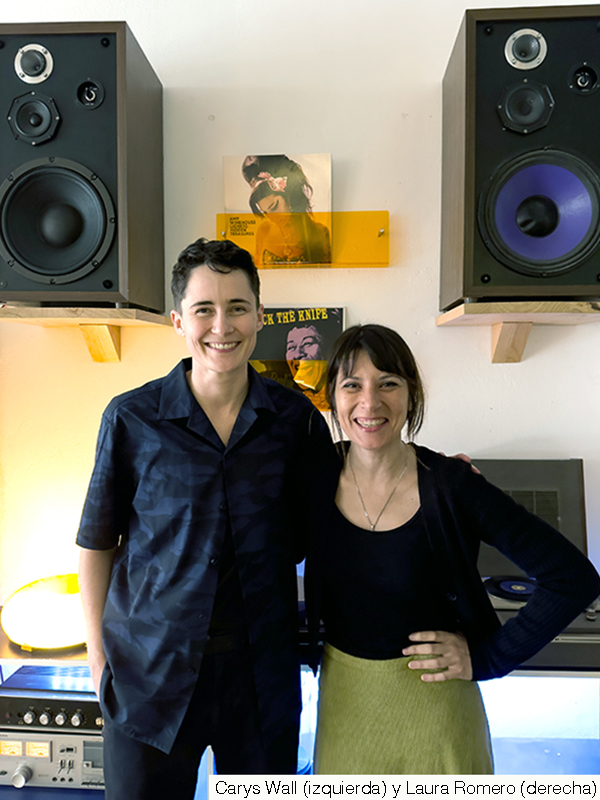

The radio in the fifties was a socializing element around which people gathered to listen to music, sports retransmissions or comic programs. Several decades later, We listen to podcasts in wireless headphones that offer the best sounds, But they isolate us from the environment. In this individualizing context, Carys Wall and Laura Romero propose collective listening sessions of sound pieces of different fur under the name of Sonica.
What is Sonica?
Laura: Sonica It is a bimonthly collective listening cycle of sound pieces, or otherwise: A meeting open to the public that we organize every two months to listen to a selection of recorded audio pieces, whether they podcast, fictions, Sound documentaries or more experimental creations. We listen in a cozy environment, intimate and in the light of candles, While we can take something. It's like attending a concert or watching a movie, But here "we don't see", but we listen to the stories. There are also no musicians on stage. Sonica It is a accusatic sound event (We do not see the source of sound).
Carys: It is also a community. Many people go to each act and talk during breaks. We want people to participate, Not only that passively consume.
What can we hear in the next session of the 24 April in Llimra Space?
L: It is a session entitled Made in Spain, making a humorous wink to that expression. We will program pieces by Spanish authors or authors from other countries that have made their pieces here or on topics linked to Spain. We will have audio in co -official languages of the Peninsula (Like Basque), Also audios in English about stories that occurred in Spain.
C: Yeah, And we wanted to propose a challenge, since we always find it difficult to find enough experimental narrative pieces, independent and brief from Spain.
Is the language an impediment to enjoy the pieces?
C: It is a multilingual event, So far we have reproduced audio in Spanish, Valencian, gallego, Portuguese, English, French, Italian English. It seems important to include audio from various parts of the world. If there are subtitles available, We put a video with the subtitles.
L: Or we distribute paper transcripts on paper. But in general, The tongue of the piece is not an impediment. Many nuances of each piece can be understood and enjoyed beyond the language code. The sound itself is already a way of writing.: That's how it is, There are many things that you can perceive of a good sound work without understanding all the words: music, The emotions of a voice, The atmosphere, The use of sounds… Our audience is very diverse, But we presuppose a basic level of English and Valencian and we do not usually translate these languages. We present in Spanish and explain the essence of the pieces before reproducing them, And we provide transcripts so that people can read while listening.
Very different audio fragments are heard in Sonica: Journalistic pieces, fiction, electroacoustic compositions, Field recordings, Documentary essay, audio experimental, sound art… How do you choose the issues? What moves you to include a piece in programming?
L: Since we started, Carys and I create an excel that does not stop growing, an infinite list of works and pieces that each one scores. We listen to audio very frequently for our jobs, And we try to search for new creations every month. We share proposals and discuss what each piece causes us to each. There are sessions that have been a bit more random in which we have not followed a topic or concept as a trigger, There has not been a thread between the pieces ... but we have proven that it works much better when a common atmosphere is created among all the pieces from a concept, since each author offers a different approach on the chosen subject.
C: The theme of Halloween, For example, It arose because I heard an audio fiction about a vampire and thought it would be exciting. We also strive to include audio from different parts of the world, In very different styles and from different perspectives. We value the work of independent artists and marginalized communities. We want to listen to work and perspectives that we do not always hear in our day to day.
The December session held at the mine was titled the town and collected sound documents of resistance and collective struggle, As a journalistic piece by Jordi Company on the effects of the Dana on the riverbank, and another of Carys with the sound of the outrage of the Valencian people following the management of the catastrophe. How much mobilizing power does audio have?
L: The audio is mobilizer because it is very inward, It goes through us without looking. The sound is able to open an intimate connection that probably has no other means. On the other hand, Free radios have always been a symbol of revolution, as well as the radio in general, It remains a solid media for the fragility of the Internet.
C: For me it was very important to reproduce before the Valencian public the piece I made about the protests. Although floods and protests were widely documented through photographs and videos, This piece is a registration of the sound of the moment: of rabies, Fear and pain, as well as solidarity and resistance. Someone who attended the event of The village He said that he had been numbered at the photos and news of the Dana, But when he heard the songs and screams, He felt transported to the first protest in November and felt angry again.
Just as cinema is still a shared cultural experience, Radio and Podcast listening, In this era of wireless headphones, It is usually individual. It is also true that the most successful podcasts sell entries for face -to -face recordings in theaters, Where he listens, In addition to being collective, It is live. Do we continue to need the carnal above the virtual? What does the community contribute to experience?
L: The beautiful thing to listen to in community is to be able to share what we have felt while we hear and be able to give us the spaces for the meeting, to chat and to also meet new people wanting to listen. On the other hand, Listen in a dim space and with speakers offers us some warmth, It helps us to dispose of "the other", to abandon us to the experience of what each author proposes us. And of course, We put aside mobile phones and screens.
C: For me, There are two factors. In Sonica, You will hear people by your side laugh, Maybe crying, Maybe scream in surprise. It is a community experience that connects you, both with the people in the room, as with the story. In second place, Listening to more complex audio pieces requires more attention. For example, There is a work called The screams of Mexico, of Félix Blume. The first time I heard it was from my phone while scrubbing the plates. I did not understand it at all. But when we listen to her in Sonica, in the dark, With good speakers, No distractions and paying total attention, It was amazing. I could imagine and visualize each scene. Many people told me that it was his favorite work in the afternoon. We try to include pieces like this, that you would not appreciate when listening with cheap headphones while you go in the subway. But that in an event like ours, They will leave you speechless.
Now that we face good weather… Will there be a new session of Sonica With outdoor headphones?
L: We would love! We organize a session last June in the channel of the Túria River. It was a different experience because we listened to in Binaural [3D sound sensation similar to being physically where it occurs] individually, But at the same time being together in a natural and exterior place. The headphones allowed each person to move around and walk around while listening. One of our purposes is that Sonica be itinerant and can happen in other formats and places, adapting audios selection to each context.
C: Soniquetes is an open community to collaborations…