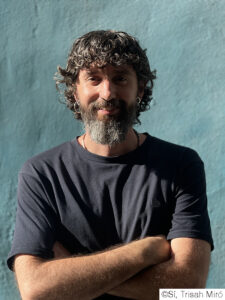

in the cinema, the science fiction genre is experiencing a great moment. The rise of digital technologies has made it possible to bring to the screen what could previously only be conceived on a page of paper., making possible the hyper-realistic recreation of any future reality that we imagine. Titles like Interestellar de Christopher Nolan, Annihilation de Alex Garland, Dune o Blade Runner 2049, both by Denis Villeneuve, have renewed the codes of the genre while conquering the hearts of a new generation of viewers. But these movies don't come out of nowhere., but they draw on a long tradition that we are forced to know in order to better understand its keys and, So, get closer, beyond the plots, to what science fiction has always proposed to us: an explanation or question about the world we live in. In Nearby universes (Ed. Barlin Books) Celia Cuenca reveals these keys to us in a text that will delight fans and scholars of the rich world of sci-fi.. An intense look, lucid and descriptive towards a cinema that has demonstrated a great capacity to revitalize its forms, causing a real revolution. In the background of Celia's text, several fundamental questions throb.. What do we talk about when everything can be represented? What do we say about the future when it has reached us?? G.LEON
Why did you need to write a book like this?? Why talk about science fiction?
It all started when I did a doctoral thesis with the ideas that I present in the book and I realized that there were many images that made me very curious.. They were images that were very aesthetically attractive to me., the choice of colors, The textures, etc. And I realized that those images that caught my attention belonged to science fiction and, usually, to films that were not so characteristic of the genre. So, I began to sense that, beyond that aesthetic surface, there was a common element between all of them. I started researching this since my thesis., but what happens is that academic language is very dense and, at the time of finishing it, I was left with the desire to turn all that into something that was a little more accessible..

I have the impression that there is currently a certain undervaluation of film genres. I'm talking mostly about criticism.. I don't know what you think.
Of course, because we play so much with genres that, in the end, they dilute. In part that is very good, it's fun, but the opposite can also happen, that it costs us, In some cases, locate certain stories. The good thing about genres is that they have a reason and a series of keys.. And use those keys, even if it's to break them, It is a very interesting exercise. If we do not know those bases, then we cannot go against them or revise them or rethink them in any other way..
I meant, above all, to a certain lack of consideration on the part of critics. I have the impression that there is currently an attempt to overcome genres as something classic that no longer represents...
Like something archaic.
Exactly.
Yeah, I think this is because a kind of dogma has been imposed according to which if you make thrillers you have to do this or if you make film noir you have to do that.. and I think that, in that sense, There are many people who have wanted to transgress those dogmas, but from a more than critical point of view, as with anger. like a rebellion, although they are not inventing anything new because that has been done forever.. But if, it is possible that there is that look.
I tell you this because it is often forgotten (and this is something you highlight in your book), that science fiction is a genre that has been tackled by some of the biggest names in film history. You mention Chris Marker, a Godard, and Tarkovsky, authors who, at some point, They have played to test the limits of the genre. Doesn't this break all the prejudices one may have about science fiction??
Yeah, It's curious because, For example, when Truffaut made Fahrenheit 451 (1966), he did not want to be associated with science fiction, It seemed like a minor issue. It is very interesting because they are great filmmakers and authors in the history of cinema., but they have not focused on that genre. Which also seems very funny to me because it means that they needed those structures and those parameters of the genre to be able to tell certain stories.. And so, suddenly, highlights the idea of gender. It's like saying, no, I need this to be told through black, I need this to be told through the war, because I know that, with that, I am going to have a series of pieces that will enhance my message. And that has happened very often with science fiction..
The book provides a fairly comprehensive review of the history of science fiction in cinema., but it puts, precisely, to the Nouvelle Vague as a turning point or a relevant change within the genre. What does that change consist of??
The years 60 It's a turbulent time., countercultural where a lot of new ideas appear in different areas, in fashion, in music and, of course, in the cinema. Y, specifically, What happens in science fiction is that we have reached a moment (vietnam war, space race, New technologies) in which everything that appeared in Isaac Asimov's stories has its equivalent in reality. So, What is this genre for?? What do we do with it? If everything we are imagining already happens outside and we can see it on television, What do science fiction stories really tell?? So, What there was was a turn in which, instead of telling what was happening outside, We begin to focus on how the main characters feel these changes.. And there we introduce spiritual questions, sensory issues, the issue of hallucinogens, that have a much more intimate charge, that's why it is also called Inner Science Fiction.
We have already mentioned it, but another important name in that revolution is Andréi Tarkovsky. Why Tarkovsky?
Because he was a super intimate guy and, Contrary to what many of us believed, science fiction is a genre that also requires that intimacy, especially from the point of view of the new wave. Usually, when we talk about science fiction, In the collective imagination we have this idea of hyper-technification, action, fight, fight against mutant species, aliens and so on. But Tarkovsky arrives (Solaris, 1972) and what it tells us is that science fiction helps us establish a dialogue with our memories, with our dead, with our past, with our planet. It is a much more intimate vision, much more sensitive. In that sense, For me it was very important to bring it to the present because the most recent films that I analyze in the book, as Interstellar (Christopher Nolan, 2014) o Annihilation (Alex Garland, 2018), They take a lot of Tarkovsky's graphics and their symbolism. I am very struck by the fact that, now that we can do whatever we want with audiovisual technologies, we are being inspired by a gentleman of the years 60.

I have to confess to you that, in that reflection on that intimate cinema or that tries to transmit that something more, you mention Dune, Denis Villeneuve's film, but I have missed him Dune by David Lynch.
Yeah, It's true [laughter] It is not. Los 80 They deserve a separate book. Bueno, David Lynch has his own aesthetic, It has its own discourse and has been much closer to science fiction and a kind of psychological horror that is a little fantastic.. I think that that Dune It is intense and would have to be analyzed separately..
Regarding contemporary science fiction cinema, In your book you pay special attention to the production design work of films as a capital element within the new forms of the genre.. What does this importance of design consist of??
[The production design] It is everything that has to do with the visual result of a film. We are used to analyzing cinema, series and more, from a narrative point of view (we have the structure, we have character arcs, Conflicts, the turning points), but many times we forget that it is not a purely narrative and literary art., but it has a visual dimension that is also adding a lot of information. It is not the same to relate the same events in a high color range as in a low color range., with contrasting lighting than with dim lighting, or with one aesthetic or another. and all that, in my opinion, not only completes the script, which is how we often study the image, but it works on a parallel level that is also adding a lot of information. The production design of a J.J. science fiction film is not the same.. Abrams, For example, than one that is inspired by Tarkovsky's aesthetics because it has a very strong symbolic load, which makes us face it in a different way.
While reading the book, I had the feeling that, at that level of significance, you come to put the production design before the narrative or plot itself.
No, because I am also a big fan of breaking down the narrative question, But I do think it's just as important.. Y, above all, What surprises me is that we are so little aware of the effect that this level of production has on us. We face many images daily and we are not aware of the power they have to construct the way we understand identity., the context, to the others, to ourselves. and I think that, If we read the cultural manifestations from that point of view, we would have a much deeper vision of ourselves. That's the idea of the book, basically. For some time now, we have been doing science fiction with some aesthetics, with a type of technology, with a type of colors, with a type of scenarios, and it turns out that, for ten years, we are doing it completely backwards. This has to mean something. In this idea of community and collective imagination there has been a change of thought and it is not in history, in the story, It's in the way we tell it visually..
If I asked you to choose an example that would concentrate this idea of the importance of production design in contemporary sci-fi cinema, of the many that you contribute in the book, which one would you choose?
For me the ships the arrival, Denis Villeneuve's film. It is one of the great examples because it is a declaration of intentions. It's not just the story, It is the audiovisual part. Traditionally, we are used to ships, in the style of Independence day, be this dish full of lights, metallic, ergonomic, which presupposes a technology that is unattainable for us (although we always believe that we are getting there), and it has this Appel aesthetic without rivets, very neutral, very white, very metal, that we associated with the superior. So, in 2016, Denis Villeneuve arrives with this film and shows us some ships that seem to be made of coal or that resemble a totem or a seed. And this seems brutal to me because what it is saying is: It is a superior technology, we have no idea what it is, but it doesn't look like these hyper-technical structures that we had in our heads. So, there is a registry change and, therefore, There is a change in the proposal of what gender can count, what is: “oye, Maybe we are making mistakes and we are going this way and the idea of advanced technology is something else”, For example. That already sends us a question about what we know and what we don't.

As you tell in the book, there is also a transformation of the hero himself, of the science fiction protagonist. It is no longer about overcoming a conflict or a specific problem, but rather it is a subject that “faces itself”, you say in the book. With what objective do you face yourself?
In the case of the character, probably, to heal some type of wound. In all these films there is a lack that is usually familiar. There is a lack of a daughter, there is a lack of a mother, there is a lack of a father, and the protagonist has to go through all that chaos and external conflict to, finally, being able to make peace with the chaos and conflict within. But this is nothing new. In the end, if the main character, in any genre, does not have a conflict, we do not have an interesting story for the viewer. What is most interesting, within the science fiction genre, is that finally the conflict goes inwards, hence the name Inner Science Fiction what we said before. Here, anguish or mystery has nothing to do with “I have to fight this alien race” o “I have to stop this meteorite from reaching Earth”. What I have to do here is talk to my daughter again or accept the death of a loved one.. As if both things were really equally relevant.
In that fight against himself, The tools of the traditional hero also change. You talk about issues like memory, la nostalgia, elements that are, somehow, conceptual, very abstract. How is it specified, in a genre as physical as science fiction, those elements as tools for solving the conflicts that the characters face?
In all the most current films analyzed in the book there is a transversal issue that is how the technology that appears in these plots is insufficient for the missions of each of the protagonists.. In Annihilation, For example, Lena and the rest of the women who access the mission, They have a series of meters, compasses, walkie-talkies and other electronic and analog devices that, when they enter the mutant zone, they stop working. This is very much terror., But here what it does is show that all that advanced technology is totally out of place because it is designed to respond to a type of conflict that has nothing to do with the narrative conflict of these stories., which is much more mysterious, much more holistic, much broader. An example that I really like is the TARS assistant, What is this robot that goes with Cooper in Interstellar to which you can add a degree of irony or tone down the sense of humor depending on the tenseness of each situation. I think it is a great representation because it is a technology that is there to support humans in the space mission., but it really can't solve the big unknowns it faces. It's more of a kind of stress assistant than a device for solving wormhole issues..
Objects are also very important., like that wrist watch Cooper wears on Interestellar. Everyday objects that, besides, They have a kind of fondness for the technological past, a love for vintage, we could say.
Yeah, that's what happens, fair, on the contrary. Just as we have a technology that is useless in these contexts, suddenly we recover a series of objects that seem anachronistic (in Interestslar it's the wristwatch) and that precisely because they come from the context of the familiar, of the intimate, of the relational, They acquire a very powerful charge. Not because of the technology that makes them work, but for what they mean for the different characters. It is the idea of the object in relation to the person who possessed it or who possesses it. I like it a lot, besides, that these objects are especially physical. comics appear, blackboards, this wind up watch, photographs… They are elements that apparently would have nothing to do in a zombie apocalypse, but what, suddenly, in these plots they are like that boost of energy that the protagonist needs to remember that internal conflict that we talked about before and get going. And above all to combat a series of prejudices about what is useful and what is not useful. How is a wristwatch going to help us reach another planet to colonize it?? Well, suddenly, through the story and the performance of the third act, It turns out that the wristwatch was the only thing that could work because it is a gift that has been passed from a father to his daughter and that, therefore, It is imbued with a force that we do not know what it is, that is not technological, but it has a power.
Family is one of the themes of many of these stories, you have already mentioned it. Why do you think this view of the family is imposed?? It's something that surprised me a lot when I saw it for the first time. Iterestella. After all the twists and turns of the plot, In the end it is basically a story about the value of family.
Yeah, perhaps it even has a reactionary and very conventional point because, inside everything, They are very structured families. But I think it is one of the few representations of what should not be violated. The body also appears as a physical element. The body is very important in these films because they are the last bastions of resistance in the face of uncertainty., in the face of a technology that we do not know what it will lead to, in times that are very uncertain for us. In that context, What do we want and can protect?? In the end, the smallest thing is the family. Which I personally interpret as the community, like that little cell that we have to defend against the sublime and the cosmic.

As you say in the book, In these films it seems that there is a demand to also get closer to something transcendent.. What is, in this case, that which transcends us?
I wish I knew [laughter] I guess, for many people, It has to do with religion. But for me it has to do with a sense of community and that which is greater than us.. In that aspect, In these films it is obviously necessary to talk about humanity. It is necessary to save or protect or warn humanity that there is a transcendent change. What happens is that that other force, be religious, be extraterrestrial, be spiritual, It is so big that it puts us in perspective as a civilization and makes us understand ourselves as a single thing.. And it is strong because, with all the things that have been happening since the pandemic, or now here in Valencia on a smaller scale, We need to have that feeling that we are all working towards a certain direction, although we don't know which one, but we are together.
Regarding that transcendent element, I was wondering, while reading your book, If they are not films that are offering us a wake-up call about that famous absence or silence of God that has been talked about so much..
I think it shows that there is a lack of the spiritual, whatever that is. For me it is very special that this wake-up call comes from science fiction, which is a genre that has always been on the opposite side of the religious. But, precisely, at this time when we are approaching a technological peak and we see that things could still improve a lot, There is something we are missing and the spiritual dimension of the human being or the religious dimension is equal to the social or political dimension.. It is part of us and it is increasingly difficult for us to create spaces or rituals to search for it.. I insist, inside or outside religion. And I think these movies detect precisely that. In the end, science fiction is a cautionary genre, that speaks of shortcomings and fears, and I think one of our fears is that there is nothing more. So, These movies have that somewhat hopeful point., sometimes a little more obvious, sometimes a little more reactionary, that you do have to look for that other thing.
At the end of the book you make a kind of call to the viewer, as a film consumer. How would you make that call??
Obviously, to start talking about the transcendent and spiritual lack or whatever we want to call it, a state of mind is needed, you have to watch movies a certain way. And what I'm saying is that we can't always face movies from that point of view., but it is necessary that, sometimes, We do it because there are profound messages that are designed or have the potential to make us reflect on certain issues.. Before, A priest could have that function or a book or a philosopher could have it., but right now it is very difficult to access those watertight figures. And almost better, so that there is more plurality of messages. But we need to find the spaces, the processes, the rituals that allow us to access that state of reflection. And I think these movies are a good example.. But, often, They generate a bit of rejection because they seem very complex or excessively sensitive or because they cover very large issues., as the theme of transcendence. So, the call to the reader is: let's dare to take one more step, Let's reserve some space to face that and take advantage of cultural products beyond leisure because, but, we are in constant superficial consumption.