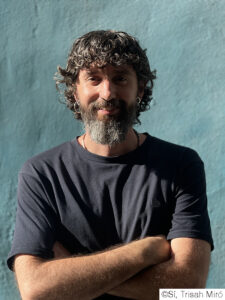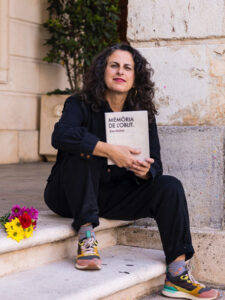
Javier Navarro (Valencia, 1969). Doctor in History and professor at the University of Valencia, has researched anarchism, the Second Republic and the Civil War, among other topics. Report writer, some of them awarded, He is a member of LAB, Ruzafa Writers Association, and has participated in the anthologies Improvisations (2013) y Eleven vaults (2015). Living Paintings (Contraband Editions, 2015) It is his first solo storybook..
The first thing that caught my attention about this book, maybe because obvious, has been the cover image. That Fading Away de Henry Peach Robinson. Was it chosen halfway with the publisher? What motivated you to choose it for this? Living Paintings?
No. I chose it. I have always been fascinated by Living Paintings as cultural practice and expression (already lost), very fashionable between the end of the 19th century and the beginning of the 20th century, and halfway between the theater, the painting and the newly released (by then) photograph. Precisely Henry Peach Robinson, a Victorian pictorialist photographer and author of this Fading away (1858), He took great care of his installations, that had a lot of theater and live paintings, with people posing like in authentic paintings. This particular photograph of yours has always fascinated me., for the light, the color, the atmosphere it evokes and the play between the characters around the protagonist, recreating a romantic theme par excellence: the death of the young consumptive.
There is a careful style, I have noticed it especially in the language, in the form, in short sentences, accurate, a strong commitment to the main narrators, Isn't that so?
Yeah, I try that. Style is everything (or almost everything) the literature of, even when its absence is deliberately sought. I'm especially concerned about concision., precision in searching for the exact word (he right word), what is (or should be) the main task of the writer, with successive pruning that eliminates what is superfluous. I try to avoid a certain complacency in my writing., letting yourself go in that sense.
I believe that the commitment to the protagonist narrator is an inheritance from the tradition of fantastic literature., since the 19th century (Hoffmann, Poe, Maupassant, las ghost stories, etc) and even Borges and Cortazar. The uncertainty, the restlessness, the strangeness in everyday life, They tend to settle more easily in the minds of the protagonists, while their daily reality becomes less familiar and, little by little, cracks.
Going deeper into the stories, there are several elements that I have wanted to see., and I say see with double meaning, I appreciate an introversion, certain voyeurism almost as if a play were being presented to a spectator reader.
Of course. That's why I think the idea of living painting (truly voyeuristic activity par excellence, and beyond the fact that it is the title of the last of the stories) is somehow present in all of them. Almost all the protagonists experience a contemplation, a certain vision, that ends up fascinating them and that, a bit like Hoffmann, also reveals its own abyss, its internal fragility.
Secrets are also very present in these ten stories, secrets and a disturbing element slipped in to nest in the conscience of the reader who observes and remains silent.
Memory is present in these stories, which is a topic that obsesses me, which does not fail to give clues about my other occupation (and profession), the historian. Without memory there is no identity. and in memory, in memory, always harbors a secret, that has almost a foundational character in our identity.
The art of writing also pulsates in at least two stories, in the protagonist of Intruder and in those of The green room. Is it in some way an appealing resource for every author who creates stories??
Of course. Writing is a disturbing act. that disturbs me. How could it not be present in these stories??
If before I talked about the tone that these ten stories share, at least one seems a little wayward to me, I mean The best awakening, Do we agree on that??
Another of the great themes -perhaps “the theme”-, of these stories, it's death, that is present in all stories. But I also intended a humorous approach, irreverent, her. The fantastic has many genres and macabre humor is one of them.. This story was intended to be a tribute to those who have cultivated it most successfully., as is the case, in my opinion, by Ambrose Bierce, among others.
I would like to know the origin of these ten stories, if they were written expressly for this book or had a previous tour, They have agreed to this project from other pulpits. Seeing the extensions of the stories of Living Paintings two catches my attention, The green room y A suitable place longer than the rest.
The stories had a previous journey and I later selected them for this anthology, where, as I said before, there are many common threads. If there's one thing I'm happy with this volume, it's, precisely, the variety of records that are present in the stories. The common denominator is perhaps the concern, the disturbance, the fantastic or different element, no familiar, that is introduced into everyday life. But from then on I have tried to make the approaches and approaches different., also the topic, the extension, etc., because each story deserved a different treatment. The green room perhaps draws more from the tradition of the classic fantastic story. A suitable place It is perhaps a more complex game about memory and the deception of nostalgia., with a dreamlike and surreal air that, I have to confess, I had fun.
GINÉS VERA