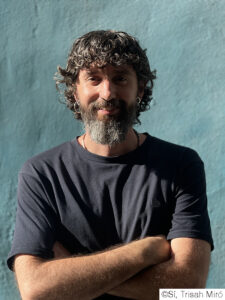
Sergi N. Castellanos, Valencia (1990) He graduated from the University of Music and Theater in Munich. He is a professional dancer at the Prague National Ballet.. He has worked at the Finnish National Ballet and the Bavarian State Ballet. (Germany). Lover of the sea and travel, passionate reader, pianist and music composer, He spends his free time writing poems and stories. The Ivory Ship (First work, 2015) It is his first novel.
In The Ivory Ship The stories unfold chapter after chapter through the voice of a narrator who in turn hears them from others., like the legends, Was it difficult to reach this narrator, At what point did you decide that it was the best way to narrate this novel like this??
Each beginning of the chapter has a unique component that only dancers can understand.: The Auditions. Each dancer knows very well what it means to spend a long time looking for jobs in many places around the world.. The trips I narrate have been real experiences, tinted with the nuance of unreal history. It was an easy way to make the described adventures my own. This resource was very common in books of chivalry. Note that Don Quixote has been the reference work in this novel, with the difference of its theme.
Of all the characters, plus brothers Erik and Halliah, I'll stick with captain Adrian van Clemens, perhaps because of that particularity that makes it unique in the eyes of the reader, Where did you get the inspiration from when creating them??
Erik and Halliah came from my first impression of Scandinavia, as seems to be clear in the first chapter. In a different situation I had the idea of Adrian van Clemens. He is perhaps the character that changes the most throughout history., and the one that shows the most depth. In the end, it is not clear where the man-without-destiny ends and the hero the reader expects begins.. It's a mix of the faces of fortune, unstable, inexplicable. A Flying Dutchman in search of his life.
The fact that the characters are so multicultural on board a ship, a small space, Does it contain within itself a metaphor about communication and understanding between people?
As a dancer I must admit that it is very common to interact with people from many places., so I see the detail of travel and internationality as common and habitual.. The Ivory Ship acts as a microworld in which the crew must coexist with no way to escape.. This situation seems to show the impossibility of peace among humans..
One of the characters' adventures has to do with the Battle of Rande, In October of 1702, Why did you choose this specific historical episode??
Bueno, I suppose that in some way I must be critical of the country in which I was born but I had to leave when I turned eighteen for work reasons.. Spain seems to forget (or simply ignore) how much was done in the past and how things have evolved. I found Rande's battle entertaining and versatile to be told.. Although I must admit that I used my imagination, and not the historical sources with which I informed myself, to write it. It's a little stylistic license that I've taken., to the pain of historians.
Yes, there is a certain relationship between this battle and Twenty Thousand Leagues Under the Sea by Jules Verne, one of my favorite adventure authors. Was he also one of your childhood authors?, What others have inspired you when writing??
This is a question I was hoping to get.. I knew that Captain Nemo had collected some treasures that escaped me in the waters. And in reality this fact perhaps makes the battle more curious.. However, Jules Verne was not an inspiration for this novel. I found enough resources at the construction site; I have already referred to Don Quixote and it is no wonder. The narrator Cide Hamete Benengeli is the root of Madame Charlotte Mince (Eggplants and Carlotas). A large number of hidden allusions are related to Cervantes' masterpiece. Other minor but understandable references are the Kalevala (the finnish national epic), some descriptive details of 'The Adventures of Sir Arthur Gordon Pym' by E. A. Poe y, even if it seems like a lie, some maritime strategy video games, economic and military to which I am quite similar.
He wrote this novel in the spring of 2014, It is inevitable to ask him how the idea of writing it and also placing it in the sea came about., in Europe at the beginning of the 20th century. XVIII.
I started this novel when I was studying ballet in Munich., had 18 years. I had a kind of revelation when I visited the German Museum and I saw a small ivory ship. My mind just scaled it up to life size. When thinking about important historical periods, the war of succession came to mind and I began to study the possibilities I had of inventing characters in that context..
Besides, I must add that the second, the third and fourth chapters were written in Helsinki. But it was in Prague when I was finally able to get down to work and finish the whole story. A total of 5 years of travel and experiences.
In one of the sentences of the novel, pronounced by Pere Albert, this character claims: “The moral is that money always reaches the hands of those who already have it before”. There will be those who thought this way then and those who think this way three centuries later.. Do you agree with her?
I have to admit that yes, I think that's how it is. It seems to be a cruel reality. But you don't have to take things out of context., since money does not buy happiness. I wanted to be critical of some socioeconomic aspects that, although it may seem like a lie, have occurred since human beings existed., but they are not noticed because they think that what is happening today is unique.. Nothing is further from reality, It is enough to realize the large number of economic crises and natural disasters that have devastated human existence since forever.. So, What do we get out of this??, one may ask; The truth is that Pere Albert seems to want to make sailors think about what they want to do in their lives., because they won't find money that way. But yes a life full of adventures, some good and some not so good.
I am curious to ask you about the relationship between your profession as a professional ballet dancer and literature..
This is perhaps the question that I liked the most.. Yes indeed, the least easy to answer. Ballet is perhaps the art of arts. I explain myself, It can be considered that dance is the most genuine art of the human being., for becoming what one is, the body itself. But classical ballet includes dance and music., scenography, locker room, lightning, etc. That is why I really feel passionate and consider myself privileged..
On the other hand I have many other passions. Literature and music (I am a pianist and composer) They are perhaps the fields that I have plowed the most. I have written stories and poems since I was a teenager., but they have never been published. I hope over time to make enough compilations of them.. I have always been a lover of reading, so ideas have always flowed through my mind constantly.
Will we read him soon with a novel on dry land, perhaps with a character more related to the performing arts?
Regarding future works based on the performing arts… I must say that I have not yet. It's too early for that. However, I offer the scoop on a new novel that follows in the footsteps of this first one., greatly increasing the stylistic level and depth in the characters. While 'The Ivory Ship' could have a youthful tinge, This second will be an odyssey that will not leave readers indifferent..
GINÉS VERA