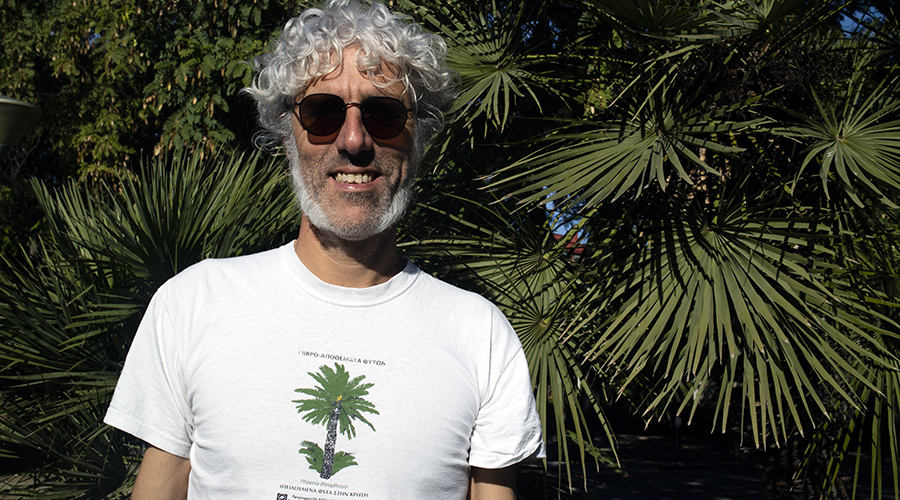
In a city like Valencia, in addition to the artistic or architectural heritage, we also enjoy a very important natural heritage: gardens, neighborhood parks, l'Horta, the Mediterranean and the Natural Parks. They are fundamental per se, not only because it makes life better and healthier for the people who inhabit it, also because the environment provides its cultural and knowledge aspect, like any discipline. I already know: we must cherish the heritage for ourselves and for the generations to come. Cherish and protect it. And that's why we need education and outreach: from the administration, from folk and traditional wisdom, from the schools and from the experience of the experts it is necessary to spread this valuable treasure. This is exactly what our interviewee does, Paco Marco Rubio —environmental educator, agroecologist, specialist in palm trees and organic gardening, and co-author of the previous diagnosis for the Green Plan of the City of Valencia (2021-2022)—, with whom we had breakfast to broaden horizons of interpretation and action in the task of appreciating and caring, now more than ever, the nature of which we are a part. He says it feels more like a seed than a root and we think he's right. SERGIO BELLO
Paco, let's start with a context that urbanites know: a neighborhood park. We are aware of the amount of life it can hold? A single tree can provide shade, coat, birdhouse, oxygen, color, reduce noise pollution... What is the current situation of Valencian parks and gardens?
indeed, you have said. A tree (only one) gives us all this, but... let's reverse the question: what do we give to the tree? The importance of neighborhood parks and gardens is great because they must achieve not only green areas, also games for the little ones and benches for the people, i fonts, and many more things… And Valencia has improved a lot, for example, with the conception of the rocks, older, wide and deep because the tree needs more soil to take root better and less compaction to better filter the water. Also the recovery of plots to make necessary orchards and gardens such as Berta Cáceres next to La Mesquita, or the Hort de la Botja in Velluters. Every stone makes a wall and create a map of communicating vessels, of urban green corridors, is to generate a necessary network for our city. Not all are wonders like the Jardins del Túria, Nurser, Monfort, the Rambleta Park, the ficus trees or the monumental palm trees or the unfinished Central Park. Much more is needed, and we cannot be content with what we have. I really like the case of Vitoria-Gasteiz and we could also achieve a similar project with our reality because in the city of Valencia we are lucky to have the Albufera and Túria Natural Parks which should contribute to the network we were talking about earlier. As do Horta and the Mediterranean Sea, but we must protect them. We are not only talking about an environmental issue, but basically also sociological and human. We must be in solidarity and create a network among citizens, between all the neighborhoods, so that we are able to unite, protect and strengthen the city's green spaces.
What improvements would you implement in the short term?, medium and long term to achieve progress like those of Vitoria-Gasteiz?
In general, we all need a lot of environmental culture, even to our politicians. We really should put a solution sustained over time to this gray reality of not even knowing the A, neither B nor C of the most basic. We talk about environmental literacy in many cases and we talk about ignorance, of indifference, i d'inoperància. Because it's a cross-country race. It is a task for all citizens, of all administrations (totes!): state (ports and coasts), regional and provincial i, of course, the municipal. Valencia should promote ambitious plans with short-term goals and actions, but especially in the medium and long term, on, obviously the budgetary and human resources items were more substantial. Invest, especially, in education and environmental awareness. In the schools, in the universities, in the museums, in the neighborhoods, to social movements... It is also very important that the media really get involved, this is fundamental. Thus we will be on the right track to obtain friendlier cities, and when we talk about kindness, obviously, we talk about quality of life.
Environmentalism, with more than fifty years on the road, it is social and political. Although scientific studies determine that a beach and its dunes form a living ecosystem (and that which lives, may eventually die), we have the case of the port of Valencia thatecontinues to grow dangerously for the beaches of Saler or L'Albufera, which could disappear in a few decades. As you see it?
Although the forecast is not good, we must fight for a better future. In a society where the basis is not so much culture and nature (education, training and sensitivity, creativity…) and yes an economic growth without measure typical of the capitalist model, the future cannot go well if we continue down this path full of problems. We are at a key moment in our history, of the history of life, because we are in a situation of climate emergency on the planet. But, Besides, is that our case is critical, i mean: Mediterranean ecosystems are hot spots, that is to say, vulnerable points that, may be, are non-returnable, May. And the expansion of the port means more economic growth without taking into account the socio-environmental part. We wondered what the consequences would be? What and how much it costs us and for how long? The words "economic growth" should no longer have a place in a situation where resources are what they are, limited, and if we open that box it might be the end of spaces like the Saler or L'Albufera.
You told me earlier that there are studies that scientifically demonstrate the positive influence, beneficial, preventive, and healing to live near green spaces. In that sense, which projects can be implemented by environmental technicians and health officials?
Let's see, scientific studies do nothing but corroborate that, when an ecosystem is healthier, better able to face environmental problems than, mainly, we are generating. A good state of conservation of nature benefits us all. this year, the national congress of the Spanish Association PARJAP (Public Parks and Gardens) puts all the focus of attention on the numerous health benefits that the green spaces of our cities bring. Its title is suggestive and very apt: Natural health systems. Consider the green plot (and blue) of cities as natural systems is very appropriate, it will make us know the nature that is closest to us. We now know that we need to be in contact with nature for our health and that we must protect it if we want to obtain its benefits. Nature is necessary in the urban environment and we should put all our effort into recovering and restoring its ecological functions. Urban nature in a good state of conservation and with a good biodiversity works as a preventive system for many diseases that affect a significant part of the population that has lost, precisely, the contact with its origin. Stroll through the gardens, play in parks, read on the benches hidden among the trees, listen to the birdsong when spring comes, enjoy the shade of an olive tree... healthy nature, healthy people.
Many interests and disciplines come together in Valencia's gardens and parks: urban planning, landscaping, water resources, neighborhood needs, esplai… It would be necessary to have a break and pause in order for them synergies are fruitful.
Absolutely, pause and pause go hand in hand to make good decisions. All these disciplines come together in a concept that I really like: complexity. Just as from the parts we get a whole, the same is true of the connections and dependencies of living systems: complexity. Complexity directly implies “many parts involved and all are important” and I think that life cannot be understood without complexity. For example: we look at the human body with all its systems (nervous, respirators, reproductive, digestive…). Or when we ask a boy or girl to say a word that represents nature and he says: the forest, the river, the mountain... Yes, but we have to make him or her see that he or she is also part of that nature. Little, I like the definition of complexity as interdependence and interrelation between things, the beings, the ideas... That's why, and answering your question, you have to sit down, to talk, to listen, hear from all parties involved, create assemblies, have the capacity for consensus… but all these things are hard to find in our society. Fortunately, more and more people want to join and learn from nature.