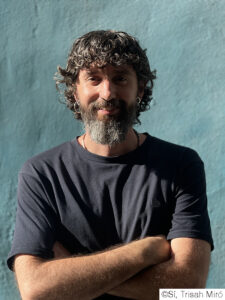
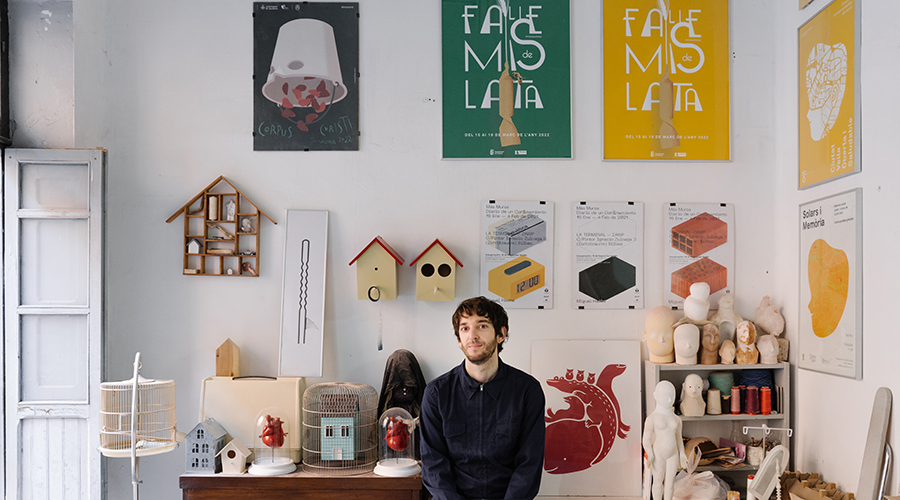
Miguel Hache illustrates commissioned posters on a plan, personal screen prints and anything that comes within reach and motivates you. He does it, also, thinking that those designs of his will take on volume to burn in the flames 19 of March, since he designs monuments for the alternative faults of Valencia. During the year he coordinates the exhibitions of Temparada Il·lustrada in Muviment with work by artists such as Luis Demano or Elías Taño, but when the Fallas arrive, the nerves surface because their designs must be assembled well and burned quickly on the big day of the festival.. In 2022 was in charge of the Na Jordana children's falla and a monument with 100 matches placed like a jenga to commemorate the 100 anniversary of the Borrull-Socors fault, and this year it is behind the Plaça de l’Arbre fault project, which debuts as an experimental failure.
Are you a faller?? How did you get involved in the world of Fallas design??
I was a Fallero until I started working on the Fallas., With fourteen years. A friend's Fallera commission was running out of budget and she proposed that I and a friend do our first Falla.. Practically the entire budget was to buy the materials and we learned in a completely self-taught way.. A lot of trial/error and a lot of recycling. When we realized, years passed, and the hobby became a job.
In addition to being a Fallero designer, you are an illustrator. The drawing of an illustration on a plan has nothing to do with the projection of a 3D monument that, besides, It is designed to burn and burn well. We assume that they will be two very different ways of approaching work..
Fully. Working with failures from such a young age had many good things, how to develop skills for sculpture. But when I started to get interested in illustration I realized that it was very difficult for me to draw without thinking about volume.. This, sometimes, can limit and I had to start deconstructing that vision so as not to have those limits..
Put us in context. What are experimental failures? What attracts you to them?? How are they different from a “traditional” falla??
Experimental failures differ from the rest for several reasons. Mainly, They are projects that have the intention of making the viewer reflect.. Where, surely, although not always, content prevails instead of continent. ¡Ojo!, without this going to the detriment of aesthetics. In second place, and usually, They are characterized by being sustainable failures whose main materials are usually recycled or less aggressive with the environment. All this refers to what the failures were in origin, therefore, and in my opinion, They are more faithful to the Fallero spirit. Regarding the innovative connotation, repetition makes the norm, and in these times what is most abundant are the fallaes understood as “traditional”, although this term should be revised. With which, Innovative failures that deviate from the norm by not following the prevailing aesthetics are a minority. I find myself in a moment in which I have the concern to find meaning in what I do., that the project contributes something, and this is allowed by experimental failures. I like working with wood, I like to recycle and give a second life to objects that were going to be thrown away.. And, besides, These conditions are used to tell things and make the viewer think, well much better. I think failure is a great medium to tell things.
When do you design a failure, You propose the topic or they give you guidelines from the failure? What is your process when designing a failure??
In principle, It is the fallera artist who decides, but there may be suggestions from the commission. As, For example, If it's an anniversary or something like that. I usually have freedom. Regarding the topic to be developed, It has to be a topic that interests you a lot because you are going to spend time working on it and it can become overwhelming if what you are going to do does not resonate with you.. I usually look for a topic and think about how I could make it more attractive.. In the end, The process is not that different when creating an illustration or a poster..
What is the theme of the fallaes that you have designed this year for Plaça de l’Arbre. What type of materials are you going to use??
It is a sculptural intervention site-specific. That is to say, It is designed and designed especially to interact with its specific environment.. The conceptual content of the fault will rescue the memory or the mark left by the passage of time in the remains of the buildings in the Ciutat Vella neighborhood, specifically, on the tiles. By the way, The failure will be sponsored by Derribos Carmen! The context, in this case, it is important, since the festival of the failures is used for the production of the work. It is a circumstance that nourishes the project because fire will have an important role, symbolize oblivion. We are committed to a sustainable philosophy and the circular economy, and we were given the opportunity to recycle a series of furniture for the falla, which has very positive aspects: material is saved and abandoned objects are given a second life. Besides, recycling is not only consistent with the project, but it directly alludes to the origins of the failures, the mat, collecting old furniture to make a bonfire.
Aren't all the “traditional” fallaes too similar to that Disney aesthetic that has been implanted by fire?
Maybe, What defines the “traditional” fallas is that they are made up of an agglomeration of ninots assembled together.. Everything that comes out of there, surely, many people would define it as experimental. But there is nothing that aesthetically unifies the experimental failures, They are very diverse between them. at the party, as in everything, there must be diverse voices. Personally, I think that a project that provokes reflection or raises social issues is more enriching than one that is built from the excuse that “something beautiful must be burned.”. Sometimes there are projects that give the sensation of searching for the theme for aesthetics., to be able to give more strokes, make more pleats in suits, curls in hair, etc.
From the design of the municipal fault (out of competition) Each year a renowned artist is commissioned who has the license to go off the beaten path.. They have done it Escif, Pichiavo, Black, Dulk… What do you think of this new policy implemented since Compromís arrived at the Valencia City Council?? Do you think it has had good results??
It has been an important change. First of all, for prioritizing failures built with more sustainable materials. In second place, for giving the opportunity to artists from different disciplines and with recognition beyond the faults, which makes many more people interested in them. I think it has been something very positive for the world of Fallas and for Valencian society in general.. Having said that, I think very interesting things are also being done from within the faults.. There are quite a few Fallas artists experimenting and sometimes I have the feeling that it seems that the Fallas have been rescued by those outside the profession and that is not the case.. There are people who have been trying to change things from within for a long time.. An example would be Marina Puche.
Precisely, We wanted to ask you about Marina Puche. This year she will be the first woman in charge of the municipal fault. What do you think that it has taken us so long to have a woman in charge of the big falla in the Plaza del Ayuntamiento?? Would you like to be you, one day, the person in charge of designing it?
Women are having more and more voice in the creation of fallaes. They have always been, but in the background, It is now when they speak in the first person, and it was time. Although it is not something that has happened from one year to the next, graffiti artist Julieta designed her first falla more than ten years ago. I don't know if I'll show up some year., but I admit that it would be nice to see one's own work in the square.
You coordinate a series of temporary exhibitions dedicated to illustration at the MuVIM. Tell us about the project. Which illustrators will be there in the coming months??
The Illustrated season It is a project that was born to give space to the world of current illustration in Valencia. A window to publicize Valencian talent, not little. We are lucky to have a wide range of people who have decided to dedicate themselves to illustration and we would like the exhibitions to be a support so that these people have more visibility. Right now Nuria Riaza is exhibiting, has brought her latest originals made in Bic pen around female family memory. Pablo Caracol and Mike will be in April and June. The selection is very varied.
Any wishes for failures?
I would like there to be more empathy in failures, especially with the people who work at the party. We must remember that behind every failure there is, at least, a person who, surely, have put a lot of enthusiasm and effort. Things from the outside are very easy to criticize and we cannot forget that there are people who make a living from this. In the end, It is still an assignment with an annual contract, For the Fallera artist, it is as if every year he had to do a job interview whose position would only last one year., maybe more… Luckily.