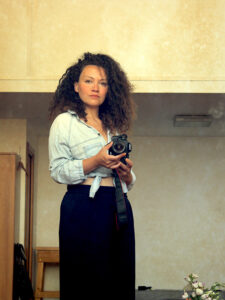
He arrived in Valencia five days before the commercial premiere of his latest production, Petra, tape with which, one more time, would visit the red carpet at the Cannes festival and with which, as he himself commented at a press conference, Jaime Rosales has attempted to move away from his first formal proposals to try to approach a more general public.. “At the point in my career where I am, For me it was very important to meet the viewer. (…) Right now what matters most to me is the box office. I say this without any shame or qualms., It seems to me that cinema has to be something that seduces the viewer, which is not easy at all. And in my particular case, that meeting with the viewer, It had to be done without giving up film writing, to a formal investigation that is part of my way of understanding cinema and the films that I appreciate and like. Finding the dramatic twists, the actresses, The actors, and a photograph that was attractive to the viewer and, at the same time, make him participate in the need to interpret the film. Both for the script and for the rhythm itself. It was a great challenge”.

Petra was presented within the program cineclublys that the Lys multiplexes in the center of Valencia have been offering since this October. Here the Petra that gives the film its title is a young painter who, after the death of his mother, He looks for a father he never knew and who he believes he finds in the figure of Jaume, an old unscrupulous self-made sculptor who supports his entire family (and to anyone who has the misfortune to approach him) subjected under despotic emotional control. This is how Petra will meet Lucas, Jaume's son, a mature man who lives traumatized by his own vital doubts, the artistic ones, and the figure of his father. And to Marisa, Lucas's mother and the sculptor's wife who lives in apparent compliance with his tyrannical dalliances. With a superb cast (Barbara Lennie, Alex Brendemül, Marisa Paredes, Joan Botey), Petra unfolds on a delicate formal apparatus. Rosales divides his work into chapters of strong influence quixotic whose order seems altered with the intention of directing the viewer's attention to a plot that deliberately plays with the elements of the serial., as the director himself would recognize. So much so, that the script at some point carried the title of Melodrama. However, Petra It is more than a story of family entanglements and sentimental debts.. But, it wouldn't be so interesting. But, It wouldn't be so Rosales.

In many chronicles and production notes, Petra It is presented as a change of direction in your career towards an apparently more conventional cinema, more classic. But, after Beautiful youth, To me it seems like a return to the beginning of your career.
Yeah, It's funny because I, the way I see my cinematography, I did The hours of the day, it was a very small movie, made from the industry, taking into account the industry, but also with personal themes and a personal style. It went surprisingly well. From there, The industry itself gave me the means to do loneliness, which was also a natural continuation of The hours of the day. It also turned out very well. And then I had two films that were very personal, very outside the industry, so to speak, They were Headshot y Dream and silence. Very artistic, very interesting to do from the point of view of creation, and I think they are also highly valued by a very minority audience., much more minority than loneliness what The hours of the day. And then, at the same time the industry turned its back on me because it said, Well, if you leave the margin, it is a possibility., There are many filmmakers who have done it and who live outside the industry. But I wasn't interested in that.. So, of Beautiful youth it was a fake first movie (almost all movies are fake first movies). And this is a bit of the continuation. I see it more as a spiral movement.. It's as if Beautiful youth out The hours of the day and this was loneliness. In that sense, It's like the continuation, just with more experience, also with more budget, with more possibilities.

On this occasion you have had two scriptwriters, also very different, Michel Gastambide (Cows, Life without stain, There will be no peace for the wicked) and Clara Roquet (10.000 Km, The good girls). What has each person contributed to this work??
Well yes, First, Clara has brought a lot of consistency to the female characters. I tend to pay more attention to the structure., in the plots and it was very important that the motivations of each character were well anchored and in that it helped me a lot. And Michel was a little more like a supervisor at all, that everything would work. Maybe Clara was more into the characters., I'm not saying that it wasn't in the structure or that I wasn't in the characters., but Michel perhaps had a more global vision. Y, in the background, A script like this, so complex and so rich in terms of twists and the drama itself, was possible because there were three of us., plus five producers also constantly taking a look at the script. Before I said that cinema is art and industry, but it is also a personal and collective work. This duality between the personal and the collective is quite particular..
There is a moment in which Jaume, the sculptor, he tells Petra about his work as an artist: “You are thinking of your work as therapy for yourself.”, but you are not thinking about the public”. To what extent does the film propose the own reflection that you are doing at this moment about your cinema??
Yeah, it's a bit that. Yeah, is that in the end the film proposes three typologies of artist. There is the artist with a commercial nose who is very attentive to what he is looking for in the market., What is Jaume?. There is the artist who makes a work that is based on his own demons and his own concerns and that is a very therapeutic way., What is Petra?. And then there is the committed artist who makes a work based on social impact or political commitment., What is Lucas's?. And well, In essence, these three typologies, which are like three separate typologies and often confronted with each other, I live them in a more integrated way. I don't find myself in any of them, but I don't reject any. the same movie, Petra, It has a bit of political cinema, the graves are there [of the Civil War] pointed out through the character of Lucas. I myself declare that I am looking for something more commercial and, at the same time, There are themes that are very personal to me.. In fact, Perhaps the most personal thing in the film is precisely in the use of the camera. It's something that hasn't been said much., but for me it is a very metaphysical use. It's that angel camera. I am a Christian, I am Catholic and for me there is a kind of supra-human entity that is there. It does not belong to the human, It is not a human look, and it's not a robotic look either. I called him the angel, ¿no?, which is also supported by music which is choral music, but you don't know where it comes from, that are not words, but they are human and they are displaced. So, there is a metaphysics in the film that comes from Dream and silence directly. That is why the film is personal and it is collective.

Regarding that use of the camera, you try all the time to create a relationship between the characters and the space that surrounds them. The characters are an entity that occupies the center of the screen, but there is always a symmetrical space on both sides that surrounds them. Was there any specific intention in this??
Yeah, It's funny because when you start filming or photographing something it's not excessively rational., It's quite natural. I generally like balanced paintings, I like to roll at eye level. Sometimes I watch movies I love by others and they do completely different jobs, and you say, well look this is super good, ¿no?, this angulation or wide angles, and I love seeing it in others. But later, when it comes time to do it, it costs me, I can't find myself, it just didn't turn out well for me. So, Where in the end I see that I am in a field in which I feel comfortable is in those balanced planes, many times between doors, with certain symmetries, that sometimes I break, but I find them again. I like him a lot [aim] 50mm. precisely because it does not deform. But I got there in an unconscious way, natural.
There is something that remains permanent in your cinema, which is the search for that point of impact on the viewer., when there is an important revelation. I get the feeling that in your cinema there is always a point where the film concentrates all its weight.. In PetraIt would be when the cruel personality of the sculptor is revealed, when the almost sadistic relationship he has with his lover is discovered. There is a lot of talk about Haneke and I think your cinema has something similar, that moment in which you put the viewer in a moment of impact, which is where the epicenter of the story is. Maybe you are not aware.
No, I'm not. I am saying that I am going to meet the viewer, but for me the viewer is like a woman you are looking for, but you don't know where you're going to find it. You go to several places to increase the chances of the meeting, but you really don't know if it's going to be in a bar, in a hotel, at a friend's house, on the street, inside the subway, on a bus… But you are frequenting those places for that meeting to occur. It's a bit the same with the viewer.. I don't have any kind of sense of control of the viewer's emotion or any kind of emotion. When I'm writing the script I pay attention to generating interest for myself as a viewer., who wants to know more. And when I'm rolling, generally I am looking for a certain plastic originality, that is to say, I want to film this in a way I haven't seen before. And then I also look for a truth in the actors. That is to say, I see this and have the sensation of looking at something as if it were really happening.. That's what I build the film with.. And then, you throw it on a screen and whatever happens happens. Con Petra, in Cannes, We had many moments where people laughed a lot.. And that for me was a source of enormous surprise.. I didn't expect them to laugh there. And it was quite recurring, so i say: ah, well if they laugh there, maybe that's funny. And if they cry there, Maybe that was sad. But for me, In fact, everything is the same. I don't have that feeling of control over the viewer's emotion..

I think the film suggests a reflection on the value of truth. What were you seeking to provoke in the viewer with that proposal or reflection??
Yeah, bueno. There are many thematic focuses. There is a very important focus that revolves around what concealment is., the lie and the truth. Concealment is not a lie, exactly. When someone does not say something or hides something, it is not the same as saying the opposite of the truth.. But, on the other hand, the concealment, over time, almost always falls into a lie. And from the lie, in the end, over time, the truth emerges. The film does show in time what that dynamic is like., from concealment to lies and from lies to the truth. The effect of truth, the rupture that generates the truth, the consequences of the truth in the short term. But, in the end, in the long term, the truth ends up being better. And then, All of that is quite in the thematic center of the film. Yes, it is one of the dramatic epicenters of the film.
The other truth is the truth of the artist, which is also raised in your film. That confrontation that we frequently reflect on as audiences or art consumers who do not know the artist intimately., between your honesty and honesty the work of art.
Yeah, what happens is that the truth of the artist, at least in my experience, It's something mysterious. The artist is not someone who knows the truth, who owns it, and give it to others. It is someone through whom the truth may or may not happen.. And when it happens, besides, he does it in a mysterious way, and not necessarily in the way that the artist himself expected. In the end, the only way for the truth to appear, at least in my experience, it is through artistic praxis. That is to say, art has to be approached through special techniques, and it is from these techniques that a truth emerges. And that truth is not always in the thematic center, it could be a truth about something else. but a truth, definitely. And in the end it is true that art allows us to illuminate truths, But they are mysterious. Y, above all, They are mysterious even to the artist. And then they become a revelation to the one who sees it. And that is the beauty and the value, ultimately, Of art.

Family is another important theme in the film.. All the conditions of interrelation and debts and taboos that are established in the family world.
Let's say that family is a topic and, above all, It is a framework that is present in my films because, bueno, I think it is present in life. Let's say we are individual beings, family and social, politicians. But I live that family dimension with great intensity., It's true. I live it with great intensity. I have had a very intense family life, I still have it and family is a very particular place.. It is a place in which each family is a prototype in which a series of rules are created based on what its individuals are like and based on what the environment of that family is like.. And it's quite fascinating because it's a place, I have lived it like this, very protective, and it is a place full of goodness, but that works within with a great conflictive activity. It's like something that protects you a lot from the outside., but internally it is a source of incessant conflict, up, downward and laterally. And that makes it a rather peculiar gear that attracts attention and, of course, very rich from a dramatic point of view. Greek tragedies already happen in families. This is what Aristotle says: The betrayal (and he says it this way) It is more beautiful the closer it is to the family. The betrayal of a brother or a father is more beautiful than that of a friend or that of a stranger. GERARDO LEON