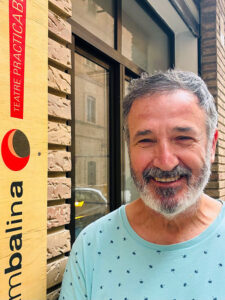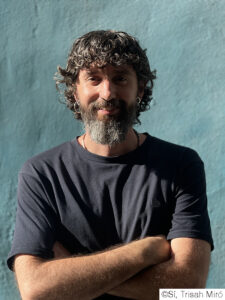

Seeing them together, One wonders what these two kids can have in common.. One looks like he was teleported (is this word still used?) from one of those 15M assemblies. The other one looks like he's coming from his in-laws' house after making Sunday paella.. Although, well thought out, The thing could very well be the other way around.. Appearances are deceptive. The point is that Suso Imbernón (El braking, When everything than) y Juanjo Moscardó Rivers (family games, Paella Today) Not long ago they embarked on the adventure of shooting a feature film together. A, breast, struggled in the direction after many shorts behind him. The other, Juanjo, seasoned in screenwriting tasks. Starring by Macarena Gomez (Shrews, in the stars), Enrique Arce (The Money Heist), Luis Miguel Segui (The one that is coming) y Lorena Lopez (She is his father), love in dust, the film they directed (with the collaboration of Maria Minguez in the script) it's a comedy. Or well, a comedy with touches of drama. Or a very serious comedy. They explain it better. The synopsis says: “Pablo and Blanca have decided to start exchanging couples, disobeying the first fundamental rule: don't do it if you are in crisis. For it, They call two of their single friends, Mia and Lucas, also disobeying the second rule: always do it with another couple. Is making love the same as getting laid? Can you have a relationship without sex? And sex outside the relationship without cuckolding??”
love in dust had finished filming in Valencia in these final days of the hot month of July. We caught Juanjo and Suso resolving the last issues of the production. Don't be in a hurry. Sit back and read, that things are going wide pa. GERARDO LEON
A ver, difficult question: How did the idea for this film come about??
Juanjo: Bueno, The idea comes from wanting to make a very cheap movie that would be very producible. (laughter)
breast: (laughter, with a face of “let's see what you say, young guy")
Juanjo: I tell Gerardo everything... (laughter)
breast: Of course, man.
Juanjo: Actually it comes from an idea that I had that I proposed to María Laura Gargarella, who is one of the scriptwriters, to develop it in 2008 o 2009. That script was almost done with Fernando Colomo in 2010, but in the end he didn't produce it. So, as it was a very small and easy film to produce, with the passage of time, several production companies were interested, but the agreement to buy it did not convince me and I decided to produce it myself.. It is a comedy about sexual themes that interest me a lot., type Chocapaquete [his first short], where my career with these topics begins. Forks, well that, a comedy that talks about the exchange of partners, but also of love, of jealousy, of friendship. The exchange is an excuse to discuss universal topics.
Since we are talking about the script, you were also co-writer of Paella Today, that addresses a similar topic. What things did you leave there that you wanted to put into love in dust?
J: Bueno, the idea [of Paella] It was more of Cesar [cobbler, your director], but it did attract me because it also talks about a loving trio. Let's say that Cesar's type of comedy is not exactly mine, but I was also attracted to. I like the type of humor he has, I laugh a lot with him. He told me to participate and I accepted.. But there it was more as a collaborator. What is true is that I contributed my concerns. And the truth is that the work went very well. Then with one of the co-producers it was something else., but with César it was very good (laughter).
You have made a low cost movie, as you tell me. How do you build a production like love in dust?
breast: It feels to me like we were driving a 600 to 250 on a highway...
J: and uphill. (laughter)
S: and uphill. With little budget, but, suddenly, The project had been growing with the incorporation of certain actors who have given it cachet and the possibility that the project could move to a level that, a priori, It was not intended for production. That is to say, we go above our possibilities. (laughter) With great risk for the producer here [by Juanjo], but we have reached the end of the game and it seems that we have done it without breakdowns and without major damage.

What help have you had to carry out the project?.
J: Well, we have had help from IVAC, On punt He also pre-bought the movie and then private investors. We have been lucky to have an important sponsor, the social network Wyylde, which specializes in couples exchange., precisely. They found the project very interesting and it was very cool that they supported it and wanted to get involved financially.. and then, at the end the producer has entered Nobody is perfectby Quique Martínez, who at the beginning was as executive producer, but the project has been growing and ended up co-producing. And the truth is that, despite economic difficulties, I think that in the image you will not appreciate those deficiencies that, with everyone's work, we have been supplying very well.
Four-hand steering, How do you eat this?
J: Well in pre-production, very good (laughter)
S: (laughter)
J: In the filming and less (laughter) Nooo, GOOD! It has gone well. The truth is that since Suso has much more experience in filming...
S: Not so much.
J: No, but if, fuck. I am more of a scriptwriter, everything that is the previous work, GOOD. But then on set I get a little lost and it's cool to have Suso who controls everything in the technical part.. Yo, For example, about the views of the shot and counter-shot, I don't realize, if they are looking good, but, the axis, if i don't know what. In those types of things it comes as a damn thing that Suso controls him.
S: For me, co-direction is rich. It always has its risks if there are times when you don't agree on what you want.. But, in general, always generates a dialectic and a debate that leads to finding the best solution. Sometimes you're just making a mistake and don't realize it.. I have seen a director who is filming and everyone is realizing that he is making a mistake and no one tells him.. Between two it's easier. Now, I'm sure we've made a thousand mistakes...!
J: Surely while we were filming there were people thinking: These two are making a mistake!! (laughter)
S: But they always say that four eyes see better than two.

Did you have a particular work process or did you see things as they came up??
S: a little bit of everything.
J: What we have done is a lot of prior planning work.. Then the day of filming arrived and things came up and we had to modify it. Have a plan B, a plan C for each sequence. But I think that the difference with other directors or with other teams that I have worked with is that they do not prepare as much or they keep it more up to date., and we...
S: We had to agree.
J: Of course!, to know how we had to do it. And since we had such a tight shoot, It has been very good to prepare it much in advance. For me, It's my first feature film and I've only made one short film before as a director., it gives me a lot of security. Bueno, two short. With Suso I have already co-directed a first short film and we worked like this.
S: With the particularity that I was unaware of that, from what you see, we rehearse a lot. With the actors it has been difficult to get the rehearsals we wanted because it seems that in the Spanish film industry they don't rehearse as much.. In fact, we would have rehearsed a lot more!

You have mentioned that you have made a short prior to this film. What did you learn from that experience that has helped you for the feature film??
J: I believe that the working method, to see the steps to follow, look for solutions... There are unforeseen events that, no matter how much you plan, they end up leaving. But I think it was seeing that the methodology worked. The bummer is that we haven't had time to put together the short.. (laughter) We would have finished the process and surely we would have learned many more things.
S: The thing is that each project is specific. This one was very different because they are very long sequences with a lot of dialogue, something I had never faced either.. The tone of the story and everything. The short helped us see what we could co-direct, but it had to be adapted to this new story.
breast, Your shorts are more social in nature and now you're moving on to a comedy...
J: Comercial a tope. (laughter)
…That, commercial What has it meant to you as a director?
J: It has been sold! (laughter)
S: I am a mercenary. (Laughter) No, a ver. I have comedy shorts. Juanjo and I met in a screenwriting master's degree at the UIMP. There I made a short film that I directed with Nuria Roca, Jeans, it was pure comedy. In the end, The story attracted me because this whole theme of sexual openness and partner exchange interests me.. (laughter) I find it very funny when there is a topic to open to society..
J: It's commercial, but it is also true that it is not the typical comedy, but the tone does fit the cinema that Suso may like.
S: It's a sitcom, but it's not pure comedy. Has dramatic moments. It's like a seesaw of emotions where everything is at stake..
J: There are times when you cry and laugh in the same sequence. I hope we get it because that would be the most. But it is designed to be like a roller coaster of sensations.. At first it's very comedy, but then the situation gets worse and little by little there are more and more entanglements..
Tell us a little about the cast selection process.
J: Well the truth is that we did a lot of casting. Previously I had done a first casting for production aid and, at first, the film was all in Valencian with Valencian actors. And it is true that we found very good actors, but it was a shame because several distributors were interested in the project and wanted to put money in before, but they always told me the same thing: that if there was no commercial actor it was very difficult for them to enter. Co-producer Quico Martínez also insisted that there be more famous actors. So, We have had to strike a balance between actors who have quality and who we liked., but that they had that commercial point. In the end, Of the original casting, only Lorena Lopez, She is a Valencian actress who is going to hit very hard.. After, looking for Valencian actors, Suso found Luis Miguel Seguiand we liked it. At first we were going to give him the role of Pablo, but it was a role that was very similar to the one he plays in The one that is coming. He fought for us to give him the role of Lucas, that at first nothing hit him, like a seducer. But he tried it and we liked it a lot. He read the script and thought that Macarena Gomezyou might be interested in the role of your partner. He passed it to her and she liked it a lot., and even though it was a small thing, he wanted to do it. We also liked her a lot as an actress and we said, ostia, if it were it would be awesome.

Spanish cinema is experiencing a very good moment in comedy.. How do you see it? Was that what encouraged you to do the project??
J: No, I really like comedy. In fact, Almost everything I've written so far is comedy.. We even made a horror short and what attracted me was that we could add comedy to it., also. It is the genre that I like the most. Even the dramas that I like the most are those that have a comedy or humor part. Sanchez Arevalo, I also like those types of dramas a lot..
S: You sweat comedy (Laughter)
J: sudo comedy. It's true that I like working with Suso because we share a sense of humor.. He is always laughing, He's always funny and that's cool, because we spend a lot of time together and it is important. We take it very seriously and we are always joking around and you can see that in the movie.. I like Spanish comedy a lot, Borja Cobeaga type, Diego San Jose, Juan Cabestany,…There are very good comedies and, in fact, people are liking it and they are connecting with the public. And the good thing is that it is very varied, from very commercial to minority things are having success. What Berto Romero is doing with his series… It is very varied and very good.
¿Breast?
S: I sign everything (laughter)
(laughter) Vale. And what was the jump from short to feature film like?? People often say, “it's like a short, but bigger”. But I think there is a problem with the measurement of time that makes it different..
J: Yeah, What we have been most amazed by is the times.. We believed that with time many things could be obtained, and the bad thing about movies is that, as the filming date approaches, Many things have to be defined that have to fit together and you can't make much progress until you are very close to production.. I think it is the most different from the short.
S: Yeah, you who were assistant director of When everything happens [by the signatory of this interview]. Everything happened there in terms of schedules [filming; I remember it!]. and in Damn, the short we have made, as it was before the long, we made the effort to aim to comply with the schedule. And we fulfilled it! People who make a living from making films are always making films and you have to respect their schedules. That is one of the main differences. And then the other is the marathon that it entails. It's a beastly effort.. Being smaller, a short you can have everything well planned and, even so, you can't always solve all the unknowns. In length it is the same, but more. Even if you write a technical script, You don't have the location and you have to adapt it to it. But then you start rehearsing and it's not exactly as you had imagined and they add production issues that make you work until the last moment..
At management level, You have the short in your head and that allows you to handle the elements of the story more easily. The length seems more difficult to control.
S: Of course, It's more complicated because you have doubts about whether you are maintaining the tone or energy from one sequence to the next. Sometimes you feel like you are getting too dramatic at some point. "Yes, yes. “This is what it is now.” You have to be doing the mental puzzle.
J: The actors, besides, They are more in the now.. They work sequence by sequence and don't have the whole movie in their head.. And what they want is not what is best for the whole movie.. So, You have to try to convince them that what they have done is very good., but here what had to be done is something else. (laughter)
S: You have to modulate.
J: That's the most complicated. Many times, even me, that I have written it, I forgot why there was that look, because there was that gesture, that phrase. And the actor proposes to you, “let's change this” and you, in principle you say, “ah yes!, let's change it, no problem". So you think: “no, no, one moment; Yes, something is happening.” That's the danger, live in the moment of that sequence and not have everything else well planned.
You have had some special collaboration such as that of the comedian Xavi Castillo. tell us.
J: Yeah, The truth is that he worked hard because, although it was very little, It was four days on set..
S: We planted it almost as a cameo because we are fans of Xavi. and it was like, “Dude, here you are practically going to be an extra. Besides, He was an extra who is a very serious guy. But, suddenly, It has three or four pearls. We told him, “You are going to be carrying drinks from one place to another”. We think that, knowing what it does, Maybe Xavi was going to be having fun and the filming was going to blow us up. (Laughter) But not, He was super-professional and did it super-well..

Bueno, and from now on what? Filming is over, what happens now?
J: Now to finish the movie. Now to set up all the post-production. It has to be finished by the end of the year. So we still have a good sprint left until we finish.
S: We have an important chicken.
Do you have it locked well?? Do you see difficulties in the assembly?
J: Man, The thing is that there is a lot of material and a lot to choose from.. We will see. Besides, It is a movie about looking for those good moments and in almost all the replicas they have given us great moments, and that is where you have to go looking for them. In that sense, there will be hard assembly work.
S: There will be a job there, if you like, It can be infinite because they are very long sequences, sometimes we have repeated many times, from quite a few angles… It's like, Wow!! If you want to go phrase by phrase, In take five this phrase is better than in take two, but in the other it is like this. Then we will say, Why did we make five if the first one was perfect?? (laughter)
And the distribution?
J: Well, we have two interested distributors., but upon entering Nobody is perfect, many doors have been opened for us. That is to say, in this sense, very good. But there are also digital platforms, so let's study the distribution strategy well, if it is released simultaneously on the digital platform and in theaters, etc. The truth is that we are very happy to be able to choose and that there are so many people interested.
S: and the remake.
J: ¡Ah, bueno! In fact, in Germany they are already interested in making a remake of the film based on the script. They haven't seen the result yet, but a director liked the script, what is spanish, but he lives in Germany, and there is an interested producer. So we are negotiating with them for the remake. That is to say, in that sense, the movie seems like it's going to have some run. The truth is that my first two movies, family games y Paella TodayThey had very little commercial history and, after all the work behind, gives you a little penica. So, I hope this one has a little more. It seems that you have elements to achieve it, we will see.

Now it seems that the Valencian audiovisual industry is experiencing a moment of euphoria, especially since the opening of À punt. Make a diagnosis of the situation.
J: Bueno, I think it's very good. We have been able to see little, the truth (laughter) But what I have seen I really liked and I have some friends who are doing things in À punt and it is very good that there is a new generation and that they are being given the opportunity to do audiovisual and quality things. From what people talk or tell me, It seems that there has been a notable change. Let's hope it continues like this.
And audiovisual in general, how do you see it?
S: Man, Well, the long journey in the desert is over, ¿no? Many of us have survived, badly lived, others have had to go abroad, like Juanjo. And now, suddenly, They have to go back and bring people from outside because there is no equipment.
J: We have found it difficult to find equipment.
One thing that would be missing is an audience that reacts to Valencian production. Missing? What is there to do?
J: I think there must be a first success. It's a shame because it's true that, in the end, We lack a successful movie like Andalusian cinema has., con Solas, For example, or the movies of Alberto Rodríguez, or in Basque cinema with Bajo Ulloa and Álex de la Iglesia. I mean, a movie that connects with the public, how was it The white farmhouse, but in the cinema. I believe that since Berlanga there has been no Valencian success. This is very sad, but it's true. It tastes bad to me that family games, I'm not saying it's a great movie., but HBO bought it and it has been seen more in the United States than here. It's just that you couldn't even see it. So, We wait to see if some of the movies that are being made now are successful and connect with the Valencian public.. That would make it feed back.. Who want to see more Valencian cinema and give more opportunities. Anyway, This will happen if quality movies are made and, but, well no. Many movies have been made before that lacked quality or did not connect with the audience for some reason..
S: A mix of quality and also money to reach people. Only with quality you can, but it is very difficult. You have to have quality and have money to promote it and let people know that it exists.. If not...