
UNTIL SUNDAY 9/6
VAT. Guillem de Castro, 118
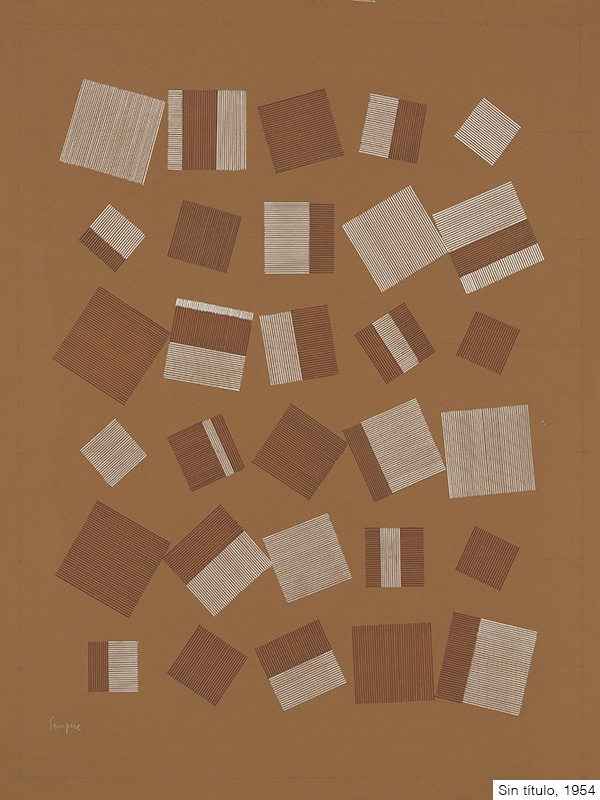
It turns out that the centenary of the death of Joaquín Sorolla has coincided with the centenary of the birth of Eusebio Sempere, and in the fight between these two commemorations it is well known who has the winnings. No one can with Sorolla. Like this, the events to celebrate the work of the Onil artist have been obscured enough and the media coverage has been practically non-existent. But the time has come, l’VAT and the Contemporary Art Museum of Alicante (MACA) have joined forces to claim the figure of one of the greatest representatives of optical and kinetic art on earth, the most universal Alicante artist (one of the first Spanish artists to exhibit in the MOMA) who found his style pulling the order, the calculation, geometry and light. Seim to Paris focuses on the period between 1948 i 1960, years that Sempere spent on scholarship in the French capital, l’epicentre, still, of western art, although his reign was beginning to run out. There he was dazzled by the work of the impressionists and post-impressionists that until then he had only seen in bad reproductions, Van Gogh, Gaugin, Cezanne, Matisse or Modigliani, but it will be the Barque generation, Delaunay, Arp, Mondrian i, above all, Paul Klee, the one that powerfully inspired the artist to investigate the formal features of abstraction. He needed little time to decide to leave aside the figure that had occupied the bulk of his academic training at the Royal Academy of Fine Arts of Sant Carles. After meeting Klee, I could no longer paint landscapes.
From this period are two of his most important series, those that make up the body of the IVAM sample: the so-called cardboard gouache guais from Paris and light reliefs. The gouaches, on black cardboard with geometric figures made with a compass, rule and tiralínies, they are overwhelmingly simple at first, but they gradually get more complicated when playing with the volume, depth and movement, and incorporate more complex figures (cubs, spheres, cylinders, cons, pyramids), sometimes inserted into others, and twisted and distorted biological forms. Square shapes give way to fragmented circles, what is release i ballen, always subject to a certain order forever. The primary colors (+Ver) are replaced by purple, the fuchsia, the granat or the taronja, treated with different intensities. At that time, Arp and Calder had already developed their kinetic art spurred on by an increasingly technological society. On the other hand, there are luminous reliefs, for which Sempere would be dubbed by critics as an "electric painter". They were simple wooden boxes with different overlapping planes with geometric and biomorphic shapes cut out with a hacksaw, colored acetate over the holes and bulbs strategically placed inside to generate the desired lighting effects. He came to complete about twenty luminous reliefs to become one of the pioneers in the use of electric light in art.
Sempere was a man who walked far ahead of the gray and stale Spain of the time and tenaciously tried to contribute to the country's modernity by publishing artistic chronicles from Paris in the newspaper Levante, interceding before the Spanish State for the acquisition of works by Vasarely and Arp, attempted to organize a great hindsight from Kandisnky… The answer was always NO. What he did achieve was the first exhibition of the artist Julio González in Spain 1960, year of his return home, disillusioned and carrying a sense of personal failure. L’any 1977, Franco died, before the first election, would donate his work to the Museo de La Asegurada, germ of the current MACA, with the intention of contributing to the democratization of art and the political construction of the country. They have passed 25 years since Sempere's last exhibition at the IVAM and the centenary of his birth is the excuse (always good) to enjoy in Valencia the seeds that Sempere kept for himself. S.M.