
UNTIL SUNDAY 9/6
Mubav. Saint Pius V, 9
16th century. Martin Luther puts the Catholic Church in check by lighting the fuse of the Protestant Reformation that would cause a great schism within the ecclesiastical institution.. The Catholic Church will respond with a Counter-Reformation to prevent the expansion of Protestant doctrines by taking, among other measures, the promotion of mediators of the faith such as saints and martyrs. So, It was necessary to create saints and images of devotion that emotionally connected with the faithful, who were mostly illiterate., incapable of reading a psalm but absolutely permeable to the images of suffering characters, like them, that take as a reference the greatest sufferer in history: Christ. The Catholic machinery was set in motion, In the 17th century, more canonizations were carried out than in the 16 previous centuries and art began to worry about retaining the features of those who, it was believed, They were going to be canonized to reinforce the identification of the faithful with the saint. started, in the words of the director of the Thyssen Museum in Malaga, Lourdes Moreno, “the first major marketing operation of the Catholic Church to survive the crisis unleashed by Luther”. About this great advertising campaign based on humanizing prominent men (some woman) This exhibition at the Museum of Fine Arts of Valencia is about the Catholic Church and takes its title from a collection of poems by Blas Otero.: fiercely human.
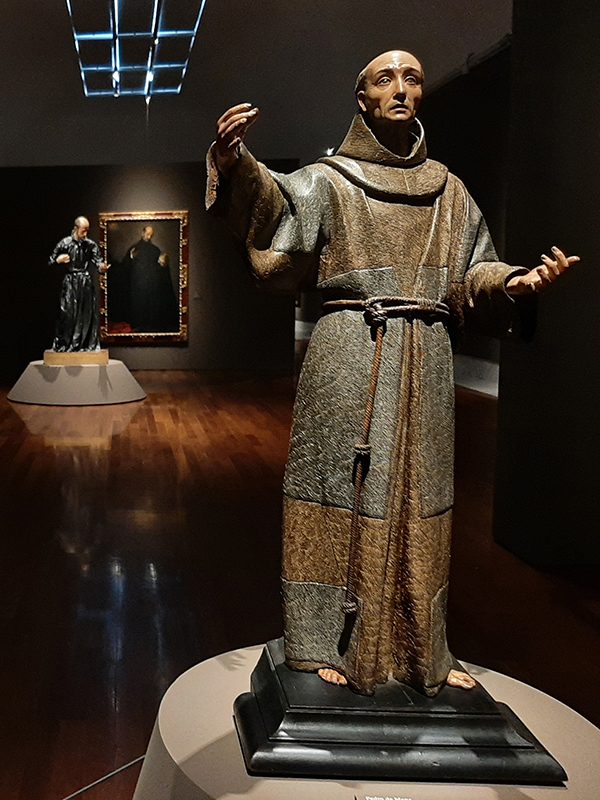
Sometimes, the martyr's features were invented but, based on copying and recopying, They became iconographic models. In the final part of the exhibition you have several Saints Jerome with their attributes (the book, the stone, the crucifix and the skull), by Francisco Herrera the Elder, Murillo and Ribera who look alike (nothing) suspiciously. Other times, artists portrayed people on their deathbeds because, it was thought, They were going to be canonized later and the image of her face had to be fixed for when she acceded to sainthood.. Others, even, A wax mold was made of the face of the budding saint for the use and enjoyment of painters and sculptors of the future.. This is what they did with San Francisco de Borja, died in the 16th century but portrayed in the 17th century by Alonso Cano and sculpted by Juan Martínez Montañés (polychrome by Antonio Pacheco) with absolute fidelity. In this sample they pose together and the resemblance is unquestionable. The objective was to make them humanly credible and truly suffering to awaken the identification and empathy of the Catholic., strengthen your emotional connection with the saint and, but still, with the Church, through realism. They will remain faithful to the Catholic faith if they believe what we tell them, thought the curia rubbing its hands.
In fiercely human you will find spirituality, devotion, realism, suffering, drama and theatricality, that is to say, pure baroque holiness. looks at the sky, pronounced chiaroscuros (bodies and faces illuminated through white), swollen veins, dirty nails, impossible foreshortenings, exaggerated expressions and postures, muscles in tension, skulls that remind us of the ephemerality of life, expressions of strength, pain and sacrifice in the heroes of the time, the tearful eyes of Santa María Egipcíaca painted by Ribera, Saint Agatha of Stanzione with her severed chest looking at the sky… This exhibition is born from the collaboration between the MuBAV and the Thyssen Museum of Malaga, where it has been exposed until recently. He comes to Valencia with him 80% of what was shown there, paintings and sculptures signed by the most powerful artists of the Spanish Golden Age: Ribera, Flip, Murillo, Velázquez, Stantion… To give greater value if possible to the collection, eight of the pieces have been loaned by El Prado, unusual thing, that the great Spanish museum lets so many masterpieces escape outside its walls at once. Next to them, three IVAM works that highlight the contemporary survival of the resources of drama and expressiveness typical of the Golden Age: the Saint Teresa from the Chronicle Team, the Crucifixion by Antonio Saura and the The mysticby Darío Villalba. The 17th century chapel music and the dramatic lighting of the paintings are not going to make you feel the emotional experience of a 17th century worshiper in a church lit with candles and scented with incense., but human pain will leave the canvas to get you a little closer to her. S.M.