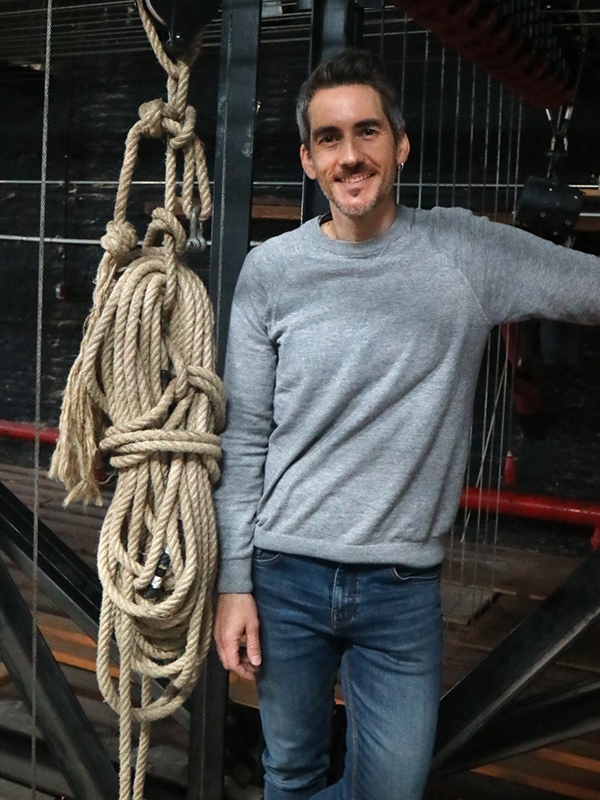
We are truly lucky to be able to claim the profession and good work of cultural professionals “in the shadows.”. Art restorers, piano tuners, translators, street artists… and theater machinists. We interview Paco González, head of machinery at the Valencian Institute of Culture (IVC). The machinists are the elves of the stages who silently and millimetrically work the stages in the bowels of our theaters., between tenuous nooks and impossible crevices of the backstage. Fundamental pieces in a magnificent gear, of a whole created by set designers and directors, musicians and illuminators. With actors and actresses who embody what originally emerged from a creative mind that wrote a text so that the public can fully enjoy the technical possibilities of dramaturgy. (and dance, music, audiovisual, circus…). So we asked Paco to focus on what is not seen, has to understand, to better understand the importance of your passionate work. SERGIO BELLO
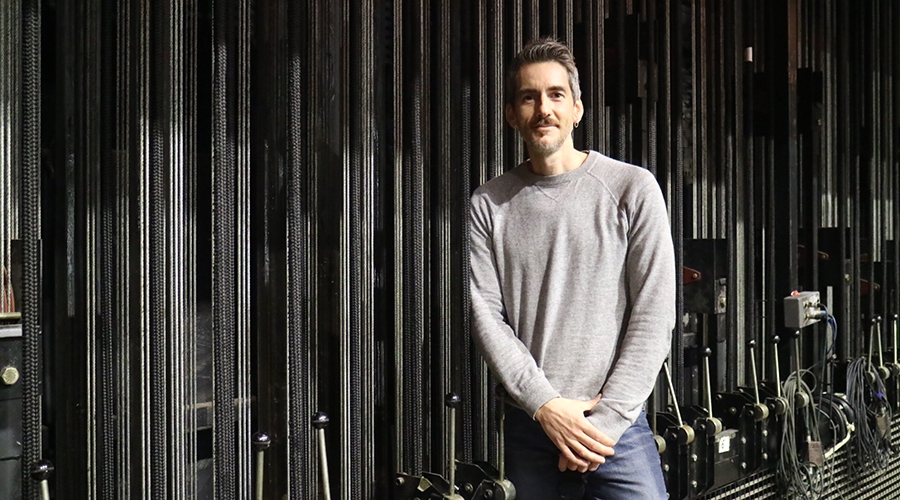
Paco, tell us: What does the profession of theater operator consist of??
The machinist is the person in charge of assembling and disassembling the sets of theatrical shows., both on tour, like in your usual theater, also covering “function service” during performances. This is, any set changes during the development between scenes, either “at sight”, either “in the dark” or with “curtains down”, that is to say, without the public seeing it. All these movements, They are controlled by the councilor, who following a script of movements based on function and the representation itself, It tells us with maximum precision when to execute them. In most cases, These machinery movements are accompanied by changes in the lighting or audiovisual of the show. This phenomenon is, in himself, like a clandestine choreography… brutal teamwork. In addition to all this, I believe that the machinist must also have “handyman” qualities., more artisanal skills to solve unforeseen problems (on urgent occasions) relating to elements related to blacksmithing, paint, carpentry, locksmith, etc.
Your experience in the first decade of the 2000 with Albena Teatre turned out to be a great school, crucial, for the future of your professional career in the technical aspect in touring shows. Tell us about her.
Yes... that's how it was, definitely. I started as an assistant, as an apprentice. During that period I learned the trade of a machinist on tour., What differentiates him from the machinist who works daily on the same stage of a theater or hall. On tour, in principle, It's always the same decoration, the same assembly in general, The challenge being having to adapt with quick and effective solutions to the characteristics or lack of technical resources of the theater in question. (structures, spaces, personal, different rod and pulley systems, schedules…). However, In your usual theater the challenge is that each new theater show is different and, therefore, It is an enigma that is deciphered in advance, with meetings, essays, etc. As an anecdote, I can tell you one at the Theater of Fine Arts in Madrid, when a fundamental piece of the set couldn't fit through the access door to the room!! A first moment of crisis and, immediately, team reaction to find a solution, because an entire production depends on solving it quickly, because at one hour the curtain has to be raised and everything in its place. We had to cut the radial and put the pieces back together on stage!! Definitely, improvise as much as possible so that the function is not jeopardized and arrive on time.
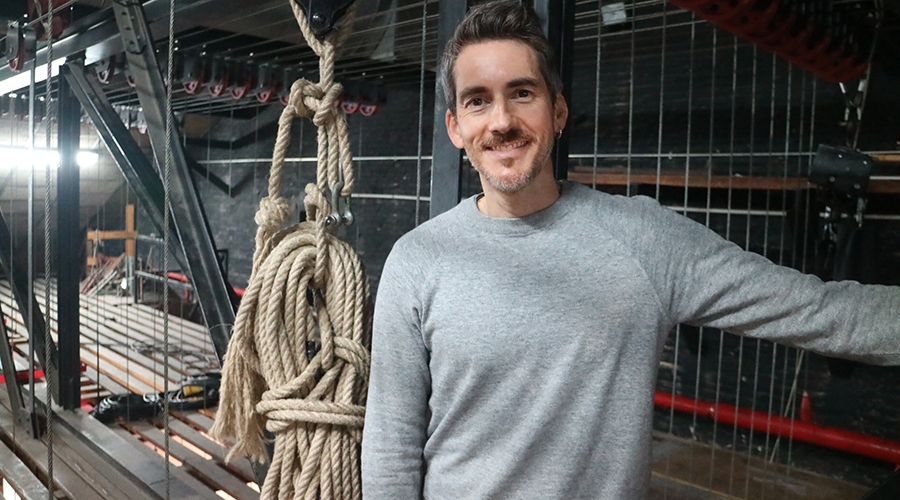
Unlike Madrid (Entertainment Technology Center) or Barcelona (Theater Institute), here in Valencia there is a gap in terms of specific training related to theater machinists. Lack of interest on the part of the administration? Given a suitable context in the future, Would you be seduced by the possibility of being a teacher in your field??
I really don't know why there isn't a school or degree for train drivers or stagehands in Valencia.. Maybe in Madrid or Barcelona they have more tradition or more halls and theaters than here... But in any case, Of course, the job needs to be guaranteed.. Of course, It is very good to learn little by little as an apprentice or from generation to generation, but it is necessary to regulate and provide economically, and in the long term, from the administration. This would help consolidate, not just the job, but also theatrical productions, as part of a whole that we are the different professionals involved in the performing arts. At the same time, Promoting theater in all its aspects in schools can be very enriching from a pedagogical point of view, given that, in my opinion, awaken creativity, Communication, expressiveness or teamwork, in addition to enhancing empathy and commitment. Y, very important, get to know the skeleton and nervous system of a theater, what is magical! The stage catwalks, the counterbalanced rods, the engines, the looms, They are extraordinary elements for those who only see the stage from the stalls.. I am sure that a well-guided visit to the bowels of a theater would be very interesting for anyone outside the profession.. It may be something you remember all your life.. And well, although I am not a teacher, If the circumstances arose, I would be very seduced by the challenge of transmitting my experience and knowledge to whoever had the vocation to learn this trade., just like myself and other colleagues learned from a machinist: Pablo Garcia, a true master... Because, besides, There are certainly very few machinists currently and everything we advance now in training will have its results., but it will take time. So, as soon as possible, better.
Among your machinery coordination functions is that of managing the work of personnel, timelines, shifts etc., but also another, that of contributing creativity in those previous meetings that you have with scenography, lighting and direction to carry out the final production of a work. It must be very attractive, ¿no?
Yeah, indeed. Sometimes, The set designer already comes with all the guidelines on how to set up the set., with a very precise technical implementation of what has to be done in the assembly. But in many others, The function of a chief engineer in these meetings with the artistic production team is to provide feasible solutions to the ideas that the set designers have conceived for each space scene., movement and location. As I said before, experience here is very important, but also the imagination and creativity to get the most out of all the material potential., techniques, spatial and structural, at a scenographic level, the scene or act requires. I love this because it is something creative., enriches our work as machinists and gives, even more, a caring and helpful aspect to those who have created the ideas, reinforcing the feeling of being part of a team. A good example was with Blanca Añón, set designer at Godot (2020). A very light cloth that occupied the entire mouth of the stage was required to suddenly fall on the stage and be absorbed behind it., through a hole at the bottom, before it hit the ground... Quite a challenge. Finally, We achieve the solution with electromagnets, strings, some sets of pulleys and dropping a very heavy bag behind the backdrop. All of this in complicit harmony with sound and lighting... It was spectacular (never better said!).