
At last, Scottish director Lynne Ramsay arrived at the Rialto Building to meet the press at an event prior to the opening ceremony of the 36th edition of Cinema Jove in which she will have the honor of receiving this year's Luna de Valencia Award. Ramsay's presence puts on notice those viewers who love a cinema that displays a complex, subtle and elegant formal architecture accompanied by a sensitive look at human dramas. A perhaps brief filmography by conventional industry standards, but of undeniable weight and attractiveness, especially in a cinematography, the british, that needs to break patterns and names beyond a certain surname that is well known to everyone.
Ramsay's career begins at the end of the years 90 con Ratcatcher, not at all complacent portrait of his native Glasgow, which takes us on a tour through the figure of a lower class young man. Just two years later it would premiere Morvern Callar, a road movie with similar premises, although with the help of a supermarket cashier who undertakes an initiatory journey after the death of her brother, played by the incredible Samantha Morton. It would not be until almost a decade later that Lynne Ramsay's films would make their true leap onto the international scene with We need to talk about Kevin, beautiful and unclassifiable intimate drama with a no less incredible Tilda Swinton in the role of a mother who does not know how to love her son or if he deserves her affection. Just two years later, surprised with another remarkable piece, Actually, you were never here, with Joaquin Phoenix in one of his best roles, that of a veteran of the Iraq war who is dedicated to taking revenge on those who abuse minors in a portrait of the internal and external miseries of the United States.

Ramsay's relationship with Spain and Valencia goes back to several of his films.. Just remember the beginning of We need to talk about Kevin, in which Tilda Swinton remembers her visit to the Tomatina in Buñol. Ramsay recalled that filming with humor: “One of the things I learned is that tomatoes are great for the skin.”. There was a bucket of tomatoes that ended up on top of my head., the camera broke and it was crazy. We were trying to separate people, but no one cared that we were there recording.” His memory of our country mixes work with personal experiences when he remembers what it was like to leave Scotland for the first time to shoot part of his first film. “There is something in Spanish culture that has many similarities with Scottish culture and it is that part of the family bond. and the food, of course, what is better in Spain. The food in Scotland is pretty horrible.”, comments between laughs.
When one thinks of Lynne Ramsay's cinema, the first word that comes to mind is darkness. A term that refers us both to its formal approaches and the choice of photography., as well as the topics it addresses. “I work with characters who are tormented: a mother who does not love her son as she should or other types of isolated characters, “But I always look for the human side in all stories.”, the director commented before the press. Some characters that, besides, They do not limit themselves to serving as references, models, of his small personal conflicts (the family, The loneliness, the helplessness), but they transcend the limits of drama to project themselves as mirrors of the social and political reality of the moment in a way, sometimes, subtle, other more obvious ones, such as the case of Actually, you were never here. “When I watch documentaries, when I see the news, It seems that we are reaching the end. When we were in the middle of a pandemic, con Trump, I went a little crazy and became a little obsessed with the elections in the United States. But the vision of politics begins from the family environment, with the tragedy in the family. And I guess that's something that comes out in my work.".
But if there is something that Ramsay's work stands out for, it is its meticulousness.. Exquisite care for the composition of the shot that is then poetically projected onto the narrative, images that seduce the observer's retina, pointing to that place in our unconscious where the symbolic, the mythological even, makes all its sense. “When we make movies it seems that there are directors who don't care about the props or the clothes that the characters are going to wear., and you don't have to leave things to chance. For me it is important to be methodical in my work and have knowledge of everything that happens in the film.. I'm worried about the color, the design; it's something important. Everything must be taken into account. I think you should pour your personality into your work.”
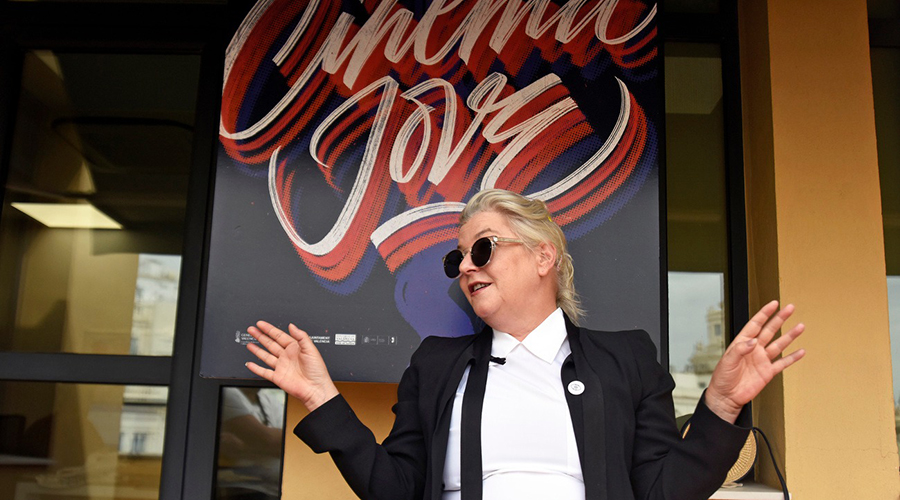
These codes have been maintained throughout his almost three decades of career in which, despite the obvious evolution, Ramsay has maintained guidelines that have remained practically unchanged. “For me they are all [my movies] they are like children. Maybe one is uglier than the other, but you love them the same. It is a difficult relationship because it may last four years., from the beginning of the initial idea until the film is made. This is one of those things I've talked about with other directors.. You have to love your job for a long time. There are times when you realize that, after so many years of work, you don't like what you're preparing. It is an evolution that resembles a human relationship. In that sense, I think my first movie was the best, but, on the other hand, I don't want to think about it, I want to think that actually the next one will be the best. “That the best is just around the corner.”
The now classic question about her disposition as a woman within the film industry could not be missed.. “Once they asked me in Cannes how I felt being a woman and I thought, bueno, It's not like I have a wooden leg either.", Ramsay comments with a laugh.. “There was an award at Cannes that I shared with the Greek director Yorgos Lanthimos and it made me a little angry when they asked me what I thought about sharing an award with him, a question that was not asked to him. This is a sector that can be quite sexist, but in the end I dedicate myself to doing my job as a director. It is true that, not only in Scotland, also in the UK, It is a sector very dominated by the white privileged class, But I consider that I may have the same talent as them.”
Among the different references to his cinema, there was a gap, of course, for actor Joaquin Phoenix, for whom the director has a special memory. “I think he is one of the best actors in the world.”. You never know what's going to happen when you work with him.. Suddenly he does something funny, then it gets very dark. He's a tough guy. Suddenly, I told you, “this doesn't work”, because I wanted to do it very, very, very good. I have never met anyone like him and I look forward to working with him again.. I know he's going to torture me again, but… (laughter) I want to do it again. It's funny because I was at the Marrakech festival where James Gray was part of the jury, and he said that Joaquin seems crazy, but everything he does he does for a reason. He makes you become a better director.”
Y, to finish, advice for future filmmakers: “I think that if you believe in your project, everyone else will believe in it.” Ramsay's Word. G.LEON