
The death of her aunt Rosa will be a special event for Joana, not only because of the emotional bond that unites her or the fact that it is the first time she has seen the corpse of a person.. Regarding Aunt Rosa, he has always had the idea that she was a very different woman from the rest of the women he had known.. In his mother's mouth, Rosa was an elegant woman, independent who had always challenged social conventions. An intriguing question, however, to the young Joana: why did she never have a boyfriend? But, how we will discover, In reality, this question is not aimed so much at revealing the past of his deceased aunt., like trying to understand your own situation, his own feelings. Surrounded by her mother Carolina and Norma, his grandmother, Joana tries to find answers in the behavior of others. Her mother seeks to rebuild her love life by seeking a relationship with a new man. His grandmother has relations with an old knife sharpener in the area. While, Joana will try to resolve her own doubts, while walking, Talk and explore the world with your best friend.
The first death of Joana, is the second full-length work by Brazilian director Cristiane Oliveira, who will already visit the Cinema Jove festival with Father's wife. Here, Oliveira repeats some of the themes that he explored in his first film, the awakening of sexuality, the rural world, spaces that, although this time they are not in a physical border space, Yes, they are located on a border of another order, maybe spiritual. We talked about these and many other things with the actress Lisa Becker, protagonist of this story and who plays Norma, Joana's grandmother.
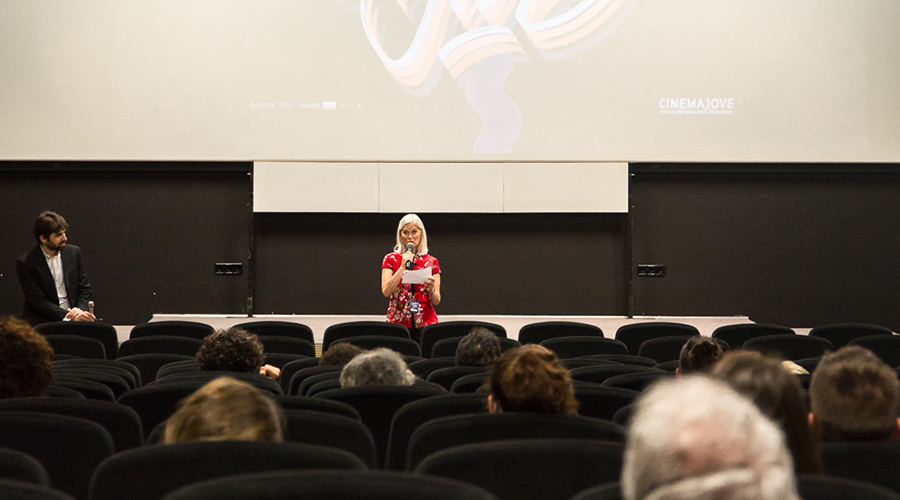
The first death of Joana revolves around a secret, something no one wants to say. That makes the film play a kind of silence that surrounds the characters.. as an actress, What challenge has it been for you to try to represent something that is never expressed??
I put myself in the position of this woman for whom appearances are the most important thing., protect the girl and the the state in which. It's more how the scenes are written. I tried to clean a lot, not show much emotion. It must be taken into account that we are referring to a family of German origin, Lutheran, with what that entails in terms of the expression of feelings. I believe that the notion of secrecy is stronger overall., not so much for me as an actress. More important for that character is the relationship, the concern he has for the girl, because the mother is very hard on her daughter, with my granddaughter. In this case, it was about trying to show more tenderness, something that may be more normal in grandparents, who have that distance that comes with age and show more calm than parents in relation to their grandchildren.
It seems that grandmother, the role you play, understands the girl better than the mother herself. You have told me that it is a fact that has to do with age., but it seems that there is also something that has to do with a generational distance, with culture.
I believe that experience makes people less tough.. Life is not like that. That woman has already been through everything, She had a husband who was very repressive., etc. I think so, age and experience help, but it is also true that this grandmother's relationship with her own daughter, the girl's mother, she is harder than with her granddaughter. She also criticizes her daughter when she wants to have a boyfriend, that is black. He doesn't like that. And the daughter criticizes the mother. That mother-daughter relationship is very hard many times..
One of the key scenes in the film is when the granddaughter discovers that her grandmother is having sexual relations with a man her age.. Do you think that sexual relations in the elderly are still taboo or something that makes us uncomfortable??
I don't think it's taboo. Brazil is very strange because sexuality is like that there, in front of you, all the time. Maybe too much, but it always refers to young women, very pretty and with the perfect body. And one feels that, after forty or forty-something, no longer worth it as a woman, as if sexuality did not exist. But it's not a matter of moralism., believe, It is one more thing of prejudices regarding the elderly. I loved that, in this movie, the only sex scene there will star a woman who is older. I really liked that about the script.. The film deals with many prejudices and, subtly, that's one of them.
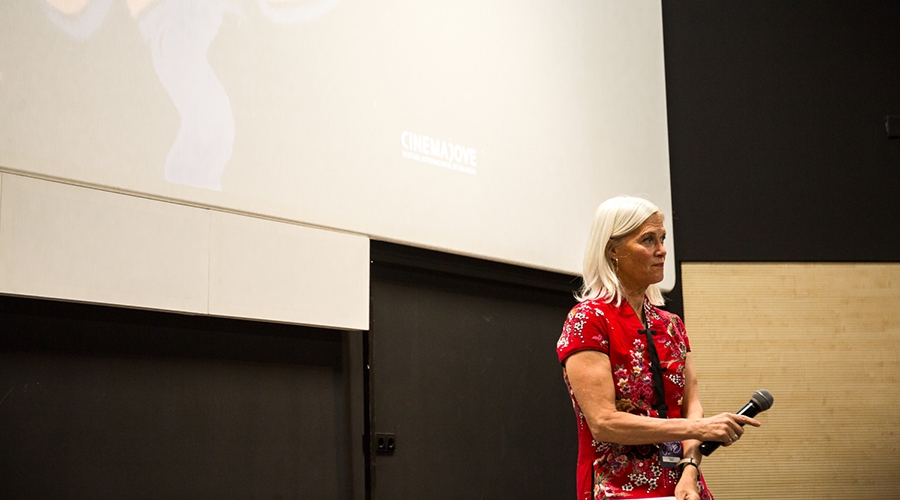
The film shows a world of women in which men remain on the sidelines or appear very little., or are we only talking about them. In some plans, even, their heads are cut off. (laughter)
Yeah, Yeah (laughter)
Do you think that in Brazilian society both worlds are so far apart??
No, I don't think about it. Today, no. It's very mixed. Brazilian women are very strong. This movie is about a smaller community, very repressed, that there is this thing about the Germans who arrived in Brazil one hundred and fifty years ago and stayed in small communities. But there is a lot of machismo, especially now with… the psychopath [Bolsonaro] because it normalized a super-sexist and homophobic discourse. Now people are not ashamed to say some things. But I don't see Brazil as a very repressed society... there is discrimination, Of course, at work, but, as i say, Brazilian woman is quite strong, although then there is also the other side in which there is a super-cult of plastic surgery, to the body, etc. It's almost illegal to have wrinkles, stay old. For example, when someone shouts something at you in the street, you tell him: “old son of a bitch”. The word old or old is a way of degrading the other. Oh well, that's another topic.
You were telling me about the situation in Brazil. If Brazil is so open in many aspects, Why do you think this political situation has occurred?? Is there a way out? I ask this because I understand that the film places the action in the 2007, but, somehow, the argument is projected on the present of the country.
Yeah, It's very interesting because when Cristiane had the idea and started writing the first versions of the script, it was him 2006, 2007 that it was a moment in which Brazil was advancing in the entire humanist and progressive part of homosexual rights, of the woman, There were government policies that encouraged, For example, films or all types of works of art that deal with gender issues, feminism and racism, There was also the issue of racial quotas for the university. It was a moment when we thought “we are already where we want.”. So, while she was writing she thought, bueno, this may not be so current anymore. And suddenly… pufff. I do not know, It is very hard because it is like that part of Brazil that we had forgotten rose and now has a lot of power and pride in being reactionary, homophobic, sexist, racist, etc. It's an interesting thing because there was a stimulus program for films that dealt with diversity issues, films that were directed by women and now we no longer know. She doesn't know what will happen when the ministry gives her the age rating., For example. Bolsonaro ended the Ministry of Culture, there is no Ministry of Culture in Brazil. Now there is 400 projects that were approved that are paralyzed because they do not want the state to be involved in works that encourage homosexuality. But, bueno, now there is a reaction, but it is very difficult to know what is going to happen.
It caught my attention, maybe because it is a very particular community, that coexistence that the film shows between the three generations in the same space. This is something that seems to be getting more and more difficult., maybe it's because of the way we live in Europe. Is it different in Brazil?
Not so much in big cities. But here we are in a rural community. But [think] In fact, I lie because if I think, For example, in the favelas, a high percentage of family heads are women. So, many times several generations coexist, where the grandmother takes care of the grandchildren and the mother goes to work, etc. In Brazil there are so many class differences, economic… in the case of the middle class, For example, they don't usually all live together, but the poorest people need grandparents, usually to grandmother, to women.
Although it is not always expressed expressly, There is a fantastic element in the film, almost mythological, that appears in the background. What presence do these elements have in the culture of your country??
Of course, for us, even if you are not religious, the presence of religion with African roots is very strong. Many people who have no religion or who are not Catholic, knows who his saint is. That world is very present. Where the film was filmed there are communities called quilombos, who are descendants of slaves who were formed during the 16th century. They are small communities of blacks who freed themselves or escaped from their employers.. In that place where the movie was filmed, this presence is very strong; both, that there are some traditional festivals that are part of the official calendar of the city. For example, he 2 February is Yemanyá day, what is the goddess of the sea. She is a very important goddess in syncretism, which is very strong in Brazil. She is like the goddess of sailors. These images of saints appear in the film, etc… It is a part of the imagination that, even if one does not realize, it's there.
Another element of the film is the dream of Europe, like an ideal. You who are in Europe right now [Lisa Becker lives in resides Denmark], what do you think about it? The film presents it as a form of confrontation, a mirror in which the characters' problems are projected, even more than the United States.
Bueno, Brazil is very much like the United States, but in those communities of German origin they still speak their own language, For example, which is a dialect of German from the 18th century. These people have a very strong connection with a Germany that does not exist, but cultivate the Lutheran, their customs, that cake that my character makes and that is made a lot in Germany. Cristiane uses that connection with Germany as an example of the contrast.
What was your relationship with the character of Norma?? Would you say there is something of the character in you? What part of yourself did you put into his personality??
There is one thing I like about her and that is that, although all the women in the movie are very tough, she likes to dance, likes to do things, if i thought about it, maybe I would say, “I shouldn't do it because I'm a widow.”, etc. She has a strength and a joy that I like. But what I do is consider what the situations that the film proposes are like and get into them.. I think about what my relationship with my daughter is like., with granddaughter, with this man, What fears does this woman have?. It's more like this, without thinking much about what it involves me. Bueno, Yeah. She is an older woman, but it's another world, another thing.
To finish and returning a little to the fact of that script that began to be written in the 2007, but whose theme is projected towards the present. Would you say the film is an invitation to change or a lament for what is happening?
I see it as an invitation to change. An invitation to have courage to accept what you are. That's what happens with the girl. The film starts from the death of the aunt, but it is also the death of the girl. She learns a lot about herself. It is a time to get to know each other and accept what you feel for the other girl., her friend. I asked Cristiane if she was targeting a young audience., but, although she did not think of a specific audience, Yes, you would be very interested in showing the film to young people and talking to them.. It is important that children have information so that, when certain things happen, know what to do, know how to protect themselves and accept what they feel. This is important in Brazil today. When she thought about the movie, many advances occurred in our society, like gay marriage, something these fascists are now trying to kill. But people aren't going back into the closet.. You can't silence people.