
Two steps away from celebrating thirty years as a theater company, Teatro de lo Inestable opens in June 4.200 km already surpassed the barrier of forty self-produced shows. In 2024, off the coast of the Brazilian state of Pará, Fishermen found a boat with the bodies of nine African migrants. They had set sail 25 people from Mauritania ninety days ago, heading to the Canary Islands, but his canoe deviated from the route and ended up drifting across the Atlantic Ocean, condemning them to certain death. About this true story, Jacobo Pallarés and four other authors have put together a piece with elements of magical realism that continues to delve into the migratory drama, with a lot of text, live video and scale miniatures that take us to impossible places. S.M.
Isn't this the first time that you have based yourself on real news to put on a show related to migratory flows?? Because?
Because it impacts. The show is composed, first, for a very long dramatic text where a very specific character appears: the boring man, what is my alter ego. What, From that place of a progressive and bourgeois Westerner, he sees the news of migration and it hits his conscience., more than action. Like the news of a woman and her daughter who were found dead in the desert, that gave rise to the work The odyssey of those lives. The two of them appeared in that desert alone and a story could be created around this to give visibility to the forced and terrifying immigration of people who cross deserts.. It is a striking image, strange, It has its terrifying strangeness.
Do you feel guilty about being a white Western man??
It's like this. I come from a school of the Pious Schools, I have all that bad conscience inherited from Judeo-Christian thought, which is our way of dealing with everything that happens outside. We often correct that bad conscience in idiotic ways., giving alms or giving whatever, but never taking action. That bad conscience, big and heavy, acts like a stone that makes me react my way. As? Well, denouncing in my own way what is happening with a text, a staging or a show with a political position that stimulates critical thinking.
Do you conceive, hoy, make theater that is not social?
not right now. I may have done it. Theater in Inestable has always had a political component. All the shows from all the creators that we are at Inestable —my colleagues Rafa Palomares, Maribel [Bayona], myself—we have always had a political component. We have always understood that we are creative political beings and that we are here to try to be as critical as possible, and report, make visible and change minds.
It seems that we are anesthetized before the horror of the images that reach us. The photo of 2015 of the boy Aylan Kurdi drowned on a Greek beach went around the world, but today shocking images of the genocide in Gaza arrive daily and we continue eating as if nothing had happened. How do we mobilize consciences??
Here is a character, Ismael, the boy in the red shirt, who is the Syrian boy who was left on the shore of Greece. We mix different migrations, The migration of Haitians to the south of Chile also appears. We mix them because, in the end, migration, the forced movement of people, It's exactly as terrifying anywhere. Indeed, we have an armor as Europeans, We need it to move forward in the face of so many atrocities that are happening., and I understand it from the Judeo-Christian guilt that we have. Europe has depleted the resources of all these places and has not created opportunities, has been invasive, colonialist and imperialist. From that guilt we see everything terrifying there is and create a shell that makes us seem immune.. But I think that this shell must be broken on a creative and cultural level by staging texts that talk about the tragedy of migration.. What do you fix? You don't fix anything, but at least you can touch people's conscience.
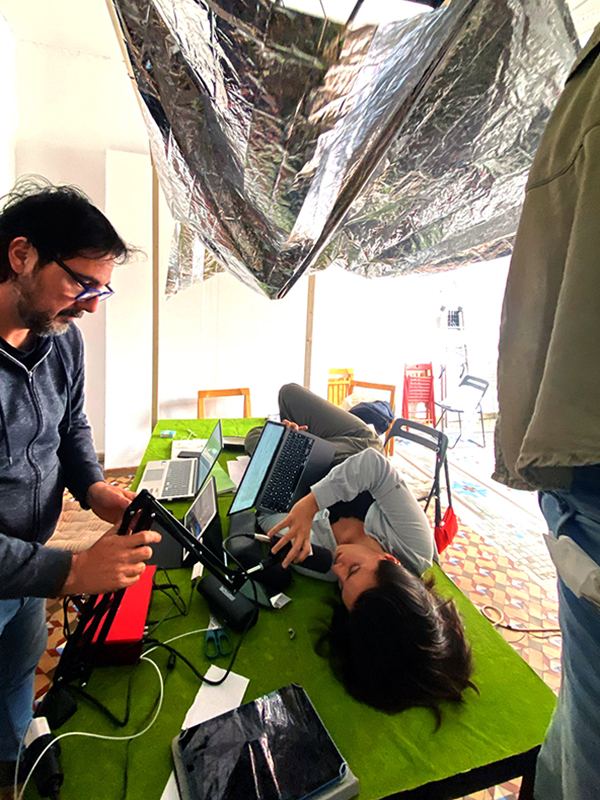 You turn once again to miniature models and live video on 4.200 km. What does this resource give you?? Will it help you capture the immensity of the sea, For example?
Yeah. There is an offscreen in theater that, due to budget limitation or limitation of the four walls, you can't take on stage. Us, with the models, we can present a whole ocean, a whole sea and a whole world on a small scale. All that off-screen stuff that we couldn't show before, we can show it live. If we want to show 250 characters and we don't have 250 actors, we can present 250 thumbnails. It is a work that mixes miniature with audiovisual. Now we don't work with thumbnails, with dolls, but yes with small origami scales. We make boats out of paper (the canoe) at different scales, very small and bigger. Therefore, We continue working on the scale and a very small set based on ropes and pulleys that will raise the different scaled elements.. In small, but enlarged and magnified with a video camera.
It was Alex Serrano, from the Señor Serrano Group, who introduced you to this language that mixes scales, mockups and live video. He incorporated Artificial Intelligence in his latest work, an island, and generated some controversy. What do you think of the use of AI in theater??
We don't get there.
But are you considering it??
He works much more on the image and we work much more on the text., incorporating, evidently, the image. Our unmoved engine is always the text, a very clear story written and worked with different authors, who then arrives on the scene, where we introduce audiovisual language. In this case, The dramatic text of the first level is a novel by 215 pages, written by two Chilean authors, a Uruguayan, a Valencian and myself, five people. It is very complicated for us, having that text, we can experiment with Artificial Intelligence.
The whales that we have as a cultural reference in the West could be Moby Dick or the whale that swallowed Jonah, but in 4.200 km some whales from Mapuche mythology appear as a poetic resource. I imagine it is a contribution from Latin American authors.. Tell me how they have enriched the work.
The truth is that, as soon as you start working with other types of authors, you don't control their references. If she is a Valencian author, You control the referents more or less because they are usually close to yours. But here we work with an author who is from Punta Arenas, in the south of Chile, almost in Tierra del Fuego. Another lives right across from Mocha Island, the island that gives rise to Moby Dick. On a first level, We worked with them understanding that writing could go on the canoe, but little by little it began to move towards the immigration of its own territory. There is also conflict between the migration that arrives from Haiti and Venezuela. Nothing different than what happens here, but there all its tradition appears: that of the shamans, the whales, the eskimos… Here we do not have a whaling tradition and there we do. They took us towards legends of whales, that talk about whales taking the spirits of the dead to Mocha Island, where the children disembarked. Just like our songs are in Valencian, because we have that linguistic context, His identity context is Mapuche, that of the indigenous people there and that appears in their dramaturgy clearly.. And it's like: Wow!, how good the mix of authors, because some references appear that you did not have and some traditions that you did not control.