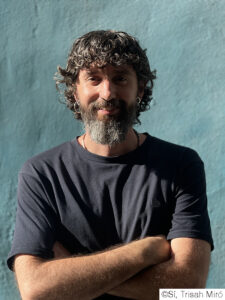
Art that boasts purity and equidistance is placed in a very specific political place, that of the liberal right. This is what Elías Taño believes, mural artist, t-shirts, comics and any other medium that serves to spread a message committed to those below and combative against those above. Just signed the graphic image of the illustrated book fair Baba Kamo, Their posters hang in the MuVIM restaurant as part of the cycle The Illustrated Season and has recently published the graphic novel Garafía which we asked him about in this interview. A story about the migration of canaries to Venezuela during the years 40-50 of the 20th century starring humble people who are very close to him, his grandfather Cencio and his grandmother Gloria.
Garafía ignores the history based on institutional politics and the great deeds carried out by powerful men to focus on the tiny stories of rural people. How important are these to understand History in capital letters??
The subaltern voices that populate history, the one that is written in lower case, They are often the ones that give us a closer view of the realities that people who do not have the means go through., neither money nor power. For me it has been essential to listen to these voices to narrate a journey and a resistance that understand nothing of epic, nor of glories, nor epics.
The graphic novel stars your grandfather Cencio, who migrates to Venezuela and is exploited for work, without rights or medical coverage. And your grandmother Gloria, who is left in charge of raising two girls and the land. Again, you give voice to a part that is usually overshadowed in the official story, that of women. Would it have made sense Garafía without them?
This comic was going to be the story of the migration to the Caribbean of many men expelled by misery and repression., and this was the story most present in the family. Until the moment I start talking to my mother, and I listen to the stories of the women of La Palma, who, as almost always, they hold other truths, another story: grandmothers, aunts, neighbors… A whole network of women who supported the harshness of life on that volcanic island, and whose temper, Popular wisdom and sense of community made a future possible not only for those who remained, but also for those who left, and that in many cases they would end up returning. Garafía could not have been written or drawn without them, it wouldn't have made sense. It would be betraying the memory of our islands.
About this sense of community that you mention, The mutual support that exists between the women who stay on the island is essential for the survival of the families.. This worker solidarity, It's something we've lost?
Since they sold us the idea of the “end of history” too cheaply until today, The system has tried in many ways to dismantle the strength and cohesion that the world of work gives to working women.. However, every so much, how we have recently lived in Cádiz, in the metal strike, or the Guggenheim workers in Bilbao, We discovered that this mutual support is latent in the salaried class, and we are increasingly aware that the sweetened “middle class” hides a bitter reality for most of the world's working women.. I do not believe that worker solidarity is lost., You just have to scratch the patina of fragile Western well-being to discover ourselves as an oppressed class., It is not easy at times and it is difficult to see it with the naked eye.. Nevertheless, in this dialectic of contradictions, its strength will become increasingly evident, and that is why capital appears more aggressive and criminal at times..
Cencio was locked up in prison after crossing the Atlantic for weeks crammed into a barge. Today to the nobodies We lock them up in CIEs like criminals. Have we made minimal progress in the defense of human rights?
This is one of the starting points of the comic, reflect that history of our recent past (that here is a migration to Venezuela, but in so many other cases he went to Switzerland, Germany, etc.), to place it in our present as a “rich” society that fortifies obscene defenses against the world proletarian class that yearns to build a better future. And in the same way that our grandmothers and grandfathers did, fleeing from misery, the war, oppression and death. Fortress Europe, of the concertinas, of the CIEs, of the raids and the racist and xenophobic judiciary that roams freely in all territories is a residue of the supremacist policies that occurred in the 1930s, crystallized in fascism, Nazism and National Catholicism, and that today we inherit to the misfortune of the people we need, even more, we demand: a just world, internationalist, supportive and peaceful.
The media of the Spanish state have hidden regional accents in search of a language neutraland a shared vocabulary. You make a deliberate effort in the opposite direction, just like Andrea Abreu in her novel donkey belly, where he gives us a master class on the Canarian parla of the most humble classes. Do you think the trend is changing?? Are we beginning to give value to the richness provided by the different ways of speaking that coexist in Spain??
Any exercise in the centralization of language is an attack on peripheral cultures.. Some decolonial authors from Africa in the seventies said that the quickest way, clean and cheap way to subdue a society is through culture. He speaks, as an inherent part of the vernacular transmission of values, It is at the same time an instrument that threatens the creation of a Clean imaginary, Fixed and giving Splendor. Which is nothing more than synonymous with the surgical removal of the possibility of building divergent societies., own and with the capacity to preserve, protect and spread your story. Its peripheral history, not alienated from the centers of power. The opportunity to get closer on a literary level to the voices that have built our reality and our history, It is a challenge that challenges the homogenization of the modern nation-state. Andrea's work delves into this question, and one, like a canary, is able to establish its roots, because at the end of the day, how we speak is how we think, and that worldview that unites people in their own language, may not even God come, nor the state, and separate her.
In Garafía you transfer the style of your work in posters and murals to the comic pages. To what extent are these two artistic disciplines compatible??
Any format in which you draw ends up being your drawing, with your personal voice. Not with your style (in a formal sense, aesthetic), but with your voice: what you say, from what place to speak, to whom... And in this way, Expressing that voice on a wall is not so different from doing it on a poster or in a comic.. Change the medium, the tools, the format… but I find that at a discursive level, in my case, the medium is not the message, but rather the message swaps from one medium to another based on continuing to build a shared imaginary that questions power relations in the capitalist medium..
You have painted murals in defense of the Palestinian people, of the Zapatista struggle or against the destruction of La Punta, You have designed t-shirts for the Burjassot Anti-Feixist Platform, together with Carla Chillida, you founded the company A Tiro Hecho, in charge of organizing the Week of Political Theater and responsible for works that strongly attract capitalism. Is your art political or not??
Yeah. I consider it that way. Not without clarifying that all art is political, and that the depoliticization of art, that equidistance with which he observes the world from his market altar, of galleries and academia, It is perhaps the most political place you can place yourself on.: the liberal right. It's a world that doesn't even interest you, you don't even see it necessary to change, and of course the one you don't look at, you only observe it from an onanistic place and of deep individuality. Beyond that, I settle for being an art worker, as Víctor Jara said, a worker, and let the people decide if I am an artist or not.
You use few colors and planes, and you alternate them depending on the geographical spaces and the emotional states of the protagonists. Was it something you had decided beforehand?? Does it have to do, precisely, with your mural and silkscreen origins?
Inevitably, Having been working with these tools for several years means that my way of approaching drawing is marked by this sparseness in colors., in the way it is applied and that it responds precisely to narrative questions. I usually don't narrate with color, I am very clumsy in its use and I still don't quite understand the color wheel, but in the comic Garafía yes I wanted to use this difference to create two spaces: the ocean blue, clean, infinite, of the islands. And the ocher of the wet earth, the heat, the Caribbean mud. On the other hand, the color red represents anger, the pain, revenge, that violent impulse of history.
Your first solo fanzine was God, Patria, Fueros and Altsasu, on the case of the young Navarrese accused of terrorism for a bar fight. To what extent does this topic touch you so that you decided to go outside your usual means of expression and undertake the creation of a comic?
He had followed the case of the Altsasu youth from its beginning, and when years later the sentence came out, The pain and anger that went through me prevented me from sleeping that night., and I felt the need to take my brushes and go down to the street to paint, denouncing latent fascism, the injustice that was being committed. They erased that mural. And then many more came, that as they were painted, others came to erase it. And this brought me closer to the mothers and fathers of those young people., and we patiently wove a web of affection, of struggle and hope to continue raising awareness among citizens about this terrible injustice. This led me to paint in Altsasu and other places in the Basque Country.. Bringing that story to comics was a natural exercise of trying to fix that fight, and tell it from the place of power, from the Civil Guard. From the vision of the oppressors we are able to see the schemes that articulate their thinking.: hatred, pollutes, fear, cowardice... Therefore, In this comic it is told from irony and satire.
In his last book, Journalist Pedro Vallín affirms that ETA helped use pain as a vehicle of power. Hence, its disappearance harmed certain political parties that had no choice but to expand the limits of what ETA or terrorism is.. In order to keep alive the ETA legitimizing element that the political and judicial right is prey to. Do you agree?
Absolutely agree. As the Corn Chikos said: “Television is an advertising space for ETA”, and feeding that public enemy is what has kept the right strong in the state. That is why they are so reluctant to accept the end of the armed struggle., and continue to criminalize solidarity with the struggles of Euskal Herria. They often lack time to accuse everything of ETA, because their sights are so short that they are unable to see that, beyond armed conflicts, there are popular discontents, neighborhood organizations, unions, students, peasants and workers who fight without violence for a more livable world, More empathetic. And they do face the violence of the system, to the sign, to poverty wages, to ostracism, to censorship… I, Because of all these types of things, I am very clear about where I stand.. And I position myself with class consciousness and anti-fascist memory.