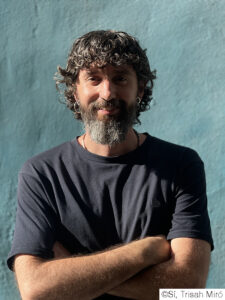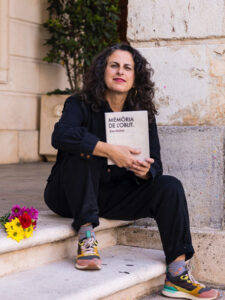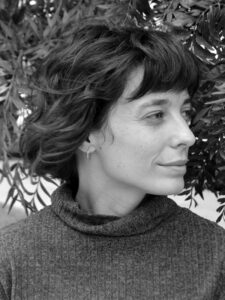


Aina S grants us an interview. Erice, who just posted The book of forgotten plants (Ariel). Erice studied Biology at the University of the Balearic Islands where he also completed a master's degree in Plant Biology in Mediterranean Conditions. She is the author of the blog Imagining Vegetables where you share and publish information on different topics, always related to ethnobotany. After the publication of his first book, The Invention of the plant kingdom, The book of forgotten plants comes as a result of rigorous research, guided by the advice of his friend and mentor, José Antonio Marina, author of the prologue. GINÉS J. VERA
Although the title of his book is The book of forgotten plants The truth is that some plants - and a few trees- that are included are not as unknown as other species that accompany them. I mean, For example, to the cypress, the fig tree, the poppy, oats along with thyme, the strawberry tree or the chamomile... Taking into account that in the section 'Before closing the book' he tells us that there are some species that "were going to be left out and deserve to be on the list" of those admitted, I wanted to ask you about those and the criteria you followed when making that final selection..
Very sure! The choice was not easy, and although I would like to say that I have developed a scientific method, objective and universal to measure the degree of oblivion to which a plant is subjected, the truth is that it is not like that. A plant may be forgotten in a town, an autonomous community, a country… and be very present a few hundred kilometers away. That is why this catalog is a proposal that comes from my personal experience working with the younger generations.; y, if it includes plants that in some will raise the question "But how come forgotten?"?”, It is because I have seen the emptiness of his absence in the eyes of many children..
On the other hand, how the book is structured as “walks” through five different environments (orchards, campos, aguas, forests, mountains), I wanted to maintain a certain balance between them, and that also played an important role during the selection.
I think it is fantastic that someone discovers those forgotten species that coexist in one way or another with us., already in orchards, grounds, wastelands… ya en terrenos boscosos próximos. Given that interesting section in which he talks about past and present uses of some species, I don't know if you have thought about, llamémosle, misuse of the book; in which some unscrupulous people take advantage to annoying species until now in peace, depleting them without ecological awareness if necessary.
The truth is that I hope and strongly trust that there are no ecologically conscious escapers among my readers!! I trust that, at most, there are people who have sinned from naivety or ignorance in their dealings with the natural world, imagining it as an infinitely generous pantry. This idea has taken root in the subconscious of many of us., perhaps in part due to the fast pace of our modern lives: a lot of information comes to us decontextualized, detached from its “instructions for use” or interpretation… and thus we can end up emptying (even unintentionally!) that “wild larder” that seemed so infinite to us. What to do to avoid it? In my opinion, the first enemy is ignorance: It all starts with being aware of the impact that harvesting has on the plant – and its environment., because it is not the same to collect fruits or roots, nor is it the same to collect one fruit out of every two, or nine out of ten. Each plant is a world that needs to be known., and I hope that the book awakens that curiosity, that desire to know more about this or that plant (and how we should relate to it without causing harm), in who dives between its pages.
From the quince sweet spoon to the mallow facial cream passed by Carmen's sayuguinas fritters or the soap dish shampoo, I would like you to tell us about these preparations and stews, if you have tried them personally and something about where they come from, Well, surely there will be more than one reader who may be encouraged to make their own versions encouraged by this book..
Although I enjoy “pocimeando”, I consider myself an absolute amateur with serious difficulties in following recipes to the letter., and it probably would not have occurred to me to include practical proposals in this book if it had not been for my previous literary project, Tell me, Sesame: 9 stories about the magical and real powers of plants. When we were preparing this children's illustrated album about the plants that live in our fairy tales, My editor suggested I add practical activities that could be done as a family.. I liked the idea so much, and it was so well received, that when I started working at The book of forgotten plants, It seemed to me worthy of being rescued and included in it. However, since I do not consider myself an expert in these matters, But I'm lucky to know people who are., I asked for your collaboration to enrich the book – and give me the opportunity to try some truly delicious recipes!! I have experimented with as many as I could., although I had to give up some (due to lack of time during the writing of the book, or for not having been able to get hold of any of the ingredients). The loquat cake has passed through my stove, the quince spoon candy, wild sayuguinas fritters and, thanks to a natural staining workshop, Last spring I also stained my fingers dyeing wool with chaff.
And coincidentally today I got collejas in the market, so I foresee some collejas noodles in my near future…
It explains to us at the end of the book, almost as a synthesis, that more than 80% of the plants included have edible uses and, in an even higher percentage, medicinal, everything and that many of them have other uses that summarize and range from aromatic to constructive., ornamental or dyeing. Given their interest in ethnobotany, some readers - perhaps drawing on their memory - may- provide some more use, maybe more local, perhaps as a result of the postwar, or traditions that will be lost from oral memory if they are not collected, for example, in the form of books like yours.. Is it possible? ¿Anima a sus lectores a que le comenten esos usos para una futura publicación?
Please, Yeah! The way I see it, each one of us – each person, every family, every town or city, each region…– could write a catalog with “its” forgotten plants, protagonists of traditions or customs that are in the process of disappearing. And my greatest wish is that, after reading the book, the desire to search the memory is kindled (personal, familiar, collective) to the “forgotten plants” of each place. I will be delighted and happy to receive all the vegetative information in the world, and if a new edition or a new project arises from there, welcome! But I would go a little further., and I would encourage anyone with time and desire, to make your own catalog of forgotten plants. We live in a time of connections, when information is freer and faster than ever (with its good things, y malas…). Why not put it at the service of a cause as worthy and important as this one?? The tapestry of memory is a collective performance that we weave in community, and maybe I've added a few strands, but together we can advance much more. I think we don't need anyone's permission to recover our forgotten plants, and even invent new ways – creative, ethics, sustainable – to value them, and give them back that lost relevance.
I consider your book to be an eminently informative and very practical work.. Not only because of the inclusion of recipes or soap preparations, dyes, etc., or those glossaries (brief and painless, gives us a friendly wink). Also due to the fact that, aware of the content it provides and the doubts that may arise to any reader, it encourages us to download files or consult its web address in order to try to dispel them.. Tell us about this addition 2.0 to the book, and for those who are interested in more curious aspects of plants, from that previous book, of The invention of the plant kingdom.
Nowadays we have many ways to access information., each with its pros and cons; and although I am in love with books, It is undeniable that the Internet offers a multitude of advantages to disseminate a world as exuberant and vast as the plant kingdom – and even more so for someone like me!, who always has more things to share than space to do so! From there, Imaginando Vegetales was born., a very personal ethnobotanical blog that initially covered stories that had no place in my first book, The Invention of the plant kingdom, and that over the years it has become my window to share articles on topics that I find interesting, from the religious history of pomegranates to the use of incense “clocks” in the East. All of this revolves around the question that led me into the world of ethnobotanical dissemination.: What can the way we have interacted with the plant world tell us about ourselves??”
In the case of The book of forgotten plants, The internet has once again offered me ways to share the extra material I have accumulated (and the ideas that fell by the wayside!). Y, how I like to experiment with new formats, a few months ago a podcast was born, The path of the lost plants, where I share out loud some of the anecdotes and stories that were left out of the book, but that seemed worth telling to me.
On the other hand, What to do with the recipes that were not included in the final version of the text, with glossaries-bookmarks, with indexes of scientific names, with the profiles of some plants that I had half prepared? My solution has been to convert them into extra digital content, which can be conveniently downloaded from the address indicated on the last pages of the book. Taking into account that plants do not usually respect our limits too much, I love finding ways so that their stories can also go beyond the limits of written paper., and also colonize the digital network (whose organization and resilience are, besides, wonderfully vegetables!).