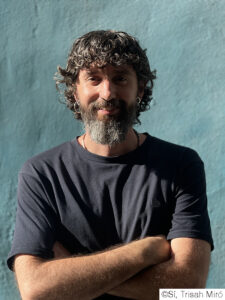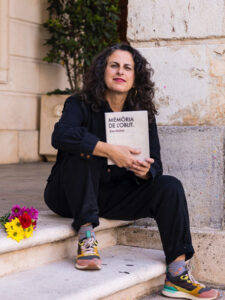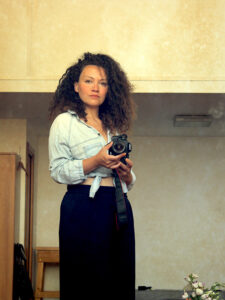


After passing through the Higher School of Cinema and Audiovisuals of Catalonia, The professional career of debutante Belen Funes develops in different producers in script tasks, Management Assistant or in the casting departments. Of this background behind the cameras, Her relationship with the director Isabel Coixet arises who would become a mentor and producer of her first shorts. Thus titles such as SARA, His first experience in the direction, y The useless, also produced by Coixet. After this tour, Funes launches to lift his first long job, The thief's daughter, that opens this Friday on commercial screens. The argument of his opera cousin takes up elements of his first short to explore new dramatic land. And SARA investigated in the life of a teenager who lives in an abandoned reception center by his father, in The thief's daughter, Sara is now a woman who tries to survive in a world that offers him few opportunities for prosperity. Sara now has a daughter and her father is still absent in her life until she leaves prison and tries to approach her. Starring Eduard and Greta Fernández, Father and daughter in fiction and real life, The tape is an exercise exercise that emulates the work of directors such as Ken Loach or the Dardenne brothers, Aesthetic referents on which the Catalan director supports.
The thief's daughter It is based on a personal experience working with prisoners some years ago, But when I was seeing it I thought the film is an extension of your short film SARA. Why do you have the need to resume that story?
This long is a story that is twinned with the first short, Because if what we were doing was an exploration of a character, A teenager who had to live and grow without a family in a reception center, This film arises from the need to answer myself in which woman a girl who has grown up becomes like this. I mean, What happens when you had to grow without referents, Without roots, In which woman you become and, above all, What is your emotional architecture to face life when you have been a lifetime alone.
That is to say, which is a kind of continuation of that story.
Yeah, more or less. Recovers that character of Sara; We change the circumstances, The face, We give you a baby, But it does want to be an exploration about that woman.

One thing that has caught my attention in your movie, And I think it's a constant in your shorts, is that the characters never express what they feel, But they support a kind of internal tension that accompanies them all the time and that is always about to explode. I don't know if you are very aware of this constant in your characters and, if it is something deliberate, What value do you have for you?
No, I am very aware because all the characters I have made in my films are very electric characters, Very reactive, You put them in an environment and react to that environment. But they don't always react by saying what they think or what they feel, but they keep it. I believe that all that internal noise that you see the character is the result of wanting to say many things and not knowing how to express them. It's like words have them inside, But you can never express them on the outside. In almost all the movies I make there is a central character who does not know how to put in words what happens to him. It also happened with The useless, where the protagonist happened a lot of things, But I didn't know or name that feeling. It is a feeling like not seeing the light at the end of the tunnel. And in this case it was like “I feel very alone and I need someone to be with me, But I don't know how to ask for it and I don't know how to say it ".
That way of addressing the characters, Is it something that arises when addressing the script or do you propose it because there is something you don't want to show? That is to say, ¿te lo planteas como un juego de inicio con el espectador a la hora de plantear tus relatos?
Yeah, Because I like the mysterious characters that you don't know what happens to them. From there comes a kind of thriller of everyday life, When you see someone to whom something happens and is not able to explain it or does not want to explain it. It seems interesting to me to face ideas like this, Apart from the fact that it has a lot to do with me and with my personality and my way of living. But, Yeah, I like when someone cannot say what happens to him and can only squeeze his teeth, What happens to Sara. That is the configuration of this young character, But already on the other side of the shore, someone who has already happened to everything. It can no longer happen, You can't have any initiatory trip because you have already made them all.
There is one thing that has caught my attention and that, Although it is also in your shorts, here is more evident, And is that what really matters in the plot is put into play in the silences. How do you work that during filming?
Yeah, In filming it was something we were very attentive to. What is understood or what is not understood is secondary, The question was, Is something? We have not verbalized what has failed exactly in that relationship, but, Is it a disagreement between father and daughter? Is that coming through the camera? For me, Give explanations in the films distorting the film material. Yo, When I'm going to watch a movie, And how I consider filming, It consists of learning to ask you the right questions, But not find the answers for everything. In the movie it was a bit the same. Does it come to us that among these people there was something that has broken? What has been broken to me secondary, The important thing is that we get that emotion. I guess that thing is born that when people get quiet it is when the movie blooms.

And what elements did you play for something to emerge at that time and when you knew you had some of what you were looking for?
Well look, Much with the staging ...
I'm thinking, For example, In that scene in the kitchen between Eduard Fernández and his daughter Greta. There is a moment of silence and, suddenly, Something arises.
Yeah, There I was going. For example, In that sequence I like when they pass the sonotone. That is the first thing they share. I give you my Sonotone, You look at it and return it to me. That explained the relationship between them two. They are not able to hug, But that is the way they have to relate, Through this small object, staying silent and without knowing what to say. I use the staging a lot for the viewer to think, What's wrong with them? Don't know, But something happens to them. I use the staging and camera and, then, I try to ride the emotion of the sequence.
There is something else that you appropriate to the spectator and it is not that you do not tell the past and justifications, The causes or prolegomena of the conflicts that are at stake in your movie. Don't you be afraid that something is lost there that the viewer may not just understand? I say it because I understand that this is something deliberate on your part. For example, We never get to know why Eduard Fernández's character, Sara's father, has been in jail and what is the reason for the confrontation between them.
I wanted to make a movie that would be explained in present. So, Bringing the past to the present is very difficult because the only way to do it is with a flash-back or with a phrase of dialogue in which people explain how we have got here. I surrounded a sequence in which it was explained why he had ended in jail, What had happened with her ear, But whenever we put it on the assembly it seemed that it was a sequence of another movie. It is difficult to bring the past and explain it in a movie that is so frantic and so present. Suddenly, Things acquire a lot of importance and the film gets solemn, And there is nothing that I hate more in the cinema and, in general, In life that solemnity. So, having it shot, I decided to remove it, totally aware that I could generate what you say, that there are doubts about how we have reached here. But then I also thought that you have to trust the spectator. And that when you don't tell the viewer all things, tends to fill the holes, And that was the decision we made.
Men do not go very well stopped in your movie.
No, I do not agree. I think Dani [Sara's couple] is an incredible guy. I do not agree on this (laughter)
But one thing that has caught my attention is that, come out or not well stopped, yes they are out of action, Something that also happens in your shorts, that deliberately remain outside the circle of facts, as if they were around, But without getting to the conflict at all. Is it deliberate or I'm wrong?
No, I completely agree with this and, apart, It was a thing sought in the movie. I'm tired of seeing that women serve or to define the protagonist or to play the lover, ¿no? It is already very tired, You have to finish. So, It was like putting a woman in the center of the story and that it is the men who define her. That it was she who moves the movie, That's why you have this feeling that maybe they are left out or that you are less interested, Because all the meat on the grill has to do with her. She is the engine of her own life and is the engine of the film.
I asked me, above all, In case you had assumed it as a dramatic mechanism, formal.
Yeah, Yeah. I wanted to talk about this of feeling so alone in a world that is ultra-super communicated everywhere and in which she is trying to build relationship structures. But it can't, They are breaking throughout the movie. Then it was a dramatic element that they occupied the out of picture. If you look, Many times we listen to their voices, But we see her. It is also a very raising opera. Focusing both the protagonist character is that you are afraid that the film is not explained well and try to make it well explained.

One of the issues that you have already spoken is that of loneliness. Why do you interest you so much? Is it perhaps that you feel that we are very alone in current societies and is it something you wanted to tell or respond to another motivation?
Mira, I only tell you that there are many people who see this movie do not know that there are girls who are going through this situation in my city. That gives us a track of how alone we are, that is to say, that stories do not transcend oneself. People are not able to communicate and say what is happening, I need help, I need you to do this for me, I need you to listen to me for fifteen minutes. That people are so surprised that this is a reality that exists in the city of Barcelona, shows that we don't know where we live. And that if we do not know where we live it is because we do not know how to communicate among us. This is directly related to being very alone in a world that does not stop, in a wheel that does not stop and which you don't know how to get out. You don't even know how to identify the wheel in which you are involved, But that there is something of this encapsulation in which we live and of which Sara is the greatest exponent.
Sara's character is in constant movement, Going from here to there. Do you do it to compensate for that absence of other people around them, To compensate for that loneliness ...?
It's not thinking. Yeah, She is a character who does not know how to reflect on herself, He doesn't know what happens to him, She just knows how to kick forward and continue, and solve the problems you have, They are very first line, Basic survival: Find a job, Find a house, keep the baby and, If it can be, Brother's custody. But she never stops. Because it can't. Because when he stops he dies, disappear.
Something that she is claiming all the time is the fact of being a normal person. This raises an ambiguity that I wanted you to resolve. I don't know if it's a demand or, on the other hand, The expression of an impossibility.
The two things. For me it is a yearning. It is like, If you repeat it very, In the end it becomes true. What is true is that, As normality parameters are changing a lot in recent years, Being normal is no longer so easy, Because being normal is having a house, A job ... and, At least in my city, This is something that has become an epic. It is something that she repeats and that she would like to happen to her, that everyone will think it is very normal, But that is far from normal.
Would you say that normality does not exist, really?
I think it's a status quo we thought we enjoyed, that we were in the welfare state, And that what is being demonstrated in these ten or fifteen years is that this welfare state has failed many people and left them out. The film wants to report that, that there are people who have very serious problems to get ahead.

I wanted to ask you about the relationship between Eduard Fernández and Greta, Your daughter. How was it in filming? ¿Cómo fue la experiencia de trabajar con ellos?
Eduard let me direct. It may seem that an actor with this trajectory will tell a novel director, Hey look, I already direct. And this did not happen. In my case, Eduard gave me all the freedom and fido from me. So, As the filming advanced and I saw that things worked and that what we were filming were fine, It was like being with any other actor, just that it did very well because it is very good.
There is a generation of directors, (You are you, It is Carla Simón, It is Celia Rico) in which the family issue is common in their raw operas. Do you feel it as a perhaps generational problem or is it something that you are interested in for other reasons?
I think that, more than a generational problem, Sorry as an issue that has to do with the education we have received in which the family occupies a priority position in everything. The family means home, The family means hug, also. And suddenly, When you grow, You discover many types of family, You learn to check your own and that can become a very powerful dramatic material to make films. I think it comes from there.
What do you think has changed in you as a director from your short SARA Until this first feature film?
I think that in the movie I have taken a step forward to dare to do more things. I think it's the fundamental thing in a filmmaker, that in the next thing you do you dare to do something new. I don't want to lose my plot or aesthetic thread to make movies, But it is true that now I dare a little more than I dared in that first short.
And to end. You have claimed Ken Loach and the Dardenne brothers as references. Is it necessary to make a type of cinema that reviews social conflicts and how do you think the public still receives it?
I think it is necessary to continue making a type of cinema in which to see a movie means to look a little into the world. I think there are already blockbusters And superhero movies. And they have to exist, They seem lawful to me, But I think the cinema also has to be the chronicle of time that welcomes the movies. That's why I like the Dardenne, I LIKE KEN LOACH, I like Andrea Arnold, I really like the movies that Carlos Saura made, For example, Because it seems to me that, When you see them, You feel, You understand the world a little more. Regarding the public, I don't know, Because I don't know what the public thinks, But I think it's always beautiful to explain the world in which you live and explain yourself. And of course, Why are they not going to continue?