

Imagine that a man arrives at an undetermined place. In front of him he finds a huge building that he wants to access.. At last, they open the door. Within, try to find the person responsible to collect a bill, but nobody knows anything. First problem: find someone to pay. The second will be to try to leave a space whose door has been closed behind him and that no one can open.. Invited by other subjects or by necessity, This individual is entering an almost nightmare world. People seem locked in watertight compartments. Each one presents a situation to each one that is more delirious and strange.. Two guys follow him everywhere, without saying a word, while the building becomes a labyrinth of vague spaces in which we don't know where right or left is., the up or the down. However, everything that happens is, somehow, familiar.
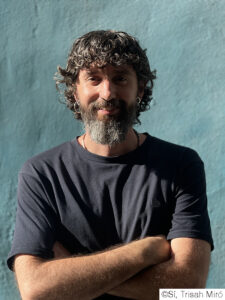
This is the premise of the disturbing first work by Danish director Jonas Kærup Hjort, The Penultimate. A work of fine goldsmithing that demonstrates great mastery both in the use of the camera, the sound or the out of frame, without a doubt its main tools. A strange world and, like in a Kafka novel, in an unconscious way, perfectly recognizable, as confirmed in this interview. A distorted image of our world.
The Penultimate can be seen tonight, Saturday 19/6, at 10:30 p.m.. at the Teatro Principal with the assistance of the director.
Your career begins in the theater, something that, somehow, is perceived in the film. What has been your greatest difficulty when it comes to transferring your world from the language of the stage to cinema??
Yeah, I worked in the theater before going to film school. I did it first as an actor, but every time we were rehearsing I was aware of the light, of the timing, tried to imagine how to control theatrical time, so I thought it was better to go out and maybe I was better at composing images and the scenery. After a while I realized that the theater is very free to create imaginative things because the people who go to the theater are very receptive to seeing things that do not have to be very realistic.. But somehow I felt constrained by the four walls and I wanted to get out of there., although it was difficult because for that I had to move in space. That's why I went to film school.. I tried to stay away from the theater to look for that realism and give more movement to my stories.. But it was about halfway through my film studies when that background theatrical came back to me and I tried to mix it up. Basically, What I'm trying to do is recover that static nature of the still image and let the viewer enter into a world., That's what excites me about that mix..
I have read some reference about your film that assigns it an influence of Kafka. In some aspects, when I thought about your movie, I remembered The process by Orson Wells. I think your film is Kafkaesque, but not only for introducing the viewer into a strange world, but in the way in which that strangeness refers us to the real world.
Yeah, People are surprised when I tell them that I am a very anxious person.. When I make a movie, If I'm not constantly researching, as in a search, I'm bored. So I try not to know what is happening “on the other side of the corner.”. I go and look and I find that there is another corner, so I go and look again. This would be the first thing that inspired me in Kafka's way of doing things.. But, at the same time, I don't want to show images of something, but to build images “about something”. I don't try to make my characters have a specific character., What I try is for my characters to contain a certain aspect of who we are., so that, by putting all the characters together, we can have a map of what the human condition is. I like to separate things and then zoom in on a detail and look there., above all, because I think it's pure and it's fun.
In your film you show a man in his solitude, but the rest of the people are separated in closed spaces. Is this the way you see the world?
Don't know. I hadn't thought of it that way. What I try is to ask questions. I think that is my duty, ask questions. I don't see the world in a particular way. I feel like I'm only 37... or 38 years? I don't remember now (laughter). So I haven't lived long enough, but so far what I perceive is that we live in a world in which we try to achieve a series of goals that make us happy, and that when we achieve those goals we will achieve that happiness. But suddenly you realize that if you achieve that goal there is no more struggle. Now what I believe is that it is not about achieving anything, It's about navigating this life. It's more, like a long investigation on the path of your life.
In that sense, Many times the director of a film or the author of a novel usually says that all the characters in his work have, each, some part of him. But I wanted to focus on the main character.. This character seems to be somewhat confused and disoriented in the world that is presented to him.. Would you say that is your position in the film?
Yeah. I grew up in Denmark. We have a very institutionalized society, we have very good nurseries, everything is an institution. It is a very direct and established way of conducting yourself in life.. From very early on you trust those authorities. But then you go to school and you realize that there are people who break those rules, teachers do this, the students that, and you, that you had a very pure image of this, You realize that there is not as firm a ground as you thought under your feet., and it's a little disappointing. And then, You wonder if you can't rely on those rules you've learned., where are you supposed to go? That is the image I wanted to convey. That building in which the movie takes place seems very simple., but in reality it is not. That is, of some tide, what I wanted to tell.
Humor is very important in your film. In fact, It has something of the style of Roy Anderson, in his way of dealing with humor. To what extent was that humor relevant to you??
as director, as a storyteller, you are alone with yourself, but a film teacher at school told me that, even if you think you're alone, In reality you always have on your shoulders all those who made films before you. This is one of the most devastating things. You think you are very original, but you start studying the history of cinema and you realize that, oh, shit, all the stories have already been told, I can't do anything really original. In that sense, There is a deep sense of Scandinavian black humor that I don't know where we got it from, but what I know is that in Scandinavia there is a deep sense of sarcasm that is a kind of root that is transmitted to our descendants.. You see it a lot and it's something I can't escape because it's part of me and I really enjoy putting it in places and spaces where you don't know if you should laugh or cry..
I would like to ask you where you like to place the viewer. In your film there are a series of very marked formal decisions that leave the viewer in a very specific position.. You have chosen a square format with what that implies for the look, you also play with the offfield.
We did a couple of test screenings of the film and tried to choose an audience that had nothing to do with training or university education or anything.. And what they liked was that they didn't always know where things were going to end., Even people who had difficulty following the story were intrigued precisely by that: what was happening outside of what the camera shows. That's interesting because, somehow, It's also part of telling stories., how the brain, by not knowing, manipulates you and sends you a kind of alarm that makes you wonder, as i said, what's on the other side of the corner. I really enjoy getting the public into that game..
One of the most suggestive things about the film is the anxiety that the film transmits on the part of the individual in the presence of other people., the others. It's a very physical presence., that turns into something violent. Was that your intention?
It's true. When I was little I had this kind of mania that caused me anxiety and in which, For example, when he took a turn, I then had to give it in the opposite direction. OCD (obsessive compulsive disorder), I think it's called. It was very stressful because I couldn't go to the supermarket., For example. I felt great pressure. And I have transferred that feeling to the film. That would be one reason. And the other is that I have realized that, when you play a sport, how to run, For example, you feel like you are leaving out all the problems and the rest of the world that usually pressures you. And I think that responds to a need that we have as animals., according to which we have the need to go out. However, We live a life in which most jobs are sitting; he 90% of my job is to sit and write, For example. I believe that we have this need to go out to combat the anxiety we feel.. And I don't know if consciously or unconsciously I usually put that in my films.. That physical need is something that I consider important for us as humans., but also animals that we are at the same time.
I would like you to tell me how you worked with the actors in a story like this in which there is no plot and each sequence or part of this puzzle that you are building is so fragmented.. What references did you give to the actors to guide them in these situations in which you put them??
I worked with them in a way that was opposite or in contrast to the world. When the world you are posing is so stylized and so empty you need to put life into it, and the only life I had were actors. I would get with the actors and ask them what the situation was in a specific scene., what's it about, what is the conflict. And to remove that excess stylization, what I proposed to them was something similar to this: Imagine it's your son who comes home and tells you that he didn't do his homework the day before., so you need to teach him a lesson. This is the situation, but now there are a series of words that you can't pronounce, or do you have to talk backwards. But remember that the situation is that you want to teach him a lesson. That allowed them to work in this strange space, but the situation was something we could recognize. This was how life sprang from situations..
And to finish, I would like to ask you about the space in which you shoot the film. How did you get there? What was it like working in that facility?? Is it a studio or is it a natural space?
Yeah, The film has a very low budget and, when we were preparing the filming, The producers asked us to shoot some scenes that would show them what we wanted to do.. Then we found an old bunker that served us. One thing when you take on a location is that you learn a lot about the possibilities of filming.. That space gave us the ceilings, but we needed to style it more. But the problem is that we didn't have money to rent a studio. I wanted a space in which people would be surprised and say, is this denmark? Then I found near Copenhagen this kind of water tank that serves as a supply for the city.. One of these water tanks had been built by a famous architect. It is very interesting because they are tanks that have a kind of grass on top., like a garden that has to be cut with robots, and each one of them represents one of the constellations. And fortunately one of the tanks had a leak and they had emptied it and they had it to organize visits so that people could appreciate this architecture. It was an incredible space.. We think, ok we are not in Denmark, we are nowhere, and we try to imagine how we could do it. And there we did find money to make twelve pieces of sets that we put between the pillars.. With those twelve pieces we made the entire movie. It was crazy because every time we did a new location we had to transform those pieces so the set pieces became smaller and smaller until we were left with just a few.. It was a real test.