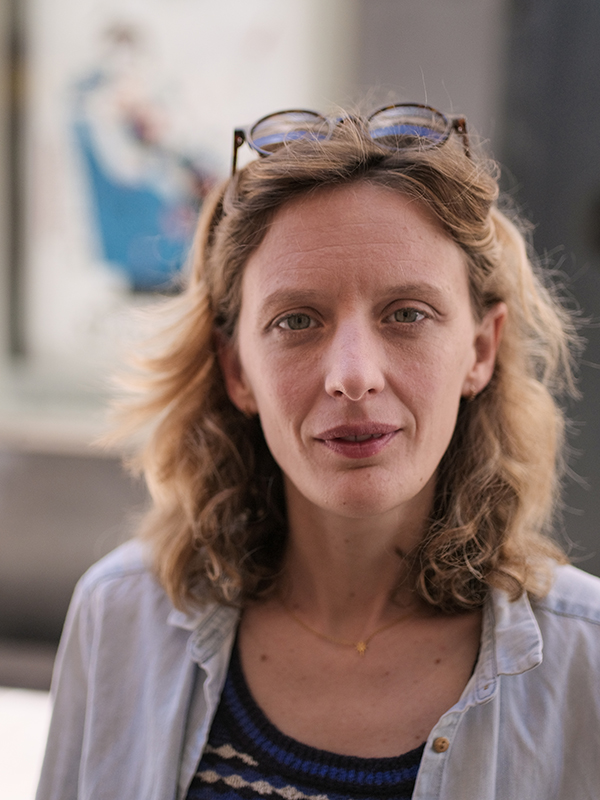

Without a doubt it was one of the cards up the sleeve of the Cinema Jove International Film Festival, what, since the day 24 from June to 2 of July, invites us to enjoy its 37th edition. And if, We can now say that director Mia Hansen-Løve is this year's brand new Luna de Valencia Award winner. Hansen-Løve's work begins in 2007 with his first long work, All is forgiven, a declaration of intentions of what his subsequent career was going to be. Small cinema in the form, intimate stories, a subject (sometimes he, others she) in the center of a storm of emotions, of doubts at the crossroads of life, narrated without fanfare, but with great sensitivity and care for what moves in the intimacy of its characters. The existential doubts of a man who cannot find his way and lets himself be carried away by his addictions (All is forgiven), a workaholic producer who leaves his family aside (The father of my children), the first love (A love of youth), the techno music scene in the years 90 (Eden), a woman facing a rationally fragile world (Future), or the weight of memory (Maya), These are some of the issues dealt with in a film corpus that is difficult to separate from the author's own life experience..
In the absence of seeing his latest work (a beautiful morning), presented at the last Cannes festival, Cinema Jove previews its penultimate production, Bergman Island, a job with international distribution (Vicky Krieps, Tim Roth), which tells of the arrival on the island of Fårö, last residence of Swedish director Ingmar Bergman, of a marriage, both film directors. The trip is the fulfillment of a dream, a pending tribute to the director of Persona y, at once, the search for a space of inspiration. Between tourist outings on the island, Chris, its protagonist, tries to discern her future as an artist and as a mother. We spoke with Hansen-Løve about this work and what position it occupies within his filmography.
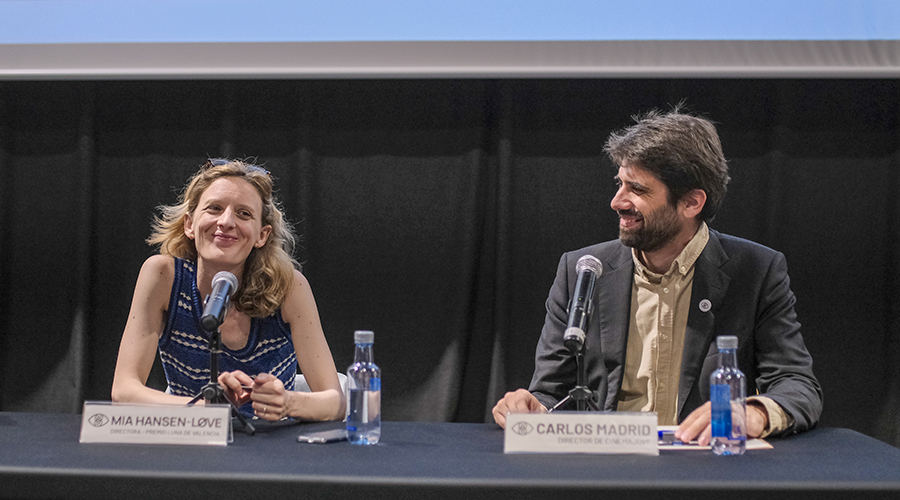
The festival gives you a prize in recognition of your work. We could say that, in these moments, You are in the middle of your career. The question would be: when you look back, what do you see?
I try not to look back too much. I try to look ahead. I try to keep everything in motion and move myself too.. What I can say is that I have always tried to make my work homogeneous. I think that, if I have been successful in something, it's in that. I think that my desire or the values that I want to transmit as a director are the same from the beginning. Maybe this is what I'm most proud of.. Besides, I don't usually watch my movies. Sometimes I see them for a special screening, but I don't usually watch my movies again.
I think there are two themes that are central or common to many of your films.. One of them is family, the other would be love. Would you agree with this recipe??
Yeah, but maybe I would add a few more. It's true, but vocation is also something that is very present in my films. I think that, one way or another, the question of vocation is something that is always there.
I have been reviewing your filmography and I have had the impression that in your first projects you looked at your characters from the outside, from the outside of your experiences, to then go on to create characters that already emerge from you, or through you, a something of you that is projected onto them. Have you noticed a certain evolution?
Maybe it's because my last two films, a beautiful morning y Bergman Island They portray women who I feel are very close to me. We share age and situation, which perhaps makes him have great intimacy with those characters. While, in my first two films, All is forgiven y The father of my children, although young women appeared, First they were portraits of men in different situations than mine., of different age, stories different from my own history, which made me put some distance. But, when I made my third movie, a love of youth, which is a coming of age, but it is also a story of a vocation, Here we already find a character who is very close to me.
Whenever I read something about you, Reference is often made to the idea that you are the voice of your generation. Do you feel that way or do you think it's a label that doesn't apply to you??
I wish it were true. I think it's more a matter of sensitivity than a matter of age.. Sometimes I feel very connected to people who live in countries far away from France.. They are not from my culture, sometimes they are my age, sometimes they are younger, others are older than me, and the same thing happens to me in my country. I would like to be able to say that I am the voice of my generation because I think it is a very gratifying feeling., especially because it connects you with a certain youth. But, to be honest, I prefer to be the voice of a certain sensitivity than to be the voice of a generation. I hope that this sensitivity is connected with a certain modernity, my way. For me there are two kinds of modernity. There is one in which I feel recognized, and there is another type of modernity that has a lot of imposture, of attitude; I am not interested in belonging to that modernity. Again, It's a matter of sensitivity.
With respect to Bergman Island, which is previewed at the festival, I have the impression that it is a film that proposes an approach to the figure of Bergman, like that great master of cinema, but there is also an intention to leave it behind.
I'm not sure, because I don't think there's anything I want more than to return to Fårö (the island where Bergman lived and where the film is filmed). I miss the place. I felt enchanted by him, so that enchantment lasted in me even after the filming of the film. Many times, when you make a movie, you connect a lot with the place where you ride, Even though sometimes you want to kill that place, because you spend a lot of time there, you know the backstage, what's behind, and many times you don't want to go back. But what was unique with Fårö, And what does it have to do with that power of Bergman?, is that the place has a kind of mysterious appeal that follows you even after.
And is it possible that in the film there is something of that around the figure of Bergman himself?? In fact, there are moments in the film in which this confrontation arises between his figure as a person, your private self, and as an artist. And it doesn't leave it very well...
No, because I keep watching his movies. I still love his movies. I'm not tired of them. My addiction to Bergman is stronger than in my movie. I'm still curious about your work.. I think it's something that will be with me all my life., like Bresson's films, Truffaut… Maybe I can feel tired of certain directors, but there are others who I feel are colleagues at work, I even think they are more important now. They are directors that I watch again and again and in whom I usually find new emotions, I rediscover them in each viewing.
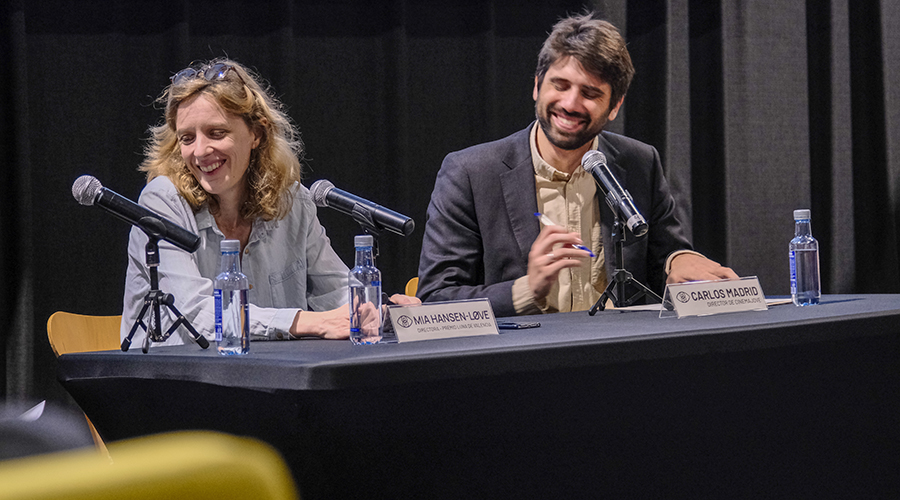
For me the film poses a confrontation between common life and artistic work.. The main character is thinking about it all the time, whether she should focus on motherhood or whether she should put her art first. Do you think we put art in too high a position with respect to other aspects of life??
Ahmm, I don't know. Yeah, I know what you mean, but I don't think he made the film to put Bergman in a more earthly place.. But I understand that people see the film as an attempt to desacralize his figure.. I understand that you see the film as a work of desacralization of Bergman, but, in fact, what happens is that it is, but there is also the opposite at the same time. Yeah, I face the reality of Bergman, to your daily life, to the person who was, but there is also some sacredness in my project. I think we live in a time of desacralization of cinema, There is less and less interest in cinema, People watch fewer and fewer movies in the cinema and when I watch my movie, Bergman Island, I see it as a premonition of this fact. So, somehow, My project is an attempt to “re-sacralize” cinema because I try to transmit Bergman's aura in the film. So my movie is full of faith for cinema, of faith in the aura of this great filmmaker at a time when people are turning their backs on cinema.
In your first films there is a greater interest in the plot, for history. But in your most recent films I get the impression that this interest focuses on the intimacy of your characters..
Yeah, It's true. Bergman Island It is a film in which we move on several levels. There is a story of two characters that moves in the present, then another story appears, a movie within the movie, other times we don't know where we are... In this case, I was also interested in the process of inspiration and creation. But I understand what you are saying. Maybe when I started making films I used the passage of time in a more chronological way, creating stories that took place over long periods of time. All is forgiven, my first movie, happens over a period of eleven years. A love of youth takes place in ten years. For different reasons, I needed those periods of time to tell my stories. In Bergman Island covers a shorter period of time, which implies another way of dealing with feelings, by showing the present of the characters all the time. But time is also included in the film because when she tells the story she is writing, It's a way to go back to the past. We imagine that what she tells is something that she has experienced or perhaps it is half lived and half invention., but it's a way to go back in time.
I was referring, above all, to the fact (What also happens in a movie like Maya, For example), about what, over time, Perhaps the characters' feelings at a given moment are more important, that the story itself. History is important, but perhaps we enjoy more how the characters feel at certain moments in the story.
Yeah, In my first film there may be more story, as you say. but the way, The way I approach history is always impressionistic.. I always choose moments that have to do with everyday life, not necessarily spectacular or dramatic. It's my way of shedding light, even when there are dramatic moments, like in All is forgiven or in my second movie. There are always moments that are related to feelings that do not necessarily have to be expressed in words., and that are often expressed with silences.
We started talking about the past and I would like to ask you how you see your work from now on..
Don't know. I have made two films very close in time, Bergman Island y a beautiful morning. They are two films that are very different, but I think they are very complementary. I feel that with them I am at the end of something and facing a new beginning, and I think I need some time before I roll again.
Cinema Jove offers a cycle dedicated to Mia's entire filmography Hansen-Løve. See programming at cinemjove.com