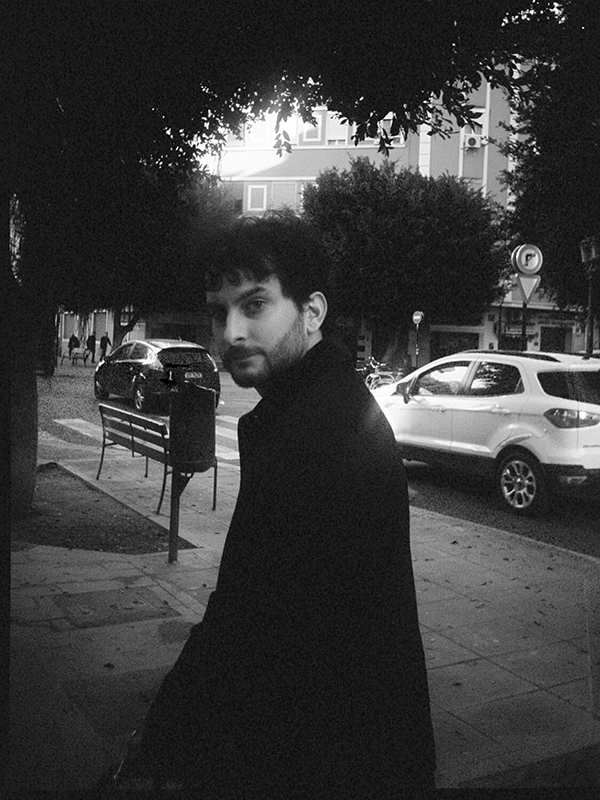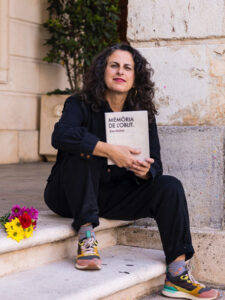

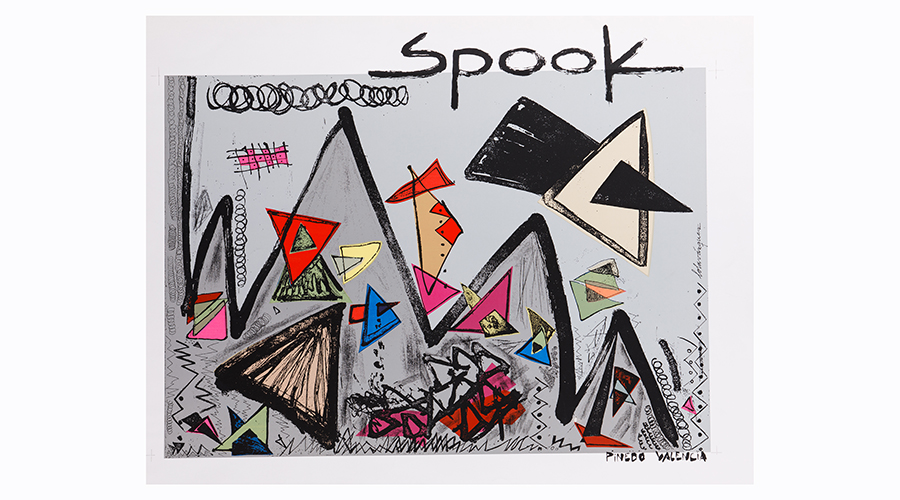
Until the 12 In June, the Graphic Route exhibition will remain at the IVAM. The sound design of Valencia that reviews the graphic aspect of the Valencian club scene in the 80 and the 90, a forgotten part of the Cod Route that was characterized by aesthetic innovation, conceptual y formal. The exhibition is complemented by a large book of the same name published by Barlin Libros that brings together hundreds of posters and flyers about events held in Barraca., Chocolate, ACTV, Spook the Spiral. For the occasion, We have spoken with Alberto Haller, editor of the book and co-curator of the exhibition, about the social and musical phenomenon that became this incipient clubbing circuit, your visual identity, the repression that electronic music suffered at the European level and the recent interest in the subject, which in recent years has inspired books and novels, plays and a series that will premiere at the end of the year.
For a start, Explain to us what was interesting about the Cod Route on a musical level and as a social phenomenon.
Obviously, by age, I could never speak in first person about the phenomenon. To know this story from that perspective, it is necessary to enter the magnificent in ecstasy, by John M. And oils. True chronicler of these years. Nevertheless, and this is something that, Although it may seem like a lie, I have realized that it is necessary to highlight, in the same way that there are expert historians in the 12th century who, obviously, They did not live in the 12th century, also, as a historian, you can talk about a phenomenon, no matter how recent it is, without having experienced it firsthand.
In that sense, I think that the interesting thing about the Route on a musical and social level was that it marked the arrival in our country of all the avant-garde cultures linked to postmodernism and clubbing, with a characteristic that I believe differentiated it from other similar scenes that were developed in parallel in other parts of Europe.: its development through the hospitality channel. That is to say: while, For example, in England the movement rave roamed freely through the countryside, playing cat and mouse with the police, Here it didn't happen that way because that whole circuit was created within splendid nightclubs in many cases., framed within the channels of legality—a much more lax legality than the current one, Of course-. Although the ending was not very dissimilar in both cases, with its peculiarities, yes it was in its development.
So, in summary, What happened in València was the gestation of a movement that developed throughout Europe, that in very broad strokes we could classify it under the label of new wave, with its distinctive and particular features, how they had the english scene, french, Belgian, German… With the particularity that here it was legal, and did not have to fight to achieve that status of respectability.
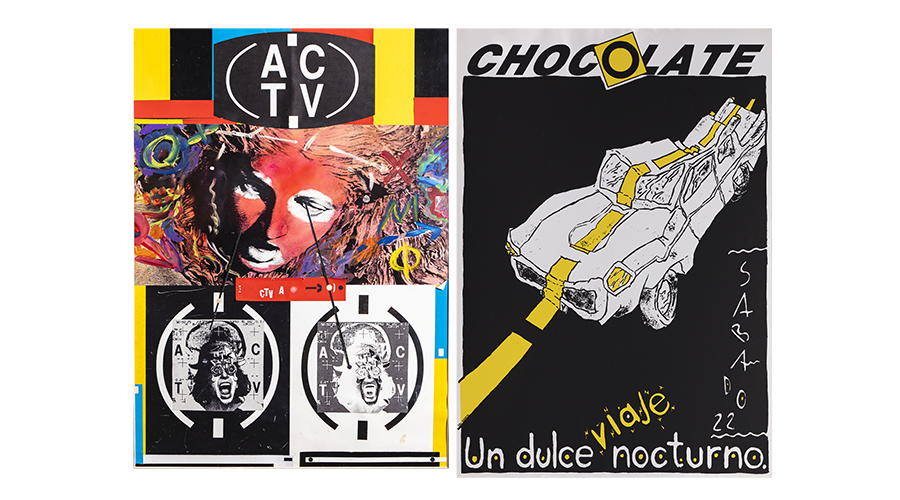
In the exhibition that you curated at the IVAM together with Moy Santana and Antonio J. Albertos, and in the book that accompanies it it appears, of course, the image of ACTV, absolute icon of the Route designed by Quique Company and Paco Bascuñán. It was the first graphic design project that was born with the desire to generate a brand and create its own identity.. How relevant was the graphic aspect of the Route in general and of ACTV in particular??
In the process that my colleagues Moy Santana follow, Antonio José Albertos and I for the curatorship, It was soon evident that, as you say, the first brand identity project as such It was developed by Company and Bascuñán for ACTV. This is explained by the historical context: the graphic designer profession, as we understand it today, was in the process of creation in the years 80. They both came from the multidisciplinary design studio of La Nave, which was a laboratory in many ways, practically pioneer in Spain. In that way, It explains why the rest of the imagery developed in these years did not start from these precepts., and it was rather the result of improvisation and spontaneity. To say otherwise would be to force the historical narrative.. Company and Bascuñán were very advanced with knowledge of the facts, and that is the difference with other projects: awareness of the relevance of the work done.
The exhibition gives space to posters and flyers made by anonymous people (waiters, printers, djs, public relations…). Something very in line with the spontaneous spirit of the phenomenon. Why did you think it was important to exhibit these works alongside those created by big names in design and comics??
Because otherwise we would be forcing the historical narrative, that in post-truth times it may not seem so serious in certain sectors, but it certainly does not start from the rigor and honesty with which I believe a historical discourse should be prepared.. If we gave relevance solely and exclusively to the big names we would be explaining the phenomenon in a partial and biased way, presenting it. This was a collective-based social phenomenon., guided in many cases by voluntarism and the mere pleasure of feel part of something. Under these circumstances, maybe unusual but real, Egos in many cases are diluted in a communal magma that transcends the individual.. Something that, precisely for the case, may be paradoxical, because the political orientation of postmodernity precisely accentuates individualism over the collective. But, Of course, without paradoxes we would not be human beings.
On the other hand, Some works are signed by members of the so-called New Valencian School of Comics, were the ones who began to provide a visual identity to this incipient circuit. Artists like Mique Beltrán, I feel Llobell, Daniel Torres or Micharmut. Tell us a little about the great authors that we can find in the IVAM exhibition and their impact on the circuit.
The participation of these leading artists in the circuit of Valencian venues in the 80 is explained, in our opinion, from a double perspective. On the one hand, there was a desire to innovate and, thus, to dust the Franco regime above. Suddenly we were Europe, after 40 isolated years, and it had to be demonstrated with fierceness and talent. On the other hand, also, It is explained from the point of view of mere business: The businessmen wanted to attract this new modern and casual clientele, that sailed the wave of times and the future. And it was these comic artists, in the decade of boom of the fanzinism, those who represented this aesthetic of the new. Hence, they began to participate and develop their aesthetics and imaginaries.. they were the modern ones, and it was this clientele that they wanted to attract.
The electronic music that played on the Pinedo highway was almost always imported., but all the graphic production that nourished this avant-garde was completely local production. Is there a common thread that runs through it?? Has it been very difficult to recover the material shown in the exhibition? Where does it come from?
I think the only common thread is at a technical level., what is screen printing. Y, of course, I think that, in terms of thematic level, because in general they sought to innovate and be original, beyond communicating—which also, Of course-. And regarding the search and recovery of the materials, It is the work of my colleagues Moy and Antonio. They have been the ones who have been 2 years combing up and down the city in search of the posters and recording the interviews that we have used to prepare the story. A brutal job on your part..
in ecstasy It was the first book from the Barlin Libros publishing house., it will be Graphic route. The sound design of Valencia the last one dedicated to the Route or are you going to continue exploring that part of our history? What's left to explore??
Well, I don't know how to give you a clear answer., the truth. I am not saying “no” because there are numerous aspects still to be historicized and unraveled in this story., but I also don't say "yes" openly because the level of dedication, The time and resources required for this type of projects is very high.. Therefore, I am open to new projects, Of course, but I think I would not say “yes” with the lightness of yesteryear.
in ecstasy was originally published by AraLlibres in 2004, when the Cod Route was still absolutely demonized for its association with drug consumption, to traffic accidents and garrulismo. When no one else did, Joan Manuel Oleaque, the author of the book, dignified it by pointing out the avant-garde quality, advanced and pioneer of cod as a sociological phenomenon, musical y cultural. How meritorious was that??
Joan's merit is immeasurable, why raise that speech in 2004 It was exposing himself to those in his guild—and many others—stopping respecting him.. Saying certain things right now has no merit, But being the first to preach in the desert is very risky.. Joan is very big, plain and simple.
Barlin has also published the autobiography of the well-known French DJ Laurent Garnier, which tells of the repression that electronic music suffered in England and France.. in ecstasy This repression is about in Valencia. Do you see a parallel between these music stories electro Europeans? What has been the path that leads from that repression to the complete integration of the genre into our listening habits today??
I love this question! I think drawing parallels at the European level is something very necessary in this whole story., and many times I think that it is a sin navelism. Indeed, Electroshock by Laurent Garnier, book that I adore from my catalog, actually narrates the background path that electronic music followed in the 90 until its full integration as a cultural element. The fight for respectability of an entire genre. But as I said before, I don't think the experience that the Frenchman conveys to us in the pages of his book can be extrapolated., point by point, to the Valencian case. Here the stigma came with the massification of the phenomenon and the sensationalist coverage that some media outlets began to make of it., but with the particularity that the scene had been developing from the legality of the nightclubs since day one, not in the middle of the field.
There's an acid house song of the year 1988 from an American producer called Bam Bam called Where’s your child which I love to illustrate this difference. The song contains a half-apocalyptic guttural voice that, on an acid base developed with a Roland TB-303, boasts, addressing the parents of the supposed partygoers, about what “to know where his children are”». “Where’s your child? / Do you know? / Look around / Nowhere to be found / Parents don’t let your kid leave out late at night / Don’t you know they don’t know wrong from right”, and all this is followed by a sinister and malevolent laugh... And the fact is that, indeed, In practically all of Europe those “parents of the children” did not know where their sons and daughters were because the raves were held in remote places in the middle of the countryside., clandestine, or in abandoned buildings as in the case of Berlin, For example. But here? There was no reason to laugh about the whereabouts of the “poor and innocent churumbeles”: They were somewhere on the Saler highway, after religiously paying his entrance. End of the mystery. The path of respectability in Europe, as Garnier tells, It involved taking over the legal spaces of clubs and venues to a large extent. Here that already existed, and the stigma simply caused them to begin to be suffocated in these rooms with practically military police measures, that the only thing it achieved was that the scene disintegrated throughout the State., especially in the red belt of Barcelona, as Oleaque relates in in ecstasy, instead of continuing to focus on the CV-500.
Barlin reissued in ecstasy in 2017, with a prologue by Kiko Amat!, the same year in which Eugenio Viñas released the podcast Valencia Destroy. Before, the ground had begun to be fertilized with the publication of the novels Destroy by Carlos Aimeur and I wasn't going to go out and I got involved by Chimo Bayo and Emma Zafón, and the book Cod! by Luis Costa. It was undoubtedly a good time to review the book of the journalist who first said that it was something avant-garde. How was the reissue created??
I knew Oleaque's book from having read it by chance when I was a student.. I found it on a shelf in the Joan Reglà humanities library at the UV, It caught my attention and I took it. When I read it I couldn't believe it: I couldn't believe that that book was talking about Valencia. many years later, after working in a publishing house in Madrid and beginning to set up the Barlin Libros project, The idea of translating and updating that book was on my mind from the beginning., but I considered that no one would “steal” it from me, so I prioritized other things. It was when I saw the launch of Cod! by Luis Costa when I said to myself “Oh… Shit!”. I ran to Oleaque's email and suggested that we meet., something that we could not do until after the presentation in Valencia of Costa's book, where we met in person. Everything was very bizarre… When we finally sat down, I formally presented the idea to Joan and he trusted me and my project., Well, he hadn't even put his first book on the market yet... Quite a gesture on his part., I can't help but thank you. And Amat's prologue, It was as simple as writing to him. He was automatically enthusiastic about the idea., because he knew Joan's work and declared himself an absolute fan.
Then came the play. Valencian that spins the Cod Route, the Alcàsser case and Valencian corruption, and at the end of this 2022 Atresplayer will premiere a series inspired by the phenomenon. How do you explain this interest in the topic?? Does it have to do with the nostalgic wave we are experiencing?? In the spirit of the times? We ask you thinking that Zahara is preparing the show The Rave Whore, and remembering Rosalía dancing in a parking lot in the video clip for “Malamente” or Parkineo17 in the Madrid Matadero, an event inspired by the quintessential collateral scene of club culture.
Well look, precisely in the book Electroshock of Garnier there is a chapter called Cycle 30 —a clear reference to a Jeff Mills album of the same name— in which he explains his theory that every musical element, artistic or cultural requires a period of 30 years to develop and exhaust itself in its innovative spirit, before the new generations take over and resignify it. What happened in Valencia in the years 80 y 90 It succumbed on an artistic level because there were other musical and aesthetic currents that knew how to continue developing that avant-garde spirit., something that did not happen here due to a whole series of issues. Clearly, for the Spanish case, It was Sónar in Barcelona that knew how to take that baton and continue exploring the fields of experimentation.
The fact that they now want to recover all of this, I believe, has to do with this cycle of 30 years. The first 15 years were of development, that was cut short by the persecution and its early exhaustion; the others 15 years of the cycle have been hangover years—metaphorically speaking, expect—, and now we are reaching that threshold of 30 years. For the case, I think that the way it will be revisited will be from mainly aesthetic approaches., because today's world prioritizes form far above content. Although not exclusively, luckily. Regarding the content, I think it also influences the sense that today we live so constrained and sad., that appealing to an oasis of freedom so close is a true balm for the imagination of the youngest. “Could you really do all that?”?”, we seem to mean those of my age and those younger. The nostalgia component is clear, but I don't think it's the only ingredient. And that curiosity is wonderful, because it is always the essential ingredient that illuminates the new, what is to come.
When we went to see the exhibition, many people who visited shared their memories of the time as a wonderful moment. Do you think that Valencians are aware of having lived in the graphic and musical avant-garde?? Is there a Valencian pride on the matter? Why has it taken so long for people and institutions to recognize the importance of the cod phenomenon??
Every generalization is always a lie and a half-truth.. Talking about “Valencians” at a generic level is very conflictive… There will be those who do and there will be those who don't., Of course. Regarding pride, I don't think there is, the truth. But I am optimistic that there may be one at some point., this whole story becoming an element to draw your chest from: “we were the first to be the most modern”. Something like that but more elaborate, Of course. Said that way it sounds childish.
And finally, about why it has been difficult for people and institutions to begin to value this new perspective, I think it is due to the stigma that ended up burying the phenomenon.. Although let it be clear: It wasn't something exclusively from here.. I don't get tired of saying it. For example, The most restrictive law that was created at the European level was the one that in 1994 drafted Thatcher's government in England: the Criminal justice and public order act, also known as the anti-rave law, which practically authorized the army to deactivate those illegal parties that were growing like mushrooms throughout the island. After completing that cycle of 30 years that I mentioned before, I think it is already feasible for those who have to be politically correct say it out loud without getting into trouble.
Musical scenes such as Basque radical rock or the Route have been overshadowed by the publicized Madrid Movida. Do you think it's a matter of centralism?, that the culture that is generated in the periphery is not given the same hype? Or is it going the other way??
Centralism explains this reality to a very good extent., but not only. I will give the case of Manchester as an example.. In the 80 illuminated a very powerful scene of new wave —of which in Valencia they drank a lot, by the way-, and that story has managed to take hold in the popular imagination. And as to whether or not England is a centralist state, I believe there will be no discussion., with the almighty London… Obviously it is a very important factor, but not the only one that I think can explain this reality. Another element to develop, For example, I think it was the interclass component of what happened in Valencia, in front of elitism of the Madrid Movida. The class factor, in this case, I think it also has a lot of influence. But come on, which is one more element to history of all this… I think that this interest in the Valencian scene has only just begun.
Ximo Bayo's songs are the ones that have taken deep root in the collective imagination, but there was much more. What other songs are representative of the era? Any that you hated at the beginning and today you consider a cultural reference of the time??
I don't consider myself an expert in—this—music.. My interest in this matter is more sociological., the historical and the anthropological. However, for the presentation of the second edition of in ecstasy in Barcelona, They asked us from the bookstore for one playlist to liven up the event, and Joan Oleaque made a short list that I have already heard hundreds of times. Her, I am left with a topic that, as Joan himself told me, It was mythical at the time: the remix that Perfekto made of Rejection, by the French Robotiko Rejekto. And also, although this is not on that list, There is a topic that I am very fond of., that I have heard in several recordings of the time: Voice of the Mysterons, from the British Alert the Press. I hope there are musicologists and music historians who are already getting on with this... I'm just saying that.