
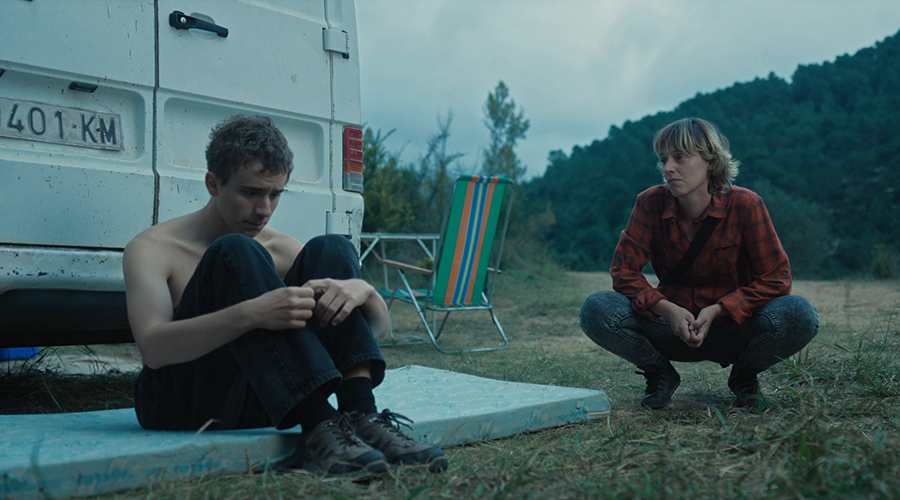
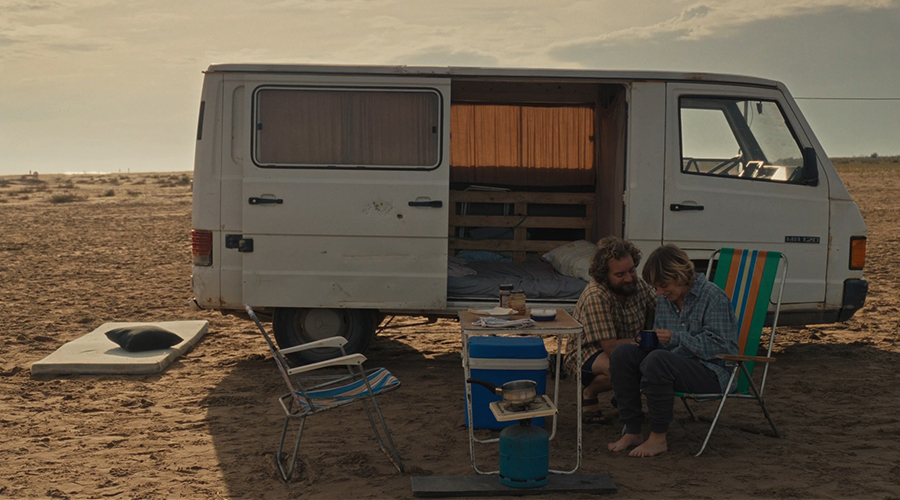
Adrià is a young man from 17 years that he leads an itinerant life with his brother Ramón and his partner, Its, in a van with which they travel from town to town looking for a life. Adrià is mute and seems to suffer from some type of deficiency, condition that makes him a victim of abuse and ridicule from some of the inhabitants of those towns where they settle to do the small deals that allow them to survive.. His timid and elusive character, however, changes on full moon nights in which it undergoes a radical transformation. As if possessed by a curse, Adrià escapes from the surveillance of his brother and his girlfriend in search of an animal with which to satisfy what seems an uncontrollable need to drink blood.. When, the next morning, the townspeople discover the consequences of their adventures, They look for him to teach him a lesson, forcing the trio of vagabonds to break camp.
But the problems don't end here. At the same time, The relationship between Tona and Ramón begins to show its cracks. Tired of enduring the constant problems that Adrià puts them in and of that wandering life, Tona proposes to Ramón to leave the van, buy a house and settle down. But, more concerned about taking care of his brother than his needs, Ramón refuses to abandon that life of freedom.
This is the argument of Llobas, second feature film by director Pau Calpe that will be released out of competition today, Friday, within the framework of the Cinema Jove de València festival. Calpe recovers the myth of the werewolf to, as he says in this interview, talk to us about other issues. His proposal tries to overcome the codes of the genre to propose an interesting styling exercise where, as we will see, The plot advances at the pace of the conflicts that the characters suffer within themselves.. G.LEON
Llobàs is based on the novel Lobison by Ginés Sánchez. What attracted you to this story??
Bueno, In the novel there was already this idea of a boy who behaves like a werewolf, but without physical transformation. I think this is the key. The moment you have a movie of a werewolf with his physical transformation, It becomes a plot movie in which you wonder if they will catch him, if he will survive, the conventional questions of the genre. But when you have a character who behaves in this strange way, the journey becomes something else.. This is about asking yourself who this kid is and why he behaves like this.. That was the question I was interested in.. In the novel there was also a voice in off very powerful of this kid who, If you want to see it in terms of fantasy, It's a Wolf, or a traumatized boy, If you want to see it in more rational terms. It was a wonderful voice, but I couldn't leave it in the movie. On the other hand, the novel was much harder, seedier if you prefer, but I'm not like that, with which I have softened some things. And finally, there is the question of extension. You can't replicate all the adventures in the novel. And the ending is also different.
The film is the portrait of the marginalized condition or the different. In that sense, How did you feel it appealed to you or how did you want it to appeal to the viewer??
The movie can have two readings. There is a more fantastic or fantastical vision in which the younger audience clearly sees it in terms of a movie about a werewolf.. But the one you go to a more adult audience, and I'm there a little bit, from the moment the transformation occurs, the metaphor about those who are different from the norm, it is more obvious. And there is a movie about how badly we take care of those who are different from the average. If you want to see them as marginal characters, we would be talking about how we reject them in some way.
Another issue that the film addresses is this idea of inheritance as a curse., like something we drag. Adriá must guarantee the survival of the species at the request of his father, who is the one, in his memory, continues to pressure him not to renounce his condition.
If you see him as a teenager who has to find himself, who has to establish his identity, I believe that Adrià moves between two poles. On the one hand, is the pole of the wild, of that strange behavior, that thing about being good in nature and bad in the city. And on the other hand there is the love for his brother and that desire to change to be able to coexist with society.. In principle, the film points to that idea that “don't change, “Do not alter your way of being.”, that “be yourself” that the final plans show. But, besides, what is it to be yourself? In the case of Adriá, That weight of the past is so impactful that we might wonder, is he really being himself? Or are you being conditioned by that weight of the past? And there the film does not respond. He leaves it up in the air for everyone to interpret as they want.. as i say, the movie bets on that idea of being yourself, but in that being yourself, maybe that past is too big a slab.
The film presents a conflict or contradiction between the desire to lead a normal life, more sedentary, or take another nomadic and untethered. This is a conflict that Ramón suffers above all., Adrià's brother. Did we lose something when we stopped being so nomadic??
When I spoke with María Rodríguez Soto (who plays Tona), I told him: that you know that in this whole story I am in your position. This situation is unsustainable. That is to say, on the one hand, I also have that Jack London romantic component of living in the wild and so on.. But, For example, I spent my last vacation in a caravan and, The truth is that it lasts a while, but it is unsustainable (laughter). I was interested in Maria's character not being evil., but that it had another component of humanity. Tona gives everything for the two of them. For your part, Ramón has a blind love for his brother and will always forgive him, But there is a time when one has to be sensible and put an end to all that.. What I mean by this is that I understand both sides., I understand the romantic component of the nomadic life, but only to a certain point.
Spanish cinema has been looking towards the life of the people for some time, and your two films are no exception. But in your case there is a certain demystification of that world. The relationship that your characters have with the people they meet in the towns they pass through is very conflictive.. They are never well received, which also dismantles that romantic idea of rural life.
my first movie (Tros/ Tierra) it was about farmers Catalans who have to patrol at night to watch the rice fields, so here the rural issue was central. But here what interested me was the boy's character, and already in the novel there was that component of fleeing from town to town and that final trip to the city. Let's say that the rural world is something that has come later. It is a condition of the novel, although it is also true that this story would hardly have taken place in a city because it would be very difficult for these characters to survive in it.. I think that, in this case, the rural world has been a coincidence or a consequence of the characters, but I was not looking to portray the rural world. In other words, If the kid didn't behave this way, life in these towns would be great. Let's say that I offer this face because I am talking about the marginality of those who do not behave in a normal way, but the rural theme was not central for me.
Another protagonist of the film is the landscape. Where did you shoot? How did you include that element in the story??
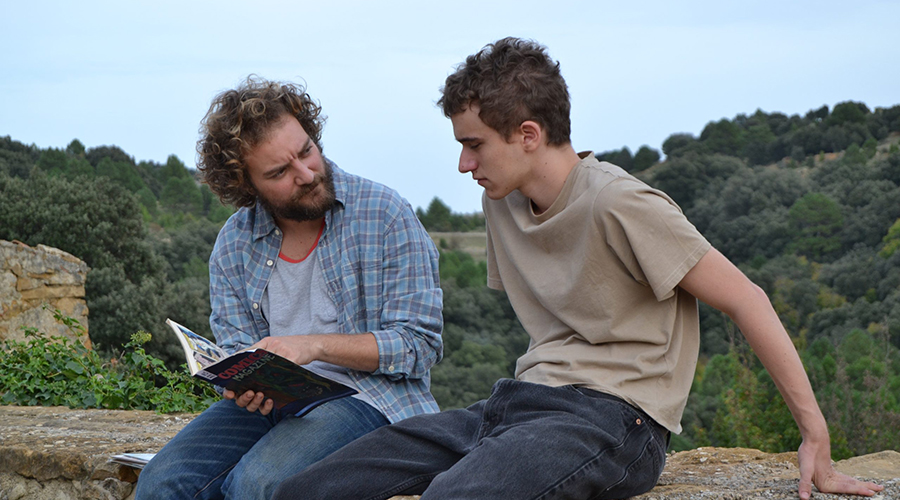
This is one of those situations where what seems like bad news, ends up being a good thing. The film is a co-production between Catalonia and Valencia. And how to roll is so complicated, I looked on the border between the two communities to see what was available and I found the Parque de latienesa de Benifasar, which is wonderful. We ended up there simply because of this logistical or financial fact of looking for a place that would meet the cost needs of production., but the truth is that it is an impressive landscape that offers everything. You have the Ebro Delta ten kilometers away with the sea and a landscape of rice fields that is very good and you have the Ulldecona reservoir with a series of towns that are at a high altitude with a rustic component that interested me.. The city we used was Benicarló, which was very close and has a suburb that worked very well for me.. So it was the result of chance., but the place is wonderful and fits well with those marginal characters that appeared in the film.
Isolation is becoming more difficult in the world we live in. In that sense, Was it a challenge for you to build that image for the film??
Yeah, That's why the surprise of finding that place where there are no large populations, which allows you to be quite far from Tarragona and Castellón, offers you this mountainous area, with those roads that appear in the movie and those towns that are fourteen hundred meters away. The truth is that it surprised me. Maybe my original idea was to film in the Pyrenees where I imagined something more rugged., but in the end we found it somewhere else. It is also a place that is little exploited cinematically, so it has something fresh that I also liked..
There is a cinema, among which I include your film, that is managing to construct a type of stories that, still focusing on those spaces, He also manages to escape from a certain folkloric manners that seemed to have to be escaped.. How did you overcome that difficulty when creating a story like this??
For me, folklore is not given so much by the landscape as by the characters who walk through that landscape.. If you do something more traditional, you might fall into something more folkloric. My first movie was about some guys who are patrolling at night to prevent robberies., which was already placing you in an unusual situation. And in this, even more. Keep in mind that we have a kid who eats chickens, that comes out at night, who can't sleep, that it bothers him when people touch him. On the other hand, He is living with two guys who live in a van. All that is no longer in folklore. I think it has more to do with the nature of the characters and what happens to them., there you find a different path.
An important part of the film lies in the tone it maintains. On the one hand, It seems that you put a certain distance with the situations you raise. pore another, The characters also take their time to develop and react.. These solutions are not just a matter of style, but they tell things. How did you manage to give that tone to the film??
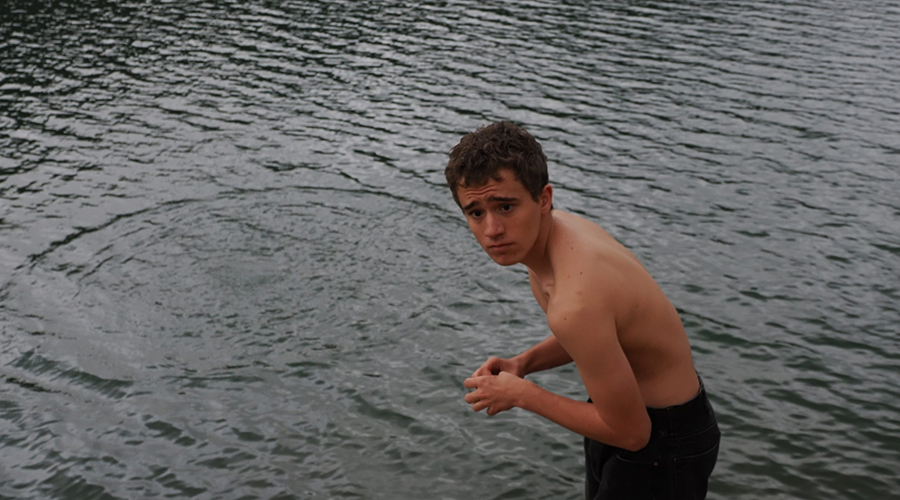
The tone was set by both filming and editing. There were several sequences during filming., For example, in which there was no possibility of cutting. The sequence shot has the goodness or beauty that you are showing something without tricks. and when it works, it's very nice. For example, in the first shot in which Adriá transforms, suddenly stands up and walks in a different way. I could have inserted a plane of the moon there so that we can see its influence, but in the end I rejected it because I found what the actor was doing so interesting that I preferred to show it without tricks or cardboard. It is fundamentally a matter of action. I always told the actors that, even though it was a werewolf movie, I didn't mean to scare anyone., but what I wanted was to look for the emotion. We could also have abused music to seek that emotion, but I haven't done it. I liked the music so much that I preferred to use it a little so that it would have more impact.. And from all this comes this tone and this rhythm that, being a calm movie, allowed you to wonder, what is happening? Sometimes, You can get the audience involved in another way and instead of making them wait for constant input, get involved to ask other types of questions.
To achieve that tone, the complicity of the actors is necessary.. I think you have three actors who are not only very good, but it seems like they understand very well what you are doing, which doesn't always happen. What did they contribute to their characters??
we work it together. It is true that there is individual work with Leon Martínez regarding the character of Adriá because he is a double or triple character, like Clark Kent and Superman, where he has to learn to move and behave in Adriá mode (shrunken, with a lost look, who doesn't like being touched) y, suddenly, being able to transform into someone who walks upright, that is capable of raiding chicken coops and acting at night. That, as i say, we did it alone. But the interactions between the three of them, we work on it together. In Tona, the character of María Rodríguez, I was interested that she wasn't the bad guy in the movie, that there was a component of humanity. In the case of Pol López's character, Ramón, I was interested in her relationship with him exploding., that we understood that it was terrible for him to leave his brother. So, among the humanity of Mary, Ramón's emotion, Adriá's double behavior, everything came together. Then there are the script readings to say “mira, This is the most exciting moment in the movie., here I want us to look for this”. And so we built the evolution of the characters.
The film addresses the myth of the werewolf, but there are also modern myths, that may be related. I'm referring to that Hulk comic that Adrià is reading. Hulk actually also represents the myth of Dr. Jekyll and Mr.. Hyde. I have the impression that the film plays with that idea of myth to tell us that these are not ancient things, that these myths still survive in our culture.
Bueno, the Hulk reference was not in the novel. As in all novels, there are many things that are suggested but not realized.. Of course, in the novel they read comics, but, what comics do you read? And so it happened with several things. another topic, For example, is when in the novel we see that the boy defends himself when they attack him, but it is not clear to what extent there was a lot of blood, little blood, etc. In the novel, each person shapes it as they want., but in the film you have to specify it and that's where you also risk it in terms of tone. And as for the comic, I was looking for a bipolar comic, let's say, dual personality, and Hulk offered me this topic, a character who also, when they mess with him, react, which is a bit of what we have played with this werewolf. Yeah, Adrià has violent behavior, but it's usually a reaction to something. It's something I could have avoided, but on the other hand, It seemed to me that it was good that there was communication between the two brothers through the world of comics and that's why I kept it. It is not so much the idea of telling the viewer that the myths are still alive today because I think that the myth of the werewolf would have been enough., but as a communication mechanism. I could have chosen a werewolf as is, but I was too attached to what Adriá is and I don't think it would have worked, That's why the Hulk thing.