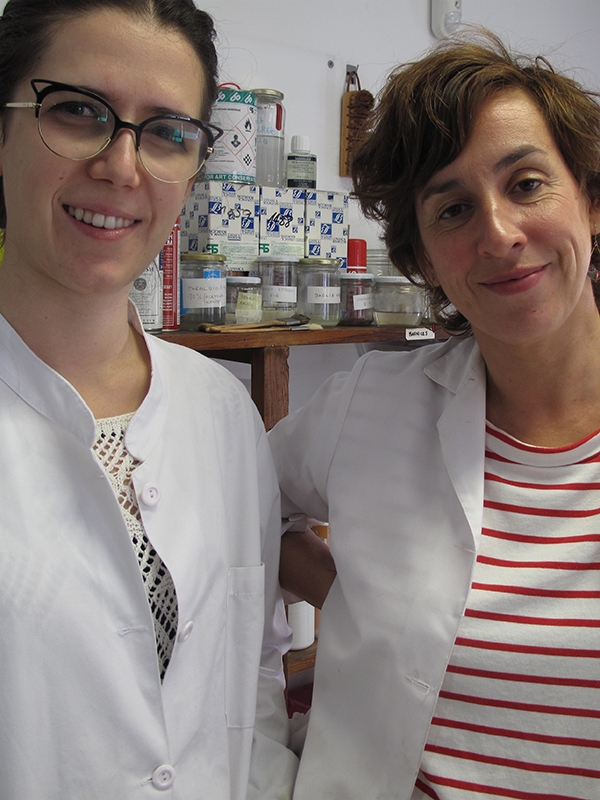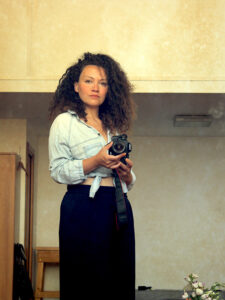
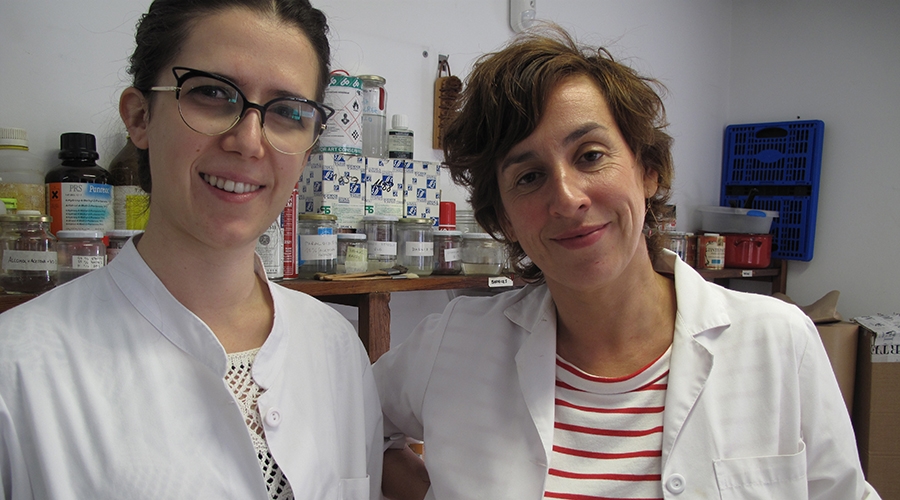
Sometimes what you don't see is the most important thing. What goes unnoticed is taken for granted, and that which is a means to the end, often forgotten. but here, hoy, We focus on everything that comes into the field of service, of detail and care: the “medicine” Of art. We interviewed – having lunch in your neighborhood, Russafa – to the co-founding partner and owner of the workshop, Irene Rodríguez Abad. Art historian and restorer, specialized in painting and graphic documents, with extensive experience. Not only because of the importance of the recovered works and the challenges achieved, but also because of the variety and entity of clients who demand it, from demanding individuals, to a wide range of museums, foundations and archives with highly relevant collections.
You cannot be an art restorer without appreciating it.… Did you start painting before studying restoration?? What sparked your interest in painting restoration??
No, I have never painted. I have always liked going to see exhibitions… I used to go with a group of friends and above all, always, since childhood, I was especially attracted to the portrait, that has always evoked things from the past in me: historical contexts, artist biography, etc. And so I began to admire the work of artists. My interest soon consolidated when I studied Art History, since it has always helped me understand it in a more humanistic and theoretical way as well. This background provides the appropriate tools to understand what is in front of you when a work is brought to you to be restored.. Also the nature of technical service, inherent to this job. A restorer is a technician who performs a tune-up.
The technique used, chemistry, environmental elements… Do they leave little room for the restaurateur's intuition or creativity??
Yeah, that's how it is. The technique and the entire scientific part, which I like a lot, It is essential in this job. When a restaurateur is on the verge of starting to be creative in the face of a challenge (non-technical) which he bumps into, that's the time to stop. If the work guides you unequivocally, forward. But when there begin to be doubts, we have to stop. For example: having worked on many works by the same artist provides you with valuable information (materials, I bring, repeating patterns) that guide you the way to follow, as is the case of Michavila, Cecilia Pla, Pinazo and Sorolla, of which I have restored several drawings. But in general, Restaurateurs are quite cautious.. In fact, now there is a tendency towards more preventive conservation. This is: intervene as little as possible and obtain the best conservation conditions (relative humidity, temperature, lightning, etc.)
Beyond a job well done, What restorations give you the greatest satisfaction?? The uniqueness of the work in question? Does the client to whom the work belongs? Or in what exhibition or museum will it be displayed??
Both areas of work are important. On the one hand, Working with institutions gives you the possibility of dealing with quality works, as well as working and enjoying continuous learning with different professionals: assemblers, stewards, artists, coordinators, etc. And I value this a lot.. Instead, In the workshop, dealing with the customer is direct. Regina and I return the enthusiasm that the client has for his work (on many occasions, really good works) in the form of a restored work, restored. Open the workshop to the general public in due course (within Russafart), to the web, and word-of-mouth have made it possible for him to meet a varied clientele that is mostly characterized by how much they value the painting or object to be restored., and not so much for speculative interest, as perhaps one sometimes tends to think. So, Both paths of action bring me a lot of satisfaction..
Irene… Will there be substantial changes in the pictorial technique and intervention?
There have always been changes, and in artistic technique, also. When oil paint in tubes was invented, it represented a revolution for 19th century painting., artists went out and transported all their equipment flexibly, saving time to make the oil painting in the workshop. Same thing with printing presses., in his time, through lithography they replaced the draftsman-craftsman. Even today there are digital art restorers… Techniques adapt and evolve!, from rock art, to the art that is to come! SERGIO BELLO