
The Sala Ultramar has hosted more than 350 shows of 184 companies during the almost twelve years that he has been putting his stage at the service of Valencian drama. The surprise jumped out in November when the hall unexpectedly announced its closure due to the "fatigue" caused by having to overcome the many difficulties that are in the way of cultural projects. Before the final goodbye, But, the work will be released at the beginning of January Morning glory de Mertxe Aguilar, actress, author, screenwriter and manager of this project born in 2012 of the collective effort of a group of professionals of the Valencian performing arts. We talked to her about the closing of the Sala Ultramar, of the different works he develops within the performing arts, of the fragility of the sector, and to leave as an act of survival.
to begin with, tell us a little about the work with which the Sala Ultramar says goodbye. what is it about Morning glory? It has something to do with the legendary Oasis song or the Roger Michell film?
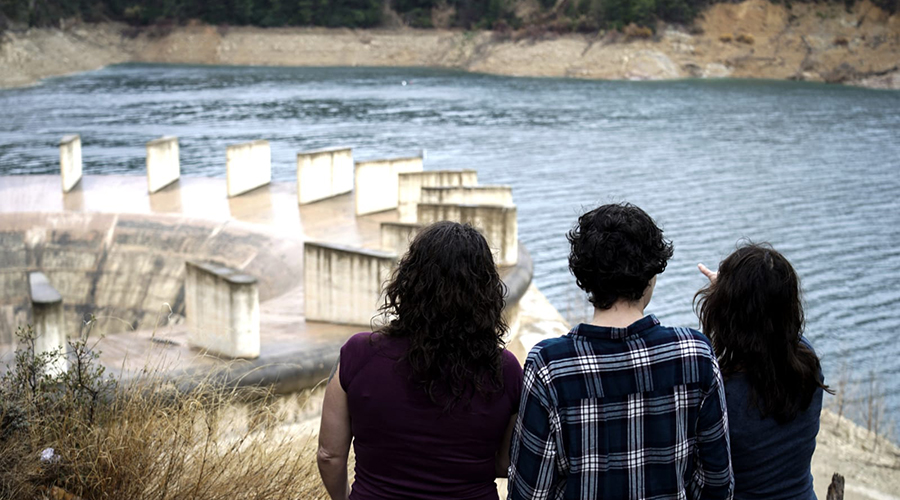
No, it has nothing to do with Oasis or Roger Michell. A "morning glory" is also called a type of scrapping that can occur in reservoirs. It is called that because the shape is like that of the flower that is also called that. He would be, to understand, like a giant toilet that swallows everything when the water level rises a lot. Morning glory talk about getting hard for that hole, d'abandon-se, to stop insisting, to let oneself be swallowed up by tiredness or to avoid tiredness, it depends on how you look at it. Free yourself from a burden that can be mental, physical, emotional… Quitting doesn't always have to be a failure, it can also be an act of survival, of care of herself. But it also means loss and that's scary, like that hole. On stage, three women investigate the disappearance of another woman near a reservoir, of a morning glory. They are discovering, confessing, questioning, inventing, interpreting what could be the reasons for wanting to get hard, to give up and accept a natural and inevitable suction. They discuss giving up fighting as a form of survival. Unnatural, but sometimes, necessary. along the way, actresses try to be pragmatic, but sometimes poetry, the theater, it invades them and they have to fight to make themselves understood and understand each other.
What team did you surround yourself with to do it??
Accompany Maribel Bayona and Julia Vicario, which is also in charge of part of the visual narration with different techniques such as collage i les miniatures. José Ramón Pérez "Jota" will make the sound space, and in the lights, will be Diego Sánchez. For production work, press and mediation, always with Begoña Palazón and Guada Sáez. In family, with always.
What is the fiber of the viewer that you want to shake?
I guess everyone will think of their own morning glory, shafts drilled through where, sometimes, we have been sucked in by forces greater than ourselves or where we have let go of those things that put us in danger. That double-edged sword that is self-care.
The Cabanyal Íntim festival has just announced that it is returning to 2024, but their panic last year was a clear symptom of the fragility of the sector. Later came the sad news that Sala Ultramar will close its doors after programming Morning glory. What has brought you to this situation??
We have been dragging a delicate situation for some time, with many difficulties to finance the project year after year, to justify aid that is usually resolved late and paid even later. Which none of the regional governments we have ever had, tot i know the problem, they wanted to solve. We have become accustomed to a constant state of worry, fatigue and frustration that has gotten worse this year, and well, finally, we had to say enough. It was not a good habit.
Actress, author, screenwriter, programmer and manager. Which facet do you stay with?? Why?
Actress. Because I have a better time.
As an actress, you have worked on many texts by Guadalupe Suárez and you have placed yourself under the orders of Eva Zapico more than once. What would you highlight about each of them??
From Guada, bueno, of his texts, the frankness, the precision. As an actress, it is very easy to understand it by the words, by the forms, the structures. Because his poetics clings to a very human truth and is very beautiful and very direct, and that is not easy to do, but Guada I do. D’Eva, with the director, so similar to Guada, needed… The accuracy, humor, the clear vision he has of the scene that makes you stay hard wherever he is, many things… It's that, Besides, we know each other well enough and it's very tasty, because when you already share and understand each other's codes, enough work, but more is achieved.
Your first long piece as an author, Azerbaijan, deals with the topic of the couple, i Alexandria, commissioned by the Valencian Institute of Culture (IVC) written together with Guadalupe Sáez, revolves around social networks, Internet and surveillance. What topics interest you?? How do you approach writing a new project??
I was once told that I write out of necessity. I think it's true. I think I'm interested in subjects that put me a little on the edge and that I don't quite understand and I always try to do it with humor, to be able to understand it better and offer (and offer myself) a somewhat disappointing ending… i believe. This year I also wrote, Finisterra, at the Dramatic Island Laboratory Josep Lluís Sirera, a l’IVC, and we did the reading at the beginning of December. Now I'm with Morning glory. For me, so I'm used to debuting as a playwright, it's enough. I'm fine with this for now.
As a screenwriter, you have worked for audiovisual projects by À punt com comedians. It changes a lot the way a job is charged when it is commissioned for a large corporation?
I was also in The cave of wounds in one Bitters, children's programs, i no, it has nothing to do with writing theater. In TV there are other more technical things, you have to adapt, get used to being told not to or to retouch or rewrite. You learn a lot, the truth. To be faster, for example, this suited me very well…
You will participate in that self-financed choral film of 2013, All with one voice, raised by the Valencian audiovisual sector in a time of crisis. A few weeks ago, the new regional administration made public its intention to withdraw all subsidies from the Valencian Audiovisual Academy. How do you rate this news??
Foreseeable. Bad and predictable.
With the programmer, what are you looking for when choosing a project?? We will not kill ourselves with gunspremiered at the Teatre Lliure de Barcelona in 2012 and Sala Ultramar took it to Valencia two years later, where his meteoric rise took place. What did you see in her?? You expected the success it had?
That it is consistent with our line of programming. At Ultramar we have always wanted to give value to living Valencian authorship and to all kinds of stage language. At that time I did not know Victor personally [Sánchez, author and director of the work], but the proposal fit in with Ultramar's line. I knew the actresses and actors and often you were also guided by the teams, because in this case, as in many premieres, there is no recording yet and you cannot see the entire proposal or a significant video of the proposal. You get an idea of everything and bet. I think it's our job. Or was… We knew it was going to be great, but I don't know if that much. It was scheduled I think three times in Ultramar and people were always left outside.
How complicated is the bureaucracy in the management of a performing arts hall? How have you conducted the dialogue with the institutions?
The bureaucracy is very complicated and very cumbersome. And until. And you understand that it has to be a little bit, but so much? Little, if it has to be like that, so be it, but what you can't do is drown out a public service to the point where you can't get your bearings, help you or offer you solutions that sometimes, not even they know. The dialogue with the administration depends on the person in front of you. There are people trying to help, but in these years, seeing the panorama up close, I think it has always seemed to me like a dialogue of the deaf or a white label sequence of the Marx brothers, I couldn't tell you. Absurd, but badly.
The Horta Theatre, a company with almost fifty years of experience, just won the National Performing Arts Award for Children and Youth and its co-founder, Alfred Pico, he told us a few months ago that he had reached a "precarious balance". How do you explain that a company with the history of L'Horta Teatre can only talk about a "precarious balance"?
It's just that I think it's a general and normal state because we're all in the same wheel and we know what's going on, how it is and how it works. Culture must be treated as a public service and the state must guarantee access to culture through subsidies or the mechanisms it considers to be effective so that an entrance to a theater like Ultramar does not cost 50 o 60 euros, because, Yeah, the actresses are paid and the room staff as well and registered and everything, and by the way you guarantee decent working conditions. If this is not managed according to the reality of the artists, and the deadlines for resolution and justification are as they are now, and we have to fund our own work many times over, blindly, as we are not going to be in a precarious state?
The synopsis of The joy is inside (2017), with which you will win the Award for Best Actress at the Mostra Teatre de Barcelona, he says that “from time to time, happiness is an exercise in endurance". you agree?
Yeah, i agree. But, We buy, I also think that, sometimes, you have to let one morning glory suck your happiness to stop resisting, even if it's a little mouse, i rest.