
UNTIL SUNDAY 8/9
F. BANCAJA. Pl. Tetouan, 23
The violent and pasted brushstrokes, Dark colors and the use of unorthodox materials are three characteristics shared by El Paso artists. From Madrid, a group of artists from different territories of the peninsula and the islands, joined, they gave one step at the forefront to renew Spanish art in a context of dictatorship, repression and immobility. Enough of the bourgeois painting of vases and hunts, It was necessary to break with the established canons and embrace the avant-garde of the moment without ever leaving aside the tenebrist essence of the Spanish tradition.. El Paso was formed in 1957 following in the wake of other European artistic groups that between the end of the 19th century and the beginning of the 20th century grouped together to reformulate the traditional precepts of art., break with the established and create a new aesthetic. Impressionists (19th century), futuristic (1909), dadaists (1918) the surrealists (1924) They were movements created collectively to renew the art of their time that established —many of them— its principles in founding manifestos. So did El Paso: “let us propose a strong and profound art, serious and significant, proclaimed loudly with the intention of renewing a traditional and isolationist Spanish artistic panorama, barren and desolate.
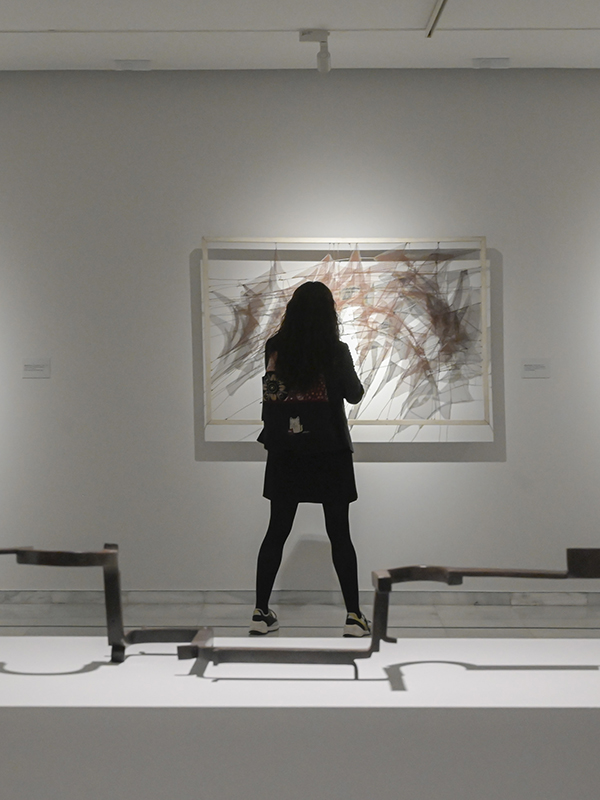
The artists embraced the informalism that came from Paris and American abstract expressionism. Manolo Millares, Luis Feito, Antonio Saura, Rafael Canogar, Juana French, Manuel Rivera, Antonio Suarez and the sculptor Pablo Serrano, They would later join the group Martin Chirino y Manuel Viola. The group was only active for three years. (1957-1960) and in that short period of time, in which there were disagreements and desertions, They were satisfied and dissolved the group to go their separate ways.. By then, Done, Millares and Saura had exhibited at the Sao Paolo Biennial, The group had represented Spain at the Venice Biennale in 1958 and the Moma in New York had dedicated an exhibition to them entitled New spanish painting and sculpture… International critics began to pay attention to them and the Franco regime exploited their fame by trying to imbue themselves with a halo of modernity., quite uncomfortable circumstance for a group that intended to take a step forward in favor of democracy and freedom. All of them meet at the Bancaja Foundation with their most emblematic works. You will find the abstract expressionism of Saura's violent and pasted brush strokes, sculptures by Pablo Serrano that follow in the wake of Julio González, the sandy oils of Feito, Canogar informalism that evokes the furrows of the tilled Castilian land, the torn burlap, wrinkled and sewn from Millares, Rivera's metal meshes, Viola's tenebrism halfway between abstraction and figuration and the works of Juana Francés from Alicante, the only woman in the group, who incorporates stones and sand from the beaches of Gandia into his paintings. all of them, representatives of a collective concern to renew the parameters of Spanish art that left its mark more than seventy years ago. S.M.