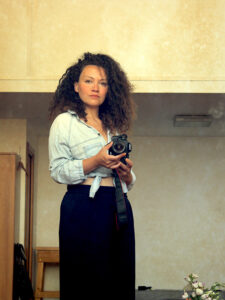

A text announces a tragic event: the death of a family at the hands of a thief. This is how the first feature film by director Sara Summa begins, which is being presented these days at Cinema Jove. The film jumps forward in time and space to show us the daily life of that family.; their rituals and customs, your small daily conflicts, his life, definitely. With very few elements, the director of Italian origin signs, in The last to see them, a beautiful painting of manners that, at the same time, challenges the viewer. He challenges us for his time management, of cinema codes, and above all it challenges us as human beings by putting us in front of the intimate circumstances of four lives., those of the members of this family, that open on the screen to expose themselves to our eyes. This exhibition will put on the table our vision of life and death and, above all, in the face of the codes of relationships prevailing in our society. The last to see them will be screened on Thursday 27/6 at The Film Library.
Your film is based on real events.
Yeah.
Why did you choose these events for your first full-length work??
It is based on real events, but the real events on which it is based are not those that are announced in the film. It is inspired by the same events that inspired Truman Capote to write In cold blood, that is to say, the murder of a family in Kansas in 1959. I started developing this project a long time ago, maybe ten years ago, when I first read the book, which is very different from the movie because Capote was interested in the murder and I wasn't, I was interested in the lives of people who died.. When I read the book, I was moved by these four characters and I went to their research archives at the New York Public Library and researched certain elements.. And that was the center of my project. When I started writing this film two years ago I decided to make my own translation of that context to introduce it into another that was closer to me., something I could talk about more easily than that Kansas of 1959. I am Italian and part of my family is from southern Italy, where we shot the movie. I was looking for a contemporary context in which I could transfer the reality of Kansas, a place of landowners, from small farms, a traditional religious social context, etc. So I thought of southern Italy because I come from there and, above all, through the landscape. The landscape is another character in the film and was very important to set my vision in motion..

One of the most complex things about the film is that you invent the intimacy of a family that does not exist. What inspired you to build that intimacy??
Yeah, It's true. There are people who have asked me if my family is religious., but not, although I know the reality of those small towns because I grew up in one of them. The family that I have invented is, in part, invention, although I took many of the elements from the real daily lives of those four characters, of those four people who lived in 1959. The act of baking a cake, there is a wedding, the mother is sick, many elements were extracted from that real family context. And the challenge was to transfer them to this other reality and create a fiction. Many of the things were created on the set., that is to say, the entire movie was written, there is a script, but the actors didn't have the script, We never gave them the script to prepare at home because they are not professional actors., They come from the place where we filmed, and a lot of the work was doing the scenes his way, on your own terms, sometimes in their own words, there are some touches of the local language in the dialogues. I also didn't try to make it completely naturalistic, that's why I didn't use professional actors. I wanted that kind of physical strangeness that only a non-professional actor offers you when he is in front of the camera.. There is a conceptual operation that consists of taking real facts, invent false ones from them and tell the audience that they are real facts, using real people to play fake characters in a not entirely realistic way. All of this creates a tension between something very artificial and something very real that I was interested in..
I wanted to ask you, in this sense, How was the work on the filming set?.
It was a challenge, but I think it was worth it. From the beginning, It was part of the project to work with non-professional actors. like i said, they didn't have a script. We only did a reading a month before filming so that they knew what the film was like and that they didn't feel manipulated in any way.. This way he avoided being prepared and got them to try to do it their way during the scenes.. Before shooting each scene, I told her what was going to happen, I told them the phrases and they had to learn them at that moment, so that they would not say them exactly as I had written them, but they did it their way, so that it was more natural.

How did you establish the emotional connection between the different actors that the film needed??
That has to do with the casting process.. Casting is a very important part of making a movie, especially for me, because everything depended on the people who were going to play these characters. It was a long process, but, at the same time, It soon became clear that these were going to be the four people. For example, I didn't want people who were exactly like the characters., but, at the same time, I wanted them to contribute something real that I could never invent. And that's real is the fact that they live in that landscape, that is to say, from a town near the place where we filmed. By this I mean that your physical appearance is different if you live your entire life in this type of place or in a city.. For example, the woman who plays the mother is physically very close to the character, She doesn't wear makeup and has that strong appearance where it seems like she's always depressed.. But the actress is a very vital woman who was always laughing and making jokes.. It wasn't always easy to find the right rhythm for this mother. With her we greatly exaggerated the slowness of her movements to find something interesting. In the end, It's not exactly how you imagined, but it was about building something of what I was looking for. I needed them to give life to these characters.
One of the things you do in this film is shoot the same events from different angles, that correspond to different points of view of each character. What was your intention?
There are many elements. On one side, For me, time is both unique and multiple.. For example, right now [during the interview] We are both sitting here and we are sharing this moment, but our experiences are different. You come from doing something else, I come from taking some photos, etc. After, You will go do your things and I will go do mine. Even in a physical way we have different experiences of this moment. I look at you, you look at me, but we don't see the same things, We don't experience this place and time the same way., although we are sharing it. This is something that fascinates me. I repeat these moments, but I don't show any special information in those replays, there is nothing new in terms of story plot. It's about experiencing time and space from four different points of view because they are four unique people., and those four unique people are going to die that night. And so, when we lose them, The emotion will be deeper if we have shared with each one of them that experience of what that space and time are like individually.. That was part of my research.. It was about putting time at the center of the film, like a protagonist, telling the viewer: pay attention to time because time is one of the main components. And that's the way this movie is built., because it is not a film that follows the classic narrative structure. Here attention is created on the knowledge that this will be the last day of their lives..
The last to see them It's a movie that, As you say, puts time at the center of the story. For it, and perhaps looking for that naturalness, you resort to very long sequence shots where everything happens apparently spontaneously, more reflection of real time than cinematographic time. Without a doubt one of the most important and difficult things about this film is in the management of that internal time of the scenes., on how to work and calculate that time to compose the set. How did you manage that time on set??
Yeah, It was complicated. How did I do it? Don't know, really. We just did it! (laughter) We prepare it… well, We prepared everything we could because we didn't have much of a budget., so we could only do it shortly after filming because, among other things, We found the location shortly before. We prepare each shot, but there was not as much preparation as is usual and, when we were on set, People moved the way they did and we had to rewrite part of the script adapting it to the needs of the camera as well., readapting everything to what was really happening. Sometimes you imagine that a scene is going to last ten minutes, but then it turns out that it lasts half as long. But the intention was to have a complete knowledge of space and time. This was at the heart of the language of the image, the flow of space and time. We placed the camera at an angle in the space and then let the actors move around the scene. We had done it once, we went to another space and recorded from a new angle. We tried to reduce the number of shots as much as possible to achieve that temporal and spatial continuity..

When I saw your film I thought it could very well be directed by Michael Haneke. Was it an inspiration for you??
Many people have mentioned Haneke or Funny gamesand those kinds of movies. I never thought about Funny games, maybe I did think in some way about The seventh continent, but very little, because there the characters killed themselves. No, I didn't really think much about Haneke because I think we have different visions. I mean that Haneke has a very dark vision of the world and I see this film closer to life than death, in life as something in positive relationship with respect to death, let's say. I was never interested in showing violence, That was never part of the idea of the movie.. It was more about the emotions that surround four lives. It's not about the how or the why, or when. It is about that knowledge that life is finite and that, for that very reason, it's beautiful. And that by observing every banal detail of daily life we realize it. I can understand why people see Haneke here and maybe I see it too in retrospect, but maybe I thought more, although it sounds strange, in Carlos Reygadas, because the landscape is the protagonist, by the use of non-professional actors, the use of silence, the context of a religious family in an ominous landscape… I thought about many directors whom I admire, but in the end we did things our way. They were perhaps at the beginning of the process, but then everything took its own course, found his own address.
Perhaps the reference to Haneke was not because of the use of violence, but for the management of time and the relationship you establish between the film and the audience, in how you manage their expectations to manipulate their dramatic expectations.
Yeah, exactly. Maybe there I thought more about ElephantSant's Gus, about the Colombine massacre, which also works with the repetition of time, where nothing happens, but you play with that knowledge. Yeah, There are many examples of this way of doing things., more than we think, but there is a moment when you have to stop thinking about all of them to think about what happens in your film.

At a time when it seems that everyone is questioning the traditional family model, your film is almost a kind of celebration of that family.
Yeah, I felt somehow fascinated by this family context, which is very traditional, based on family dynamics that are not current, even in terms of values, in the roles, in having a hierarchy, a very clear direction, The son knows that he will end up running his father's farm, these elements that do not have to be precisely the way I perceive the world, but that I find fascinating in terms of the tranquility that this way of traditional knowledge transmits.. In fact, I think people are returning to those certainties., in that traditional way, that hierarchy, that maybe it's something dangerous, in that way of organizing life and family because it seems that there are no more references. And I find it fascinating to teach this family context and understand the rigidities and dangers of this type of model in which, as individuals, they don't look very happy. But at the same time you love them like family too., there is a lot of empathy. I never intend to judge them from the outside, I feel empathy for each one of them. From the first moment I felt fascinated by these family dynamics and by these specific roles and conflicts resulting from this traditional knowledge of the world.. The two young people in this family may not agree too much with this way of seeing the world., but at the same time they are protected in this bubble from the outside real world. So, Yeah, There is something this way about family..
I would say that, in that sense, the film is not so much about telling a story as it is about creating a world. I don't know if that was your intention..
Yeah, What I am interested in cinema is in creating an experience. An experience that does not have to exist outside the movie theater. I'm not as interested in a story as I am in creating those experiences.. So, Yeah, I hope we have managed to create a world. A world that does not have to be a story with a beginning and an end, but what, finally, offers you moments to experience something that you don't have to experience in your everyday life. I hope we made it.
When you see this movie you immediately understand that, with a proposal so subtle in its approaches, There is some part of the public that cannot be immersed if it is not sensitive to certain issues. What opinions have you received from her??
Yeah, I am very surprised because I thought the film was very difficult for a very wide audience, but we are very happy because it has been selected by many festivals. At the Berlinale, where it premiered, There were seven hundred people in the room and then in other shows it was always full, that is to say, that there were many people who were not necessarily directors, critics or cinephiles, There was a very wide audience who came into contact with the film. I hoped people wouldn't stay at the end of the movie., but out of seven hundred people maybe three left, which was a real shock to me, but it made me very happy. I wanted to convince as many people as possible, and I was happy to hear from the audience who stayed for the discussions that they had been moved by the film. Sometimes they felt fear or anxiety due to the tension that runs through the film, but they saw something human in which they saw themselves reflected and that touched them. I know this is not going to happen to everyone., but it's okay. The film is not going to satisfy everyone because, otherwise, it wouldn't be so good (laughter) I think that, If someone went to see the movie with false expectations of seeing a thriller and such, I'm sure you're thinking “what is this?”?, nothing happens here, It's very boring.". But if you are open to something unexpected and different, If you don't have those expectations of being entertained every second of the narrative, I think everyone can find something..