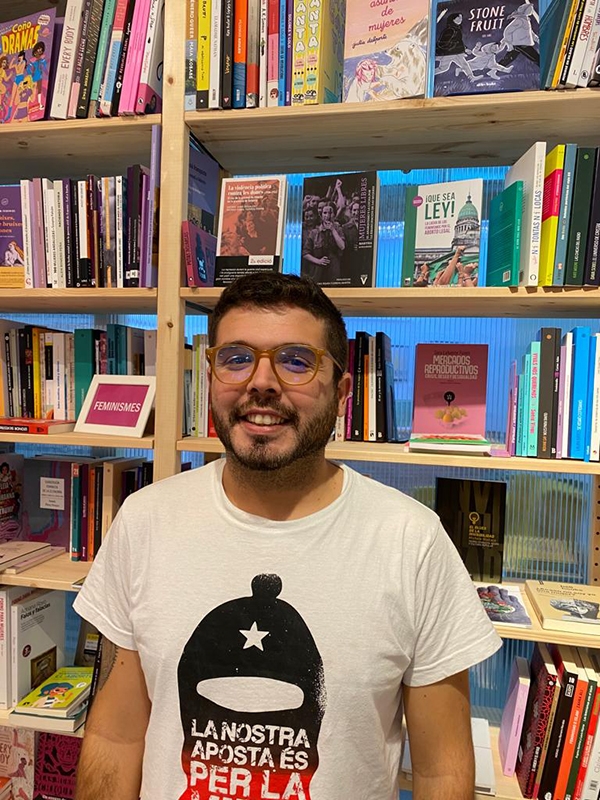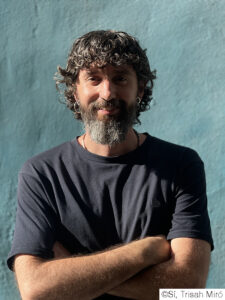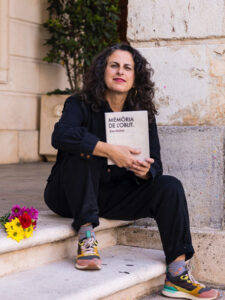
In Valencia, we have a new space dedicated to critical thinking called L’Espai Comú that brings together five projects united to knock down the stake of single thinking by pulling all together: the means of communication At Directa, the development cooperation NGO Mundubat, the feminist cooperative Formigues Liles, the social movement Per l'Horta and La repartidora. It is the bookstore that has promoted this joint project that began to walk in the past 15 of October after obtaining more than €32,000 with a micro-patronage campaign to finance the reform of a car workshop in 220 square meters in Benimaclet. There are still touches to be made and murals to be painted in this industrial air space lit by the light of a skylight, but it is already in action and hiding, behind a translucent polycarbonate screen signed by all the people who participated in the micro patronage, a common room for groups that want to use it, where between four and five events are held a month. In this interview we talk with Jordi G. Miravet of the gestation of the project, of the trajectory of La Repartidora and its publisher Caliu, of toxic masculinity, of Benimaclet and the Valencian associative fabric.
The Repartitora has hit many bacs. From Carrer Arquitecte Arnau landed in Torreta de Miramar —a very small space with thirty square meters of bookstore and twenty of room—and now Rafael Tramoyeres is planting a stick. What brought you from here to there??
We were at Arquitecte Arnau for three years and he kicked us out of the other project we were working on, for matters of contract ownership. They wanted to keep the place and they told us: "go away". At that time we paid 250 euros for a place that, it was not very well located, but it was big. I will have to land when I can. The project was in deficit at the time, do not charge, but we didn't earn enough to pay the expenses. It was a political project, a bookstore with the books we had. We live in a community project, that is to say, the people who were part of La Repartidora, when we started, we lived together. Two of us worked in the bookstore and the other two had other jobs, and sharing the economy made it possible to free Mar, who was the only person who only worked in the bookstore. A project with a deficit required unpaid work. Thanks to that formula, the project grew and now we are three people on staff.
How L'Espai Comú was cooked?
It came to a point that we will see that there [Miramar Torreta] we couldn't grow any more. Not a growth of having more books—we understand this as a political project—, but we couldn't bring people to the presentations. The band, There was the issue of Covid, the capacity was very small, we weren't working to our heart's content, the books were very much piled up… Let's do that thought of making a change, but this, it is not a change in economic terms of let's grow and grow, but in terms of being at ease, be calm, accommodate projects… More on that vision. I, obviously, if we were going to a big place, we have always said that we don't want to go alone, we are a project that understands that things must be done collectively and with other people. It is not a project in which we say, first we join and then we go find a venue. It is a project that we promote from La Repartidora. We first spoke to the people of Per l'Horta, but in that process many colleagues found out and joined. Mundubat found out through Per l'Horta; Lilac Ants, who are also companions, they told us they were interested too… Inertia arose here. How we work a lot in Valencia, or at least in our environment. Things are very natural, connections, mutual cooperation, she is very spontaneous, very natural, and it starts a lot from meeting us in practices. And where we went, The Direct he came with us, we have a lot of affinity, I also collaborate with The Direct. From here, once we had that insurance that the local didn't have to pay it only La Repartidora and we had certain minimums insured, we decide to promote a micro-patronage campaign in Goteo to pay for the renovation, which was fully taken over by La Repartidora, through what we could draw (or not) of the campaign.
Which was totally successful…
Yeah, reached the optimum level, even surpassed him. 32.600 euros, and participated more than 500 people, so we are very happy about that. Beyond being able to get the money, for the idea that you have a community behind you that supports and values what we had to do. They support you, you do the project and then you have the feedback of: "wafer, how choose what you have done with our money". liked it, people are very happy. There are a thousand open projects from that whole community, and in the end it was the idea, look for a great space to fulfill life, of things related to the world of the book, beyond what we can do better in terms of selling more, which is something we don't put in the center.

Imagine that you were clear that your neighborhood was Benimaclet.
Yeah. I think that such a bookshop would be complicated if it were to operate in a space other than Benimaclet. This in more unromantic terms, more materials. After, because Benimaclet is our home. Before entering the bookstore, they were already part of the associative fabric of the neighborhood, which at the same time has made us part of the bookstore, which at the same time has made us return to the associative fabric of the neighborhood. In the end it is our home. Pels factors materials, but also for the emotional ones, by the politicians, for social, I can't imagine the bookstore anywhere else.
Five bookstores coexist in Benimaclet [laughs]: The Red, The Traca, Study 64, Gaia and The Deliverer. I Primate if you want to tell it again. And they all work. This means many things. We could say that Benimaclet is the neighborhood with the most associative and combative fabric in the city of Valencia and that is our audience. We specialize in critical thinking and, in the end, it's our audience. Possibly we are mistaken and would work in other neighborhoods, eh, but jo, I wouldn't try [laughs]. We are an associative bookstore, this means that we finance ourselves through a fee paid by members, are some 200, most of them are people from the neighborhood. That's because of those connections, in the people of Cuidem Benimaclet, the people of the feminist assembly, the Earth and a thousand other collectives that are there. Those synergies that you create every day. Clar, if it's not all that fabric in other neighborhoods, it is much more difficult to generate that community that supports and sustains you. Benimaclet is very easy because the community is there, and it is very easy to generate it.
What kind of books can be found in La Repartidora?
We have the books in sections and they all have a critical look. In the children's section you won't find princess or Disney books, yes you will disturb the typical classic tales, but changed, with one more flip. També narrativa en català —perquè pensem que és important donar-li valor als llibres en la nostra llengua—, issues of sexual diversity, feminisms from all perspectives, also a clear commitment to environmentalism at a time like the current climate crisis, a lot of memory… It is a key issue, the fet of thinking-us, not to lose memory, to recover who we are and where we come from. And then, too, other topics such as Marxism or anarchism - also starting from memory or thought -, anti-racism, overall resistances… This whole idea of the politics of those who often do not have a voice. A bookstore like this, what he does, that is to say: here they do have a voice, here they can draw from that well of memory.
All the books are in Catalan?
Nooo, in fact, most are in Spanish because production in Spanish is much wider. Our editorial [Calius] Yes, it only publishes in Catalan, it is a political bet to give naturalness and normality to writing in our language here. what's going on, it should be the most normal thing in the world, write in Valencian in Valencia, but how is it not, fem eixa posta.
Tell me a little bit about the Caliu publishing house catalog.
Caliu is born to fill that gap that is given. Because the social movements did not have a narrative, no one will tell this. There are very few Valencian-speaking publishers in the Valencian Country… There are very few publishers in general. And those that are there deal with more general topics, children's narrative, like Joke. It does a lot of things, but it didn't touch that. We wanted to put this story on the table. Normally we make collective books where we give voice to social movements. We came from the student movement and the first book we made was one dedicated to our years in the student movement, because we understood that it is a cyclical process. you leave it, then others come who have no tools, there is no relief. then, we will publish a book to bear witness to what we had done, what we had done wrong, what we had done regularly… But that people would know where they could shoot. That's a bit of the philosophy.
We have books around feminism like Weave feminisms, a book in which there is a feminist perspective from the different struggles they are having, of urban planning, the community houses, environmentalism… We also have books about the struggles for territory that have taken place in recent years in the Valencian Country, we think it is also important to give that information. And a little bit of everything, texts by Rosa Luxemburg, who is a thinker with whom we align a lot. Two years ago it was one hundred years since his murder and we made a book in tribute to him. All very linked to the territory and speaking from here.
Recommend us a novelty that has recently entered…
Mira, I have just read a book by an anti-racist and feminist thinker from the United States, Bell Hooks, that talks about masculinity. He analyzes why toxic masculinity exists, of how patriarchy affects men, and because many times it is not included in the agenda of feminism either. Des d’una perspectiva molt pedagògica, makes an analysis and gives proposals to change the situation, how to help combat this toxic masculinity and make men able to feel other things and relate beyond anger and these behaviors. I thought it was very appropriate because she is a writer who is not afraid to talk about things that she knows can be problematic in her environment, because to say that patriarchy affects men more than women is something we do not consider, but when you read it it convinces you.
This approach is beginning to be heard and it is true that men also carry a heavy weight on their backs because of the patriarchy, of having to be strong, brave, provide for the family…
The perspective of what should not be lost, in the end, violence ends up being crueler and more explicit and fatal for women because men are the ones who exercise power, but the perspective of how all this is generated should not be lost either. That to men, in the first moments of his life, they are stripped of many feelings and many ways of relating, it is clear that it generates some mental problems for them. Not being able to express yourself is a very strong thing indeed, and this must be taken into account.
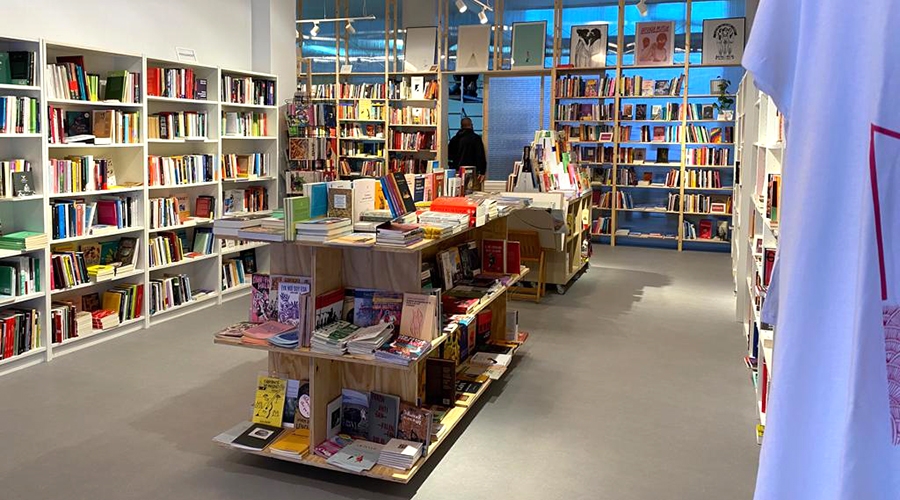
But La Repartidora doesn't only live on books, you also have t-shirts…
At first we looked for that double edge, beyond books, to maintain the project. The shirts were a nice addition. We have a lot to do with the U projectbeefe by Carles, t-shirt design, who has also set up a printing cooperative called Cendra. And thanks to him, with the margin of what we earned from his shirts, we will hold back the project a little at the beginning. I always have them diem, for which we are very grateful. The project has grown, he, for example, works in La Repartidora indirectly because in Caliu we made a collection called Xicalla for boys and girls, and he is the designer of that collection. It has also been from The illustrated Atlas of the Valencian regions.
T-shirts theme: they are integrated into what we know as ethical clothing, that is to say, made with sustainability criteria, of labor rights. And he is doing a very important job in this. For example, in the latest shirts, el cotó és d’Andalusia i la producció és valenciana, then the manufacturing process is tightened, distribution and sale of the product. If people come with clothes that do not meet these parameters, we tell them: “mira, the design is very choose, but it doesn't work for us because what we say must be in line with what we do". If you are telling me that women must make the revolution, but then that shirt was made by a woman in Bangladesh, this is of no use to me.
What events do you have in December??
In December, a course that talks about the idea of the commons will end. The ideal of the common is to generate a policy that does not have the markets as its center, that would be neoliberalism, nor the State, because in the end they understand that the state is also an agent of power. In the revolutions that have taken place with the state, in the end there has ended up being a hierarchy and some elites dominating the people of the town. Com, for example, to the USSR, which in the end has been state communism, there has been one party that has dominated the rest. then, we talk about putting the community at the center, like the zapatismo or indigenous movements in Latin America. They are more horizontal communities. Yes, there is popular organization, but he has a real assembly, there are no elites. During the course, we worked on how this can be specified here, because the reality in Latin America is very different. We have brought speakers who talk about cooperativism, of public-community management of common goods that is more horizontal and reaches the whole world.
In December we will present a book called Pantry kitchen. We work in the kitchen as a way of thinking about the territory, the kitchen as a key to food sovereignty, of local consumption. They are the recipes from Al paladar, with the life stories of the producers who make Al paladar possible, because they don't have a big distributor, sinó que cada cosa la compren en xicotets distribuïdors: the meat comes from extensive livestock farming in Alcublas, the beer is organic from Alcoi… We will present it on Friday 17/12, we will have a round table and then a tasting of Al paladar products.
And to finish, we have a strong associative movement in Valencia?
I see him better than ever. There was one more street cycle that ended in 2015, it was the 15M that stretched until municipalisms or institutional politics absorbed this. Or social movements were integrated within, let's call it what we want. It doesn't matter if it was bottom-up or top-down. Here there is a process of closing the political presence in the streets, of demonstrations, and from 2015 there is a whole institutional process, more invisible. For me, that I consider anti-capitalist, it is a process that has not carried out powerful structural changes, in the sense that the economy and people's material conditions change. This has not happened, although there have been improvements. Despite the feeling of defeat, why those things haven't changed, or that all that movement more explicit in the street of the years before the 2015 seems to have been lost, I think that in those years many people have gone to institutions, much else we have done an ant job. The Delivery Service is from 2014-2015, when that process begins. Caliu appears, the core of The Direct in the Valencian Country, are generated mogolló of cooperatives and political movements.
And another thing that I think is positive is that strongly marked organizational identities have been broken, and now politics is thought more from practices, is more open, it goes more to the real needs of the people. In Valencia I think there are three key movements: on the one hand Per l'Horta, a very important movement that has managed to win the last battles in territorial terms and to shield the vegetable garden a little, although there is much work to be done and I wish there could be more; on the other hand, the feminist movement, which is a very big victory. The most powerful thing about the feminist movement is that it has had the ability to enter into all other movements. That is to say, think about feminism, beyond feminism as a movement, which is also being very powerful. But I think this has ended up touching all the struggles and I think it's very important. And finally the neighborhood movement. The Entrebarris organization is articulating a whole neighborhood work resistance and neighborhood assemblies, compensating politics from the most micro, what is the neighborhood. They bring together the different neighborhood assemblies that exist: We take care of Benimaclet, Orioles in Block, Union of Barri Cabanyal… There are eight neighborhoods in Valencia that have their assemblies. This is very powerful because a more real and less identitarian policy is being made. Because, in the end, the black flag, roja, the star… all this is very identity, it shows a lot, but curds little and lands very little on the real needs of the people. Now there are many cooperatives, many projects, that they don't see each other that much, but they are generating a clearer alternative. That's my idea. He is still very optimistic, because the problem we currently have is very serious, and possibly the movements are not yet strong enough to deal with it.
It is said that the problem comes from the working class - if you can talk about the working class, but to understand us - no longer fighting for a common goal, that the struggle is being compartmentalized. Vegans around here, the LGTBI group over there… all more precarious but each in his own way mini struggle that isolates him.
Little, yes it is possible. I was just telling you the opposite. Although I think this happens in global terms, my reality, the one i know, he is running away from all this more. To think from diversity and not from identity. But this is something that you must keep in mind at all times because movements tend to close and become identitarian and you must be in the perspective of: “no, no, I am this, but I don't have the absolute truth". We are a reality in a much greater diversity and we all have to go to the same root that is in power. A power that is capitalist, racist, colonial i biocida, because it goes against life, against the planet. That is the root and each one, from its reality, must fight. But what you say is true. There is a book called The diversity trap who defends this thesis, that of the working class. But I think that thinking about the identity of the working class is a problem because, in the end, it is another identity. We all have a common goal, but if we don't think from the point of view of diversity, it's difficult to get there, because you are excluding a lot of people. Thinking about this diversity for me is the key to being able to reach a common goal.