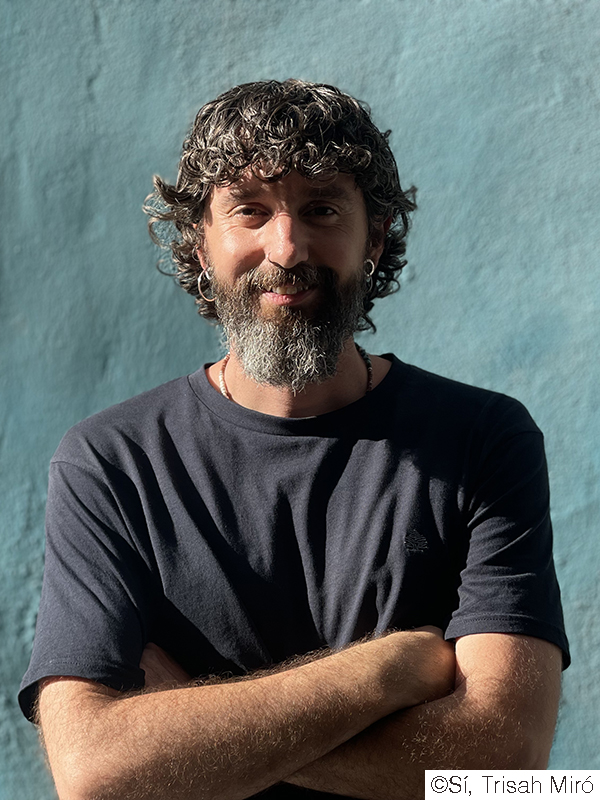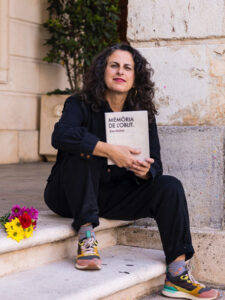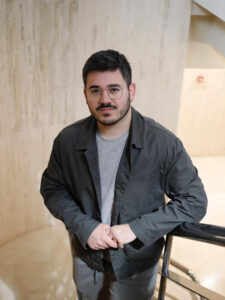
We had lunch with Lucas Sáez, art historian, specialist in underwater archeology, cultural manager and collaborator of the podcast On the other side of the mirror and from this magazine. He and Simón Fariza are the authors of the documentary Kaiser's spies. Submarines off the Valencian coast, that sets interest in underwater heritage, concretely, in the wrecks of ships and submarines from the First World War that lie on the seabed, a few miles from our coast. Heritage, geography, key episodes of the First World War and the symbolism of the sea are condensed in a documentary that À Punt should broadcast because it is unusual, surprising and bold. He begins his promotional journey now and we hope that the winds will be favorable to him. SERGIO BELLO
You studied Art History and have specialized in underwater heritage. How did you get there? Any family influence?
The day I decided I was eating in a restaurant with my father. It took me a long time to know what I wanted to study because high school, for me, it was four years. I went from sciences to letters and from letters to arts. I ended up doing the artistic baccalaureate at the I.E.S.. welcome. That is one thing I am very grateful to my family for.: They let me do that kind of thing., They let me experiment and make mistakes.. Already in the race, during that meal, my father told me: “Take a look at the topic of underwater archeology, since you like diving and the sea.” He let it out like someone saying anything else., but that made an impression on me, It stayed there in the depths of my consciousness and I already began to direct my race towards that exit..
Does the cinema, literature or comics had something to do with it?
Insurance. Cinema and literature I have always consumed a lot. My mother told me that I could spend my money on traveling and culture., That made me richer. Science fiction has always been my niche, I believe that from that framework you can talk about all the issues in life and provoke reflection.. But, of course, adventures have always been a constant, since I was little I wanted and sought to live adventures, obviously, at the scale that each moment allows you. Archeology has that point, but also a halo of romanticism. In the case of the underwater environment, besides, there is a factor that enhances that feeling.
Was the next natural step for you after finishing your degree in Art History to study Archeology??
yes and no. Teaching is perhaps the dominant trend, what happens is that, Archeology, when you come from Art History, It puts you in a bit of a weird situation., you understand it when you are there. In Art History we do not study practically anything about Prehistory, but people who come from History are very experienced in the subject when they come to Archeology. In the end, You are seeing other types of artifacts manufactured by humans that you are used to if you come from Art History., It's a bit strange profile, but we are enough. I still have a very good relationship with many of my master's classmates and we are in contact..
And next was the doctorate…
Originally, I really wanted to do it about the Roman period, but here I think prudence played a role. When one considers writing a thesis, have to look for new ideas, things that have not been investigated, as far as possible. There are not many underwater archaeologists in Spain—although there are more and more—, but those that exist, They are very good and some of them are great specialists in the Roman period. That's when, at some conferences, the idea crossed my mind: underwater cultural heritage, according to UNESCO, It is something that has been totally or partially submerged for at least one hundred years.. And at that time the centenary of the First World War began to mark.. That's when I saw that this was the topic.
It is a topic that has significance in today's society., ¿no?
Exact. It is linked to today's society, and begins to be a material conceived as heritage. There was a triad: a field to discover, linked to contemporaneity, and with the concept of heritage to work on. There I saw the vein.
How did the idea for the documentary come about??
Simón and I were working on an audiovisual project that had nothing to do with this topic.. Sometimes you hit the wall and things don't go the way you want.. We had an idea in our head, but there were deadlines, a few times, some requirements that restricted us. We made a project and showed it to Trisah, he studied it and told us: “Guys, This isn't going anywhere.” That sometimes happens. Then Simon told me: “I've been thinking about your research for a while.” I told him that there was material there, The thing is, I didn't know if it could stick.. Then he asked me if I would be able to give him a thread.. That's when I thought of an interesting character, Robert Morath, that I thought it could serve as an excuse to tell about the presence of submarines on the Valencian coast. So we started working on a new project., we discard the previous one and get unstuck. Everything began to flow and we believe that the work turned out to be quite interesting..
What exactly is the film about??
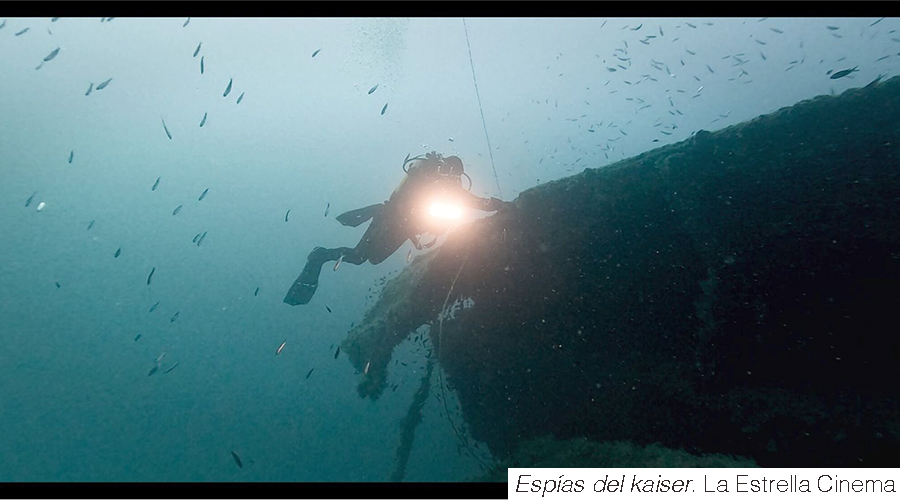
Tells a part of our story, a very little known one. We are talking about a specific period, the first world war, in a certain place: our coasts. A historical episode in which Spain played a neutral role, but that does not mean that it was foreign to him. Through a specific case, the history of the German submarine U64, and his commander, Robert Morath, We show in a broader way what the naval battle in the Mediterranean meant. It's an adventure story, of characters straddling two eras and events that generated an underwater cultural heritage that today we have to identify, protect, study and disseminate.
On a more personal level, Who encouraged you with the project??
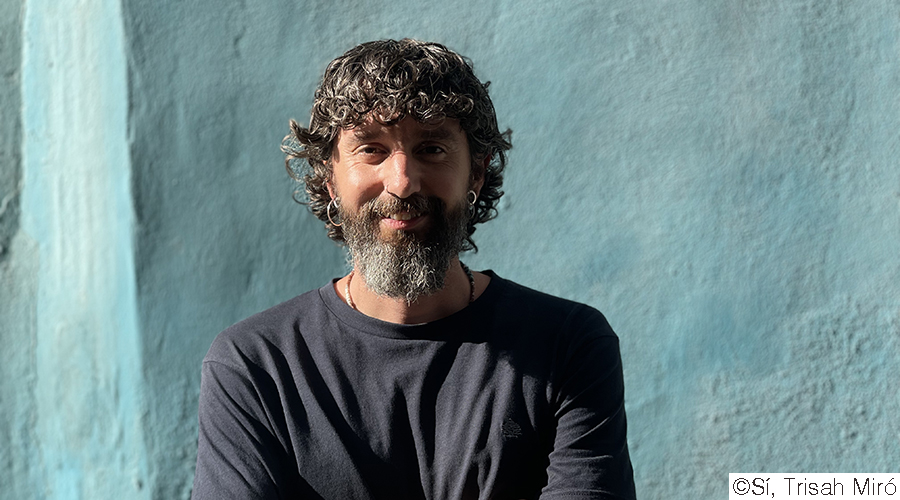
Patri has been my partner (Trisah Miro). He insisted on me a lot, because it is very difficult for one to read, listen… I have been collaborating on the podcast for ten years. On the other side of the mirror, a program about diving. I have a specific section called The conspiracy of the wrecks, where I talk about underwater archeology on a regular basis. It all started with the thesis, for which I collected information on wrecks from the First World War and realized I had a lot of information I wanted to share. Monté el blog <patrimoniosubacuatico.net> for dissemination, without any specific intention, and a radio station from Madrid contacted me. This is how I started on the podcast. I had never considered communicating anything, at all. Regarding the documentary, It was my colleague who told me that it would be interesting for me to do outreach and get out of the academic field.. If you research something very thoroughly but it stays in a drawer or in a thesis cornered on a shelf, it's very nice, it is necessary, but… does it actually arrive? I have been moving towards the idea of raising people's awareness about the concept of heritage., its protection and recognition.
Of course, what is not communicated does not exist.
Exactly. I had a professor in one of these postgraduate courses who said: “Under water you recognize what you know.” A recreational diver can locate a Roman anchor trap, but if you have never seen one and don't know its morphology, he will not recognize it, because marine life is colonizing it and little by little changing its shape. If you have an educated eye, when you dive, you see it; if you see it, you can raise the alarm; if the alert is given, can be protected; if it is protected, can be studied.
It can also be plundered…
Yeah, If you want, we can talk about the issue of plunder.. But one also becomes aware, If you know that it has no economic value in that sense. That's something we fight a lot against.: the concept of “tesoro”. I don't like using that word at all., because it has an economic connotation. One thinks of treasure and thinks of something valuable in monetary terms.; Of course it has value, It is valuable at the patrimonial level, but not commercial. What happens is that in the press there are like three words that appear a lot: “tesoro”, the “Titanic of” (I mean, “located the Titanic of the Phoenicians”); and from time to time, “Atlantis”. These are things that appear recurrently because they are hooks that work in the headlines..
The sea has that dimension of idealization, to project one's own desires overseas, ¿no? It is something that has always attracted the collective imagination..
Fully. The sea has a beautiful dichotomy: just as it is a means of communication for people, merchandise and ideas, It is also a barrier. There are civilizations that have not felt the need to navigate, few, but some. For them, the sea was a barrier, the end of the world. But there have been societies throughout history for which it was obvious that they had to cross the sea, and it was obvious that they were taking a risk. We have that expansive need, and I do not speak from a colonial or imperialist vision, that also; I'm talking about wanting to know what's beyond. The first natural barrier that we have been able to overcome since time immemorial is the sea.
What did your meeting with the underwater documentary filmmaker Josep Maria Castellvi mean??
I have never been much of a football fan., but I had a neighbor, many years, downstairs, to Mario Alberto Kempes. One day I had a party at home and he came to tell us off.. I opened the door and my friends were amazed. I had never had that feeling of being in front of someone like that., but with Josep Maria Castellvi it happened to me a little: I felt like a child watching his striker. When I started getting to know his work, his books… I went a little groupie: I brought him the books so he could sign them when I went to interview him.. Everyone we've talked to has been great., but I felt that special point of admiration with Josep Maria: It is an admiration for the work, to the form, to the personality, how do you tell it, how it works… I have investigated Robert Morath, but what I know about him is what has been published. The one who really knows about Robert Morath and this whole story is Josep Maria.
How was the trip to Germany to film?, some anecdote?
It was very fun. Simón wanted – and I found this very interesting for the documentary – for all the participants to express themselves in their own language., whatever it was, because this way they are more comfortable and it is more natural. That's why we have people speaking in French, in german, in Catalan and Spanish. When we get to the Kriegsarchiv archive, I asked them questions in English, but the man answered me everything in German (we had previously made all the answers in English too), but I don't understand German at all. In the documentary you can see it a little on my face when I watch it.. The laughter was in the van back, hoping that he had said in German the same thing that we had understood in English. At the end of this adventure, we stay with the people we have been able to meet, the stories they have told us and the experience of opening our minds and understanding our own history in a broader way. I have to confess that we are already thinking about the next project.
Regarding this, How is the distribution going??
It's costing a lot. It is not only the commercial interest of selling it, it is the interest of being seen, why, in the end, things like that are done for that. We are knocking on the doors of specialized channels, although we already know that many have their own production company. Believe, sincerely, which is a documentary that should be on Valencian public television. By theme and because the target audience who is interested in this history of their territory is the Valencian. Then, by extension, we can go to other parts of the Mediterranean: Catalonia and the Balearic Islands. The documentary is made in two versions, in Valencian and Spanish.