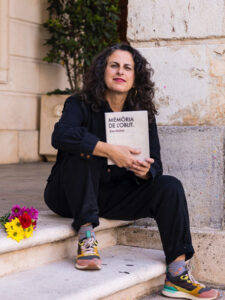
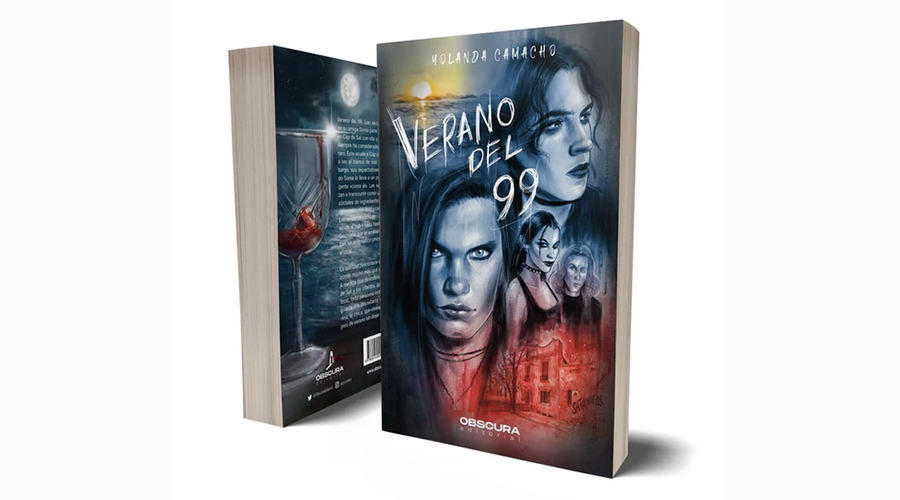
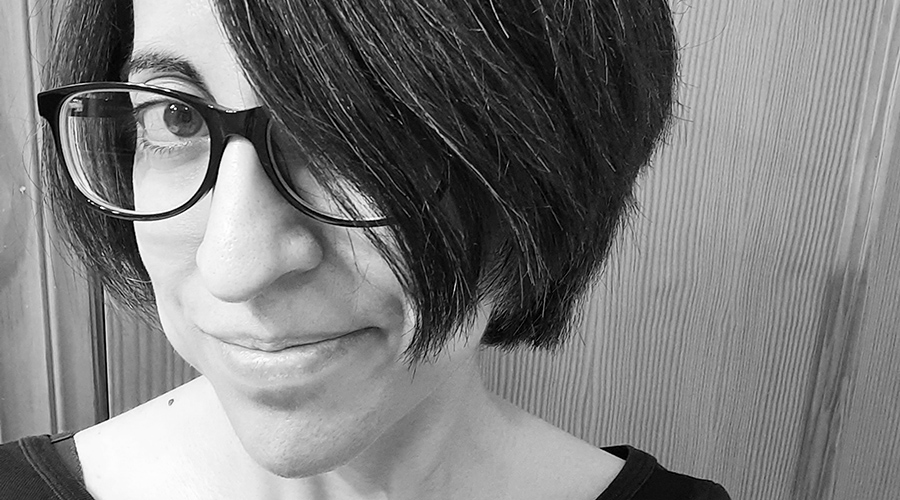
Leo is a young man who is going to spend a few summer days in Cap de Sal, a town on the Valencian coast, with her friend Sonia. Leo is a special boy or, at least, He perceives himself differently from the rest of Sonia's friends., that move it. But, on those vacations, A pub has opened in the town that seems to fit in. Leo spends one night after another in the pub. There he meets Sebastian, one of the owners, to whom you are attracted. But Sebastian and his partners keep a dark secret. Hay, besides, another mystery: the disappearance of a girl named Marina whose whereabouts no one knows. Leo is involved, So, in a series of strange situations. This is the argument of Summer of 99 (Dark editorial), latest book by Yolanda Camacho (Valencia, 1983). We talked to her about vampires, literature and many other things. GERARDO LEON
Where did the idea for this story come from??
Well, it's so old that it's already hard for me... (laughter) I have a lot of obsession with vampires., since always. Start small, when I saw Interview with the vampire (Neil Jordan, 1994) and it blew my mind... And I stayed there (laughter) Actually, I couldn't really say where it came from.. It was during a typical summer when you're young, you get bored, you are listening to a lot of music, you are a bit dark, And that idea of what would happen if came to mind. [the vampires] they had a pub. It's true that the pub thing came about because of a book that I was very obsessed with at the time., The music of the vampires de Poppy Z. Brite. There is a vampire who starts running a bar in a neighborhood of New Orleans. That's when the image of a person in that bar arose., in the middle of a summer, boring... It's true that the first version didn't have that vacation element. In the first version, The protagonist was a girl and it took place in her own town., But the story changed a lot over the years..
The vampire genre is closely connected to literature and, above all, Anglo-Saxon cinema. In that sense, One of the most difficult challenges to overcome is how to transfer this entire universe, with a series of very established codes, to a culturally different space, in this case, to the Valencian coast. I think that the book manages to bring those genre codes very well to that space and to another culture.. How did you think about it??
I have always thought that, to give credibility to a story, It is best that everything be as close as possible. There are many people, even in Spain, who set their stories in the United States or other countries, but I have always thought that, If I want the story to be tangible and know what I am writing about, It has to come from a space very close to me, because it's what I know. The thing is, If I start writing about other places, I will end up falling into the clichés that I know from the movies. If I have not lived in another country, what am I going to write? Whenever I write I do it with the story set here. Bueno, I don't always mention where it's set., but I never try to give the impression that we are somewhere else. I always resort to what is closest to me.
In that conspiracy of elements, What was the biggest challenge you encountered??
For me, The most complicated thing was that I was so obsessed with making it believable that it hindered the action a bit.. I am aware that many people who read fantasy genre always want everything to be more exaggerated., let there be more monsters, more blood... For me it's the other way around. At the time of writing, I always try to make the story at a level where, if someone told me, I would be left wondering if it could have really happened.. But, Of course, a lot of people don't like that. Many people read fantastic, expecting it to be something very, very far from reality. In that sense, it scared me a little. This is a small story that always remains discreet.. That is to say, strange things are happening, but, if someone told you, you would say, is this true? That's why I was a little afraid that it might seem like it has little action.
Renewing the codes of a genre that is so exploited seems very difficult to me.. But I believe that the novel also manages to overcome that obstacle.. For example, the fact that vampires don't have fangs. Or at least it is not said if they have them, which creates an interesting atmosphere. How would you address that problem??
I was thinking a lot about what kind of vampire I was going to make.. He told me, vale, Is he a real vampire or is he someone who drinks blood, but it is not what we understand by vampire? In the end, It was a combination of several things.. It was not going to be the typical figure that we all know, with fangs, that do not step on the street, etc., but I did want it to have some typical elements: let them worry about too much sun, the fact that they live in a kind of lair... I also wanted to play with the protagonist's conversations [Leo] with Sebastian about vampires. For example, Those movies in which someone starts searching on Google seem very absurd to me.: vampire (laughter) We all know what a vampire is!! If the protagonist begins to imagine that there are vampires, he himself already knows them. To what extent is it logical for you to act as if you have no idea? The normal thing is that he himself has references, who has seen movies, and use that knowledge to ask, but, oye, what do you do? (laughter)
In that sense, I find the game of ambiguities that the novel is posing all the time interesting.. Why were you so interested in that game??
I return to the topic of reality. There are people who have told me that it is strange that Leo does not first suspect what is happening.. But, we go back to the same: this is real life. If this were happening to you, You would think that these people are involved in some shady business, but you wouldn't think they're doing what they're doing because that doesn't happen. from outside, from the point of view of a fantasy reader, could say: the protagonist does not find out. But, in real life, you wouldn't think so. You would be thinking strange things, there would be misgivings, but you wouldn't even get an idea. I wanted to have a lot of influence on that.. Then there is also the issue that they are young!! Y, when you are young, the feeling of danger is quite relative. you think you're very smart, you go to your ball, and although you see alarming things, It's like nothing happened.
I was going to ask you about that because, clearing up what is the plot that holds the book, it seems to me that, In fact, It's a pretty interesting portrait of adolescence., of their behaviors and contradictions. You have also discussed this in your other books.. Was it your intention to make that portrait??
Yeah, a little yes. There's the thing about being a teenager and the fact that you don't have anyone who shares your interests and you feel a little outsider (laughter). Normally, when I write youth there is always that profile. I like to think that someone will read it and, if you feel like that, like “I don't have anyone to talk to about these things”, let him know that, in the end, there is always someone who is there to listen to you. What, inside your small circle, what you are used to, you still feel very alone, but, in the end, there are always people beyond. It's true that those people over there also have their problems., oh well. (laughter)
For what you've done so far, It seems that you use gender to always address some issue of this type. It is not exactly the story that gives the meaning of the novel, but there is something you want to say that then takes the form of a story.
Yeah, above all, now. It is true that, when the novel occurred to me, everything was purer, there was the fantastic story and that's it. But, little by little, I have been wanting to talk about more things: of the media, about how the topic of disappearances is trivialized... At that time, talk shows were on the rise in which anyone would appear giving their opinion on anything without having a clue.. This is what happens with the environment of young people, who also never know what they are doing. They are censored because they look strange or because they listen to such music, but you don't really know them either, you don't know what they are doing with their free time, you don't know who they are going with. In the end, everyone ends up making conjectures and giving opinions, but you never know what's going on there.
One of the things that seems most notable to me about the book is how you convey the emotions of that stage of life, but also their language. It is not simply a representation. I wanted to ask you, What is it like to write about those ages?, and have a certain consistency, from the passage of time or with your current age?
I think it's a matter of remembering a little (laughter) There are people who, even, He tells me that he doesn't like when I write juvenile. They are people my age, what does it tell you: It's just that the youth thing is already very far away from me. Yeah, catches you away. But, you have been young! (laughter) No one has reached forty without having passed through being young. In the end, You just have to think a little about what you were like then.. It is true that, in this case, as it's a story I've been developing for a long time and the first versions came about when I was younger, simply, It was about keeping his spirit. It is also true that history takes place in the 99. If I had to write about the young people of today, I still get lost, but in the 99 I was that age. It's how I felt at that moment.
The protagonist is that boy who feels or perceives himself different from others., the weird one of the gang. Why is the strange always so dramatically attractive to us??
In my case it is more a matter of identification than because I consciously think about it or because I think that this will attract more.. In fact, I was convinced that it could be a problem because, now, there is less identification with the strange. I think that, in the nineties, he took the character a lot outsaider, but not now. Now I get the feeling that people are more likely to think that a character like that can be haughty., who is playing cool or trying to be special. Before it didn't happen so much. But, in my case, It has been more of a question of identification. And also because for the story it was the excuse for him to end up overlooking things and approaching people who are not in his circle.. Leo really needs to meet people with whom he can be himself.
Music also plays a very important role in the book.. You name many groups, even songs. I wanted to ask you if it is a simple exercise in nostalgia, vindication of the culture of an era, or had some other value to the story. You mention Placebo, Suede, Massive Attack and so many other groups, even earlier, like David Bowie or The Cure.
Music helped me set the mood for the time, because it is true that the story was not always set in the nineties. In fact, had versions located more now. But, at a given time, It seemed to me that it was logical. In it 99, I felt closer to that story. Yeah, all the music that is mentioned and that appears in the Playlist [what we find in the book], It's from that time, helps you get into that time. It was to recreate the atmosphere and tastes of the moment.
This is a book with quite a sense of humor.. How do you use that resource?? Is it something that comes to you or is it something you have planned from the beginning??
I think that humor is useful for that moment when you know that something is too absurd for you or that in real life it would be very absurd., to tone down. The vampire is a character that we know so much that, in the end, Humor helped me to handle that situation in which a human is talking to a vampire and there are things that he knows and imagines..
In a note at the end of the text you talk about Dracula of Coppola and, above all, Interview with the vampireby Neil Jordan, the one you already mentioned. I remembered the movie and it is true that it has some elements in common with your novel. There are these three vampires trying to figure out what to do., whether they should surrender to the passion of blood or repress themselves. Is this an intentional homage or were you not so aware of that reference??
And, Yeah. I believe that this vision of vampire society in which some want to stay in the shadows and others do not, It's already a bit universal (laughter) It helped me build the relationship between them.. And also to think about how those people are organized, or what they say, which sometimes is not very sustainable. From your point of view, do what they want, it doesn't make sense. But, It is also true that they want to have fun. You are bitchy because you lead a way of life that is a little strange, and you can't do what you want? It is the struggle between the immaturity of the vampire who only wants to have fun and is not aware that doing what he wants is not always feasible., and the one who is clearer that yes.
For me the book has suggested a final reflection, what would be something like: “Be careful not to look down on people because it can end badly.”. I don't know if you share it.
(laughter) Yeah, It also deals with a bit of that “let's see who you trust” thing.. Maybe it wasn't intentional., but I do think that, in the end, What the book talks about most is when you underestimate danger, of those moments when you feel so comfortable in a place that you don't see the red flag anywhere. And then, Yeah, There is also what you say about those friendships that you end up despising and that, in the end, what awaits you on the other side is not that big of a deal.
Without revealing anything. Would you say that, in the end, Summer of 99 it would be a love story?
A ver, there is love... or something similar (laughter) I wouldn't say it's a love story either., but of course, at those ages love is important. I don't think I could have written the same story., with all its ingredients, without intense feelings. It wouldn't have made sense.
I have the impression that there is currently a lot of interest in genre literature. What do you think it is due to??
I think people are realizing that a fantasy story is not necessarily a minor genre.. You can talk about things in life, of feelings and important things with fantastic ingredients. for a long time, people thought that real literature, he would be, the police officer was realistic, y, then, it was fantastic, which was like an escape. First, There is nothing wrong with something being an escape.. A work can be evasive and be wonderful. But, besides, is that you can talk about serious things without leaving aside the fantastic ingredient. In fact, sometimes it is very useful to talk about those things. There are still many people who think that the fantastic is minor or marginal., but, little by little, there are less and less. There are more and more festivals and more editorials. I think this is going to go up.
Spain is a very powerful market for this type of literature.
Yeah, I think it's at a good point now.. Many festivals are emerging, many publishers, There are many people who write fantastic... And then, It has many subgenres. I'm already lost because they have their own name and classification. But, I go back to what I did before: The main thing is to understand that a work can be profound and talk about human and “serious” things., although it is fantastic.