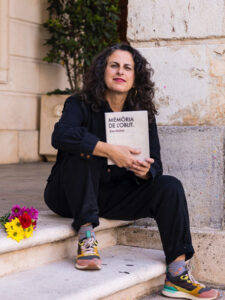
The protagonist of exhausted mares He begins by declaring his admiration for a sad mother tired of working to the point of exhaustion and turns on a tap from which abuse comes out., job insecurity, cultural elitism or linguistic conflicts crossed by class consciousness. Because what Bibiana Collado Cabrera wants to talk about is those below, of the Spanish-speaking children of poor migrants who listened to Camela in Valencia in the nineties and upon arriving at college they betrayed its origin due to details as banal as the way the fruit is eaten.
exhausted mares It is a self-referential book in which you tell real experiences or that, at least, they seem like it. Why did you choose this format??
“The poet is a pretender. / Fake it so completely / that even pretends that it is pain / the pain you really feel”. Fernando Pessoa told us that the poet is a pretender. The novelist, also. exhausted mares It is a book written in first person. Its protagonist, Beatriz, He takes us by the hand and shows us his “little” hell. Along the way, he reflects on the process of writing the novel., about the nature of the episodes he wants to tell, about what you can or can't say… And build thought together with the people who read the work. This gesture of accompaniment and immersion to be able to build a collective story is more powerful from the first person.
Andrea Abreu in Donkey Belly describes the poor Tenerife that does not enjoy hotels, cleans them. In Supersaurio, Meryem El Mehdati portrays job insecurity with autofiction and in exhausted mares Beatriz, the protagonist, She tells how her mother had to fight with the janitors of the apartments she cleaned to let the girl bathe in the pool while she worked. Has class consciousness reached the publishing world?
The cultural products that surround us tend to erase class or make us project ourselves onto a class horizon that does not correspond to our reality.. Indeed, In today's young narrative this crack is becoming evident, that non-correspondence. The publishing world is knowing how to take this point and readers appreciate it..
This class consciousness runs through the entire book., starting with the title. ¿Las exhausted mares are those working class women who can't afford to rest?
Exhausted mares are our grandmothers, our mothers, our aunts… It's us. It's us. in the novel, Beatriz explains it like this: “Growing up consisted of understanding the reasons why my mother was almost always serious and sad.. The main one was simple, simple and overwhelming: I was tired. Not tired metaphorically, not tired of the world and its problems, of misunderstanding or fights. No. I was literally tired, physically tired. Busted from working so much, like a mare always exhausted at the end of a race that never ends”.
You say that financial problems are a great obstacle to love, but they are rarely reflected in the literature. Why do you think literature ignores this important aspect in love and life??
In our sentimental education there is an erasure of the economic. Money appears rarely in our traditional fiction and, when it appears, It usually does so within a generalist structure that does not analyze or challenge the specific.. Hence we have integrated monetary stereotypes that do not allow us to see beyond. As Beatriz says in the book: “Lolita never pays the bill”.

Pedro's financial problems, one of the characters in the book, They undermine his “masculinity” and are a determining factor in his violent behavior. Explain to us this relationship between precarious economies and abuse.
Pedro is fifteen years older than Beatriz. According to the cultural canons that we have inherited, He should have a more favorable and stable economic position than his partner. She should be “the spoiled”. However, He has a very precarious situation within the university world and has been left without money after his divorce. It will be impossible for him to respond to that masculine role that overshadows the relationships of older men with young women and that will generate frustration that will lead to violence..
You describe a very perverse situation of abuse that always has a sweet prepared to compensate for the bitterness.. Is this how abusers manage to deactivate their victims??
Victims are deactivated by a system that runs through us and continues to perpetuate itself.. For your part, Abusers often combine episodes of extreme violence with other “honeymoon” with those who try to erase the damage and undermine the perception of the victims. I addressed this aspect in my previous book, the poetry collection Violence (The Beautiful Warsaw, 2020).
You draw a line between the children of liberal professionals with a certain cultural level and the children of farmers or construction workers who have not absorbed the culture at home.. The latter arrive at the faculty more scared, suspicious and insecure. What role does culture play in this sense??
What role does origin play?? What role does the cultural genealogy with which our family or friends connect?? Does it condition our way of being in the world, our professional future or our emotional relationships? They play a crucial role and of course they condition us, That is precisely one of the main theses of the novel..
Explanations like Camela, a popular group whose cassettes were sold at the gas station and that did not appear on TV, could help understand what class consciousness was.
Camela did not appear on television and was not heard on music stations. He didn't have a big company as backing. Their cassettes were not found in the usual stores. Nevertheless, They achieved overwhelming and undeniable success. From a peripheral place, from the margins, They managed to occupy the center of the cultural panorama. Almost without support and jumping into the mammoth music industry. The sociological phenomenon that it entailed and the very interesting evolutionary curve of its reception are worthy of a serious and in-depth study.. Who started listening to Camela?, With what cultural genealogy do they connect??, Who felt represented and why??, etc. in the novel, Beatriz, being a teenager, She attends a Camela concert scheduled during the patron saint festivities of her town and is shocked to see the number of people who are listening to this group that was not talked about in any media.. that night, singing their songs out loud, He understood what class consciousness was.. It's one of my favorite passages in the book..
It was a group despised by cultural elitism that now receives some recognition, but, according to your book, from condescension. Does the distinction between high and low culture hurt?
Yeah. Y, besides, It is a false and inoperative distinction to carry out an analysis of what happens to us as a society.. Cultural studies long ago abandoned this terminology.. a piece of advice: if you hear someone using it, match.
The book raises a couple of very interesting questions for which there is no answer., I don't know if you have any hypothesis about where the shots are going.: Why did Camela embarrass us and Estopa not so much?? Why is Rosalía covering Los Chunguitos a genius and Estopa singing “El del medio de los Chichos” were neighborhood kids??
Of course I have it. We all have it. And in the book you can read between the lines. Elitism, subalternity or racialization are key to answering these questions. I could have dedicated an entire chapter of the book to weeding it out, but readers are smart.
The book draws a distinction between those who have time (economic privilege) to wait, to get a teaching position at the university, For example, and those who NOW need a full salary to be able to live. We know that privileges are inherited, Is the culture of bowing one's head also inherited??
Of course. The imaginary of those below It is inherited and it is that imaginary that constitutes the core of our identity.. This is observed very clearly when Beatriz's arrival at the university is narrated..
Is the individualism and atomization in which we are established deactivating class and gender consciousness?? Does the fear of losing our livelihood make us docile?
Yeah. And if. It's not that you've had bad luck., It doesn't just happen to you., It is not something specific. These are systemic problems that affect the majority of people.. Becoming aware that it is a collective issue is essential.
The book explains how the children of migrants (poor and “castillians”) Those who spoke clumsily in Valencian were sarcastically called “chamó y qués”. It is paradoxical that those labeled as “villagers” for speaking their language, persecuted and discredited for a long time, then they make fun of Spanish speakers who try to speak it. How do you explain?
The chapter of the novel in which the anecdote you allude to is told is called From when the daughter of Andalusians wanted to teach Catalan at a foreign university and aims to show how any language can be used to indicate and negatively mark the origin, that is to say, can be used as a tool to exert class violence. That's why, in that chapter, both directions are appreciated: in the town, the object of ridicule at school is the Spanish of those children of migrants (mostly Andalusian); however, in the city, The object of ridicule is the Valencian of those who have come from the town to study at the university.
In one of the metaliterary sections of the book you say that in Valencia there is no equivalent to the imaginary of the charny. Wouldn't it be churro?
The truth is that no. According to the RAE, he charny It is the “immigrant in Catalonia from a non-Catalan speaking Spanish region”. But he churro is not the immigrant in the Valencian Community from a non-Catalan speaking Spanish region, but rather it is said “of the Aragonese and the inhabitants of the mountainous part of the Kingdom of Valencia who speak Spanish with Aragonese features”. Therefore, churro is not an immigrant (or it doesn't have to be), while the charnego does, with everything that entails.