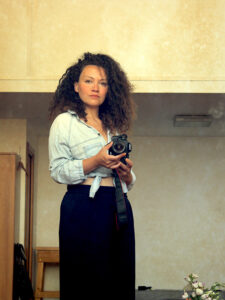

This is the story of Iris. Iris is a young woman who has a dream: become a fallera artist and one day build one of those monuments that decorate the streets of Valencia during its major festivals. Iris is studying a vocational training module to become, some day, a great professional. As class work it has been chosen to design a fault. However, have a problem: can't find his inspiration. For it, begins a research project that will lead her to interview some of the most relevant Fallas and Fallas artists. jays Alicante. It is true that, at the moment, the number of women in the union is still residual, but things are changing. In conversations with the artists, Iris will find herself and that muse she pursues. But, to this personal problem, another unexpected circumstance is added: the appearance of Covid-19 in our lives. With the spread of the pandemic, the news of a possible closure of the fallaes 2020 it seems, daily, a reality. Uncertainty about artistic work is combined, now, a huge anxiety about the future.
This is the plot line of Flashes of light, documentary directed by Nacho Ruipérez, director known for his countless short films and for directing his first fiction feature film, The disinterment, film that was released just a couple of years ago in commercial theaters and with which it would sweep the Valencian Audiovisual Academy awards. We were chatting with Ruipérez about this single, but emotional, project that has kept him busy in the months following that confinement to which we were forced during the first State of Alarm and that opens today, mars 8/12, inside Cinema Jove, at 8:30 p.m.. at the Main Theater.

You go beyond fiction, with your movie The disinterment, in an almost documentary-reportage style. How has this transit been?? How did this project come about??
Bueno, This was a bit of an oddity.. The thing is that I have a friend who is a producer and he offered me to make a short documentary film.. Then, things were on a tightrope, The first echoes of the pandemic were already beginning, and I told him, let's do it. We had a super-tiny budget and, what happens with these things, he explained it to me, the quarantine came upon us, and in the end it ended up being a very experimental project, a medium-length film with a duration of almost an hour with part fiction and part documentary. I said yes to this on the condition that they let me experiment and, in the end, something quite strange has turned out, but, at the same time, a kind of chronicle of the moment we were living, why, as I like to say, This project has almost taken care of itself..
as you say, Flashes of light It is a work that plays with a documentary part and a very prominent fiction part.. How did you marry both genders? How did that idea come about??
It arose basically because technology forced us. There came a time when we wanted to record everything, But every day that passed was a day that we lost because they were going to lock us in our homes.. The problem is that we only had one camera and, to save time, We came up with a way to introduce mobile phones that the BQ brand left us.. We think that the protagonist, which then did not have so much weight in the film, It would help us to do a meta-cinema exercise in which she herself appeared doing a report for a class project.. From there, We added our cell phones and things became more multi-format and multi-camera.. thanks to that, the fiction part began to work. On the one hand, saved us, and on the other hand it gave the movie a narrative dimension that I like much more right now.. We have the virus to thank for that..

your movie The disinterment It has very local elements. Memory, For example, a scene in which the Valencian senyera appears on top of a coffin. Here you address the question of the Fallero artist. I understand that there is a tendency in you towards those elements of popular culture.
It's like they're looking for me. Note that I am not Valencian, I am from La Mancha. But I have lived here for a long time and I am rooted to this land and, I guess, when you go to a place, to that language or that brand, so to speak, those elements are looking for you. I already told you that I did not start this project.. It was the producer who said he wanted to address the issue of Fallas artists, there aren't many and they wanted to give them a voice. And well, Not that I knew much about the flaws., but I started to document myself with Raquel Antón, the co-writer, and we started to get information about things that we didn't even know existed.. Sincerely, I didn't know they existed jays, something I have learned in the course of the documentary. Yes I knew them bonfires, but the jays I didn't know they existed. But it's almost more interesting this way because work becomes a personal journey that allows you to discover a world that is unknown to you..
It is a fact that in the Fallas world there is a confrontation between tradition and modernity. There is a resistance to modernity and, on the other hand, there is another force that pushes them towards it. How have you experienced this tension??
Well, it's funny that you say that because this is covered in the movie.. And it is treated because artists like Ana Ruiz, which has a more avant-garde style, They are trying to break those more traditional molds. In the end, the plot was diverted towards that fight that you and, even if it's sideways, It is discussed in the documentary, but not so much to do modern pedagogy because, how I see it, the fun of all this is to take these classic elements, traditional, and try other new elements. Don't lose all the items, because this party without tradition has no meaning, but it is true that, when choosing certain topics, when choosing certain materials, that's there. We didn't want to be Manichean with that issue either.. Simply, we let the [artists] they spoke and then we edited what they said, as is. We didn't want there to be a univocal reading of this, in the sense of: “mira, This is what we think about this.”. In that sense, I'm happy. We have chosen a sample of artists (Because there aren't many Fallas artists either.), and from there we have given them a voice and they themselves have been constructing the discourse of the film. In assembly we have only given it the final meaning.

The film talks about a very interesting issue which is the creative problem. The protagonist is fighting against those doubts and the uncertainty of creating. I imagine that you, as director and screenwriter of your films, you have lived that process. How do you feel that uncertainty and how have you perceived it in relation to the film??
It's something we've been looking for since the first versions of the script because, somehow, It is a truth that lies beneath the story. And it is a very personal truth because, indeed, after making a movie, a debut feature, The abyss always appears as to whether you can make a second movie, and on top of that you get this whole era in which making a film is almost a miracle. So, that feeling and that anguish, That emptiness is in the film with all the sense in the world because it is a feeling that I have had these last two years. It's that, and now what? Work can be worked, right now I'm with The white farmhouse [series that has been resumed with À punt], but they are things that they ask you to do. Now, to be able to make an auteur film, where you write the script and you can control the movie however you want, it's not that easy. So, I have felt that facing the emptiness of the artist and that is why it is in the skin of the protagonist. Even more so when you live in a time trial that seems like the world is ending, which is the feeling we have had this last year.
The film is set precisely in those moments when the arrival of the coronavirus occurs and it seems that they are going to lock us in the house., and in the uncertainty that produces how all this will affect our lives. How has this affected you?? You have already told me something professionally, but, personally, how have you lived it?
A ver, Fortunately I haven't stopped working. In fact, in quarantine I locked myself up, I started writing a series, a length that we are now working on, I haven't stopped. The anguish, in my case, comes in case you can continue doing what you want. Fortune with this project Flashes of light the thing is, as it is a very small producer, we have worked as if it were a short film. We were five people, five friends, those of us who raised this by doing everything, like when we made shorts. In that sense, I have felt with a state of freedom that, paradoxically, I didn't have it with my film because it was a larger device at the industry level in which there are certain things you can't do.. Here we have allowed ourselves the luxury of not knowing where we were going, to experiment, to try and, then, see in assembly how we organized everything. There were times when we didn't even know what we were shooting.. Once off script, we were shooting because we were running out of time, for the need to roll, but we didn't know very well where that material would end up or if it would have a common thread.. That gives vertigo, but, at the same time, I find it very exciting.

You are telling me and I was thinking that, despite the problems, maybe the coronavirus saved the movie, because he gave him a thread, ¿no?
I don't know if it saved it or gave it a turning point that anchored the project more.. In another way, It would have been a more generic job, It would have been a timeless project.. But this form anchored the project to the moments we lived, and it seems that, that's why, even if it has a shorter life, because it will remain as a witness of the time, I like to say that it is a small chronicle. It's going to be almost like film library material., what we were living, seen through the eyes of a character, which is what I find interesting.
I remember a moment, when the quarantine came, in which I went for a walk through a completely empty Russafa neighborhood, but in which there were still some remains of monuments that were half assembled. Somehow, it was sad. I wanted to ask you if we realize the value of what is popular when it is taken away from us..
Fully, totally… In all sincerity, This is what I hope the viewer feels when they see the movie because, sometimes, we live so fast that, until they put it in front of us, we do not see the importance of what unites us. In the end, the failures, beyond the monument, It is much more. And as an outsider from Valencia, I do believe that it is important to have something that unites us as a people., as a group. I think that is seen in people's own testimonies when you ask them.. In one of the news cuts of À punt, There is a Fallero who gets excited when talking about this. Sometimes you see that they are thinking more about that than about their own family or friends.. “They have removed my faults, ¿no?"They are only done once a year and there are people who have experienced it with a real emptiness.". and I can understand it. an equivalent, in my case, This year I have not been able to go to the Sitges Festival. For me it is an annual congregation that I cannot miss., and this year I have missed it and I have that same feeling.

The incidence of the coronavirus and your reaction to it is something that, and I think this appears in your movie, It has been valued as per neighborhoods. I have the impression that the reaction against or in favor of what had to be done or how to deal with it had more to do with where one stood politically than with whether the measures were really appropriate or not.. How have you perceived it?
Bueno, In the documentary we have tried to be as little political as possible. In fact, the only thing we do is, as I said before, give a voice to the people. There are several testimonies from people on the street who are protesting and criticizing the Valencian government for having canceled the fallas, once they had already been planted. But I understand that, at the time, It shouldn't have been an easy decision.. I think it was a correct decision and time said so later.. But I don't have an opinion on it.. I think the thing is what is going to happen this year and, in the end, what has to be done will be done, what the experts say. I wouldn't dare say if it's right or not.. I think that, as it is said several times in the documentary, what should be done is, first, defend people, and then everything else, even if it bothers us.
There is a part that the film shows and that I find interesting and refers to teaching the art of making mistakes versus professional practice. One might think that, in something as manual as this, that difference would not be so marked. Your protagonists comment on it. They have done their studies, but it's not the same as when you start doing the work. What is missing in that world for teaching and professional practice to come together??
It's a complex question. It's difficult because, For example, the university system, I no longer say in the case of modules, like that of Fallas artists, The device is so large that the system itself creates funnels and does not allow certain professionals to be teaching classes. I'm telling you from the inside because I teach at the university and I know how it works.. I don't criticize from the outside. And it is complicated because the system does not allow attracting professionals, as in the case of adjunct professors. In the end, There is a process to be a professor at the university that requires so much academics., so many thesis, so many papers, so many requirements that you have to dedicate yourself to it for life. So, that person cannot dedicate himself to the practice. Finding that balance is always very complicated.. what happens? Well, we have a university full of professors who know very well the area in which they teach at a theoretical level., but not so much on a practical level. And this is what they express, when Iris asks a classmate, how's it going? And the other tells him what he has learned in the workshop. Well of course, where do you learn to shoot a movie? Well, when you get into a shoot and start making mistakes, to screw it up and, So, you are learning. Well I think this is the same. Let's say that, in the module, They teach you the basics, and then you start practicing and it's not all how they told us in the classes.

The theme of women is central to the film.. How do you value the role of women in the world of the Fallas artist?? You told me that there are few, but, Would you say it is a cultural problem or is it just a generational issue??
I think all this is very generational. They say it themselves. I am very amused by the last testimony., that of Mari Carmen Baeza, what does it say, “It's good to be here classifying” because she must have been asked so many times, What do you think about being the only female firefighter?? I believe there will come a time when all of this will remain a part of history.. Indeed, we still have a glass ceiling, We all know that and it is absurd to deny it.. But I think it's getting over, we see it every day, and it is also true that this type of documentaries makes it possible to make visible. But I have tried not to make too much of a demagogue on the subject.. It was the issue we started with and we had to address it and give them a voice., but I have tried not to manipulate the discourse and simply make visible. Give them a voice and let them say what they wanted to say without any type of censorship or self-censorship on my part..
There is another question that I suppose, by getting intimately close, you will have perceived, and the world of the fallero artist is also in crisis, apart from the fact that this coronovirus thing will have been a very hard blow. It is talked about, but you who have approached the artists, how have you seen it? There is news that workshops are closing and that it seems that it is becoming more and more difficult to make the work profitable..
No, no, they are really fucked. Mira, many of the things that appear in the documentary are falsified. We later had to shoot what we needed when it was already so hot that we were dying and [to the interviewees] we put winter clothes on them to maintain continuity. And the first thing that happened to you when we went to do the interviews is that we started to cry.. they told you, and now what? This is a total uncertainty. They are screwed. What happened is that we pretended that it was the moment before the quarantine. But the first thing we found was a great disappointment, with very long faces, and restlessness. And I imagine that the entire sector will be the same. It is seen in a moment when one of the characters sneaks into a press conference [in the Palau de la Generalitat] and he asks them and you can see that they are wrong. First, for the emotional part, and then for the economic part. It is a very hard blow for a sector that has always had it difficult.. Above all, the artist sector, because the commission sector lives it differently. But the artist is always making a living. Shit always goes down, we all know that.

Now to finish, At the end of your film the protagonist takes off her mask. I think that's a little bit what we all want., take off the mask.
Exact (laughter). And see the horizon because I believe that, from what I see around me, the problem is that, not see the horizon. We cannot function if we do not see that there is light at the end. We have to have that carrot. That psychology is needed because, Either we see a little hope or let's see who raises this.