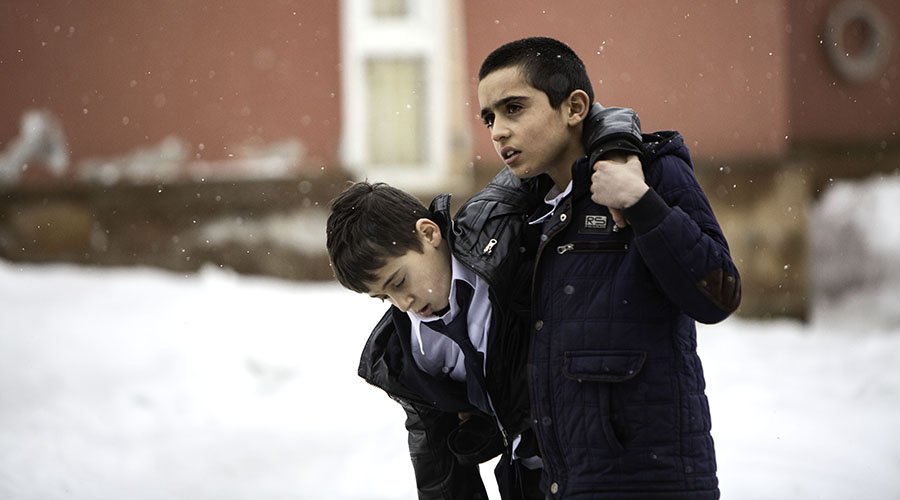
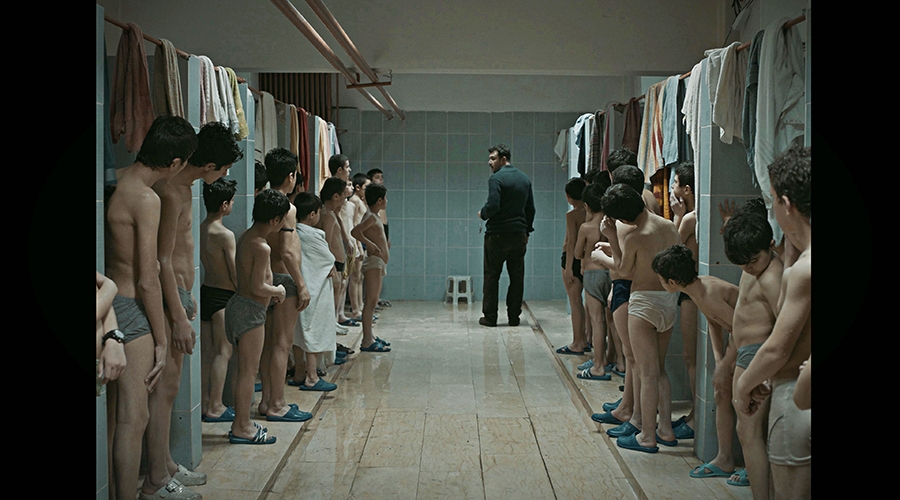
Yusuf and his best friend Memo are two students at a boarding school for Kurdish children located in the icy mountains of Anatolia., in Türkiye. Despite the cold of winter, Teachers force children to take ice-cold showers before going to sleep. Because of one of those shower sessions, Memo falls very ill. Viewing your status, his friend Yusuf will try to find help. A real adventure begins for the two friends. But the system of hierarchies that governs the center becomes ineffective in the face of such a simple problem.. Fearful of bearing the consequences of guilt in the situation, adults will try to avoid all responsibility. While, Memo's life hangs by a thread.
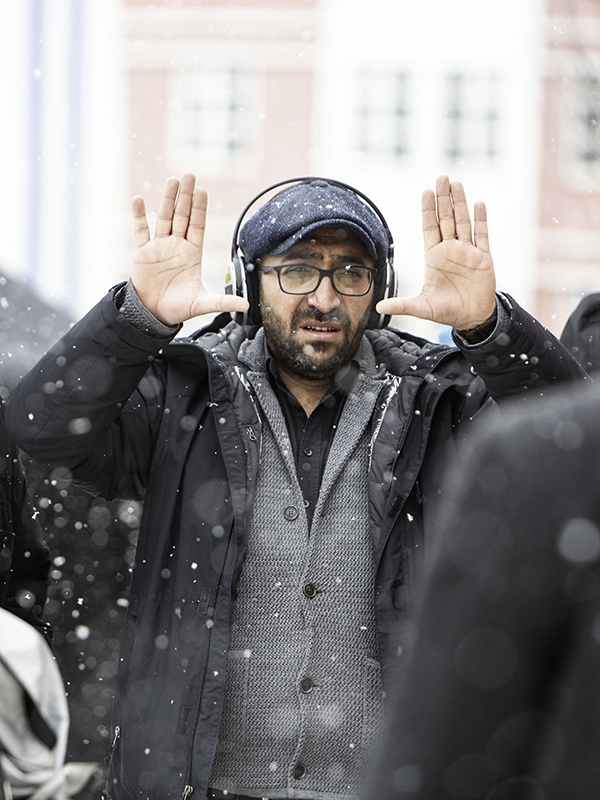
With the camera on my shoulder, but with a radically firm pulse planning, The Turkish director Ferit Karahan presented this modern story that wants to be a mirror at Cinema Jove, not only about the deficiencies of the Turkish educational system and its explicit racism towards the Kurdish community, but of the entire bureaucratic and political order that governs your country. Karahan leaves no puppet behind. From the base, to the top, his verdict is very clear: absolute failure. That's not how he says it in this interview after learning that his film Brother’s Keeper has been awarded the Award for Best Film of this 36th edition of the Cinema Jove festival that is closing.
How did you receive the news of the Best Film award at Cinema Jove??
Well, in fact, We were making plans to come to Spain. I had a special curiosity about Valencia. However, We had applied for a visa for the Berlinale before and were unable to get our passports due to Covid closures in Türkiye. The friends of Cinema Jove tried very hard to take us there, but, somehow, we couldn't get Spanish visas. I must say that the festival team and I are very sorry about this situation. Finally, in the morning, Carlos called and said we won the prize. After this sadness, It was very good news.
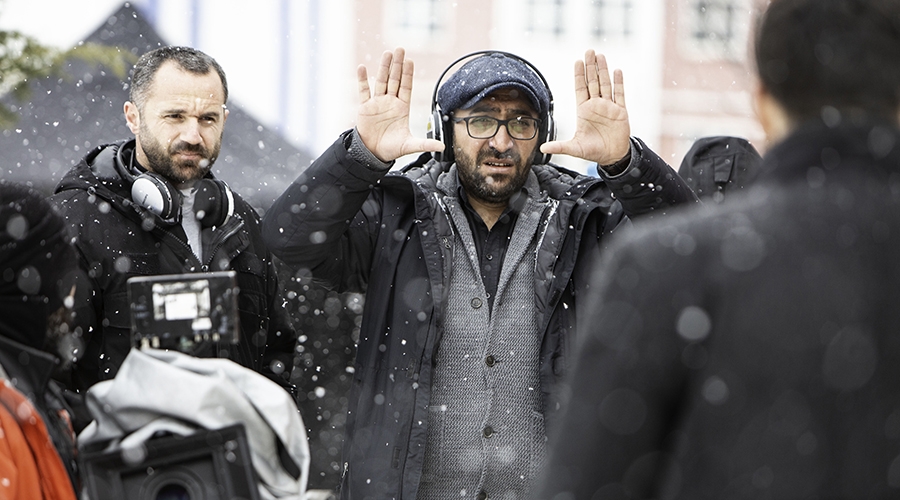
Brother’s Keeper went to the Berlin festival where it won the FIPRESCI award in the Panorama section. How do you rate this international reception??
We are getting good responses overall, which surprises me a little. It was unexpected to me that people understood facts that are so unique to us.. I think the simplicity of the story has something to do with it.. Some see the first half hour of the film as a dystopia. Our reality is a dystopia for them …
The film is based on your own personal experience. I would like you to tell us a little about this fact..
In general, In Türkiye, boarding schools do not have many resources. Those who do have them, are built entirely on hate or have a vision that is committed to the official ideology, rather seeing education as a gift. When I wrote the first version of the script in 2009, I had more of a point of view from one of the old boarding schools I was at. Then, in 2014, we wrote a lot of covers with Gülistan Acet, my screenwriter. I had the experience of six years studying in one of those boarding schools.. Although it has been almost 20 years, there I find not only some of the experiences I had, but also my roots. But my memory remembered it as a nebular ground without gravity. I wanted to address my school traumas, that left a deep impression on me. When facing it I felt the need to be as close to reality as possible., but I didn't want to make a documentary about my own childhood. Finally, in 2015-2016, there was a period when Türkiye suddenly became involved in the Middle East atmosphere and the Kurds were fighting ISIS. Bombs were exploding everywhere and young people were dying. I studied at a boarding school during a period when the Kurdish-Turkish conflicts in Türkiye were very intense, since the beginning of the decade 1990 until almost the end, and the process in 2016 was so similar to that of the 1990s 90, It wasn't hard for me to get into those feelings.. one night, while cooking dinner, Almost all the scenes came to light while I was talking to Gülistan about how this lie that arises from fear in oppressed societies becomes a form of resistance and how we could incorporate it into the film.. Then, We sat down and finished the script in 7 days.
The first thing that attracts attention about your film is the young actors. What was it like working with them??
I had worked with children before and my teammates thought I had the talent to direct them in a film. But this time it wasn't so easy. Maybe it would have been relatively easy to work with one or two children; but controlling five hundred children at the same time requires a lot of patience. Each one had to have a different character, and what they have seen on television had manipulated them too much as actors. I had to tackle even the simplest things from scratch. For example, Samet (Yusuf) I walked like a thug because the characters I saw on television were like that. I tried to talk to almost everyone. Although they were not interested, I tried to explain to them that the most important thing is their naturalness and character. Work with people, especially in small towns, has great dangers. In general, film crews move very close to children during filming. This behavior, that at first seems good and innocent, can negatively affect those left behind. You get into their lives and constantly manipulate them.. That's why it's a situation where you have to be careful.. He often emphasized that filming was a temporary and normal situation. Eventually we were going to leave here and they would be left alone. That's why, the first day of filming, I took a serious attitude towards children and treated them the way I treat other people.. At some point, a form of communication develops and the film moves in the right direction. Bueno, if the casting is correct. My advantage is that I know these children very well because they were all going through what I had already gone through and I immediately understood their state of mind.. I felt where I needed to soften and where to harden. I would say you have to trust your intelligence a little.. Children have character and when they know that their ideas are important and are appreciated, They can understand everything that is said and give back a lot.
One of the things that stand out in your film is that balance between drama and a certain sense of humor.. Do you use it as an escape from the drama or does it play another role?
The ground is very slippery in Türkiye and it seems like everyone is about to explode. Actually, We started using these details as we thought about how we could break the poetry of repetition and go deeper into the structure.. Symbolic narratives can contain great danger. Sometimes, this narrative form can be very eclectic, especially when it doesn't match reality, but when you put it in a logical and meaningful framework it makes a great contribution to the film and turns it into a multi-layered structure..
The film makes a harsh criticism of your country's educational system and, maybe beyond, to the Turkish political system itself. What was your intention, in that sense?
I think the structure surrounding the film tells something more than the main story. when you look at it, Brother’s Keeper It has a very simple theme.: a student tries to keep his friend alive. But I wanted to do a panorama of Türkiye in the background. I don't know if anyone has said this before me., but I think all movies are road movies in a certain sense. Character stops determine the momentum of the story. This form of storytelling existed even before the stories of Gilgamesh and Odysseus.. This journey of my main character was an act that showed that many doors were actually walls. Almost all over the world, educational systems are set up to raise obedient lambs that do as they are told. All exams, the qualifications, The rules are a wheel configured to choose the most “obedient” because you have to overcome them to go to the next level or, otherwise, the system will consider you failed and will eliminate you. There are very few educational systems that promote creativity and independence. You need people who question, and this does not seem likely with the current educational system. Here a contradiction arises. You cannot be libertarian and independent and expect individuals to be obedient at the same time.. Because obedient individuals can be good workers, but they can never advance science. Mostly, they copy other people's ideas.
Boarding schools are systems that impose obedience on students not only in classes, but also as a way of life. Since they are based on the “normalization” of the people, They also function as assimilation centers. However, here is another contradiction. Yeah, boarding schools work like this, but you have to attend because in Türkiye there is no other alternative, or you stay in your town and continue working as a shepherd or farmer. I think we're like flies caught in a spider's web. If the fly flutters and leaves one or two of its wings in the web, can be released but can no longer fly. If not, It's food for the spider. After all, one way or another, both lifestyles are at the level of the needs of the system.
When you see your movie, It's hard not to think of Abbas Kiarostami or even The four hundred blows by Truffaut. Do you identify with these cinemas?
The films you mentioned are important and are a true treasure. I'm not sure about their resemblance, but fear is the main field that I am also working with. In fact, in a climate of fear and oppression, all forms of relationships hang by a thread. Everything is like a thick layer of fog. It seems to exist more when you're far away, but the closer you get, more it seems that it does not exist. I built the relationship of the two friends in the movie on this basis. There is, it's there, but actually, almost does not exist. The system, somehow, doesn't even allow this. Everything is based on a lie and people have to lie all the time. Because the conditions are so harsh, Lying becomes another way to bend those walls a little.. It almost becomes a form of resistance.
Your film stands out for its careful planning and for the internal timing of the sequences.. How was that job?? How did filming change the story of the script??
I think the way I handle those elements is more important than the story. If we can bring our films closer to literary forms, we can move away from any conservative vision and tell genuine stories that move people. Personally, I feel very far from conventional cinema, But that shouldn't mean that movies have to be boring. I thought of the movie more like a detective movie, where everyone becomes a police officer. This genre transforms the narrative, which also originates from the content, in a tense and dark structure. However, the fact that some of those involved are children, Your fears, they form the entire perimeter of the story. In this film I wanted to immerse the audience in that atmosphere from the first frame and make sure they were there until the end of the film. That's why at the table, before starting filming, I had designed all the plans and how to shoot each scene. When I was on set, everyone knew what was going to shoot that day.
Finally, I would like you to talk to us about snow as another character, almost an antagonist. Brother’s Keeper It is a film that is based on physical sensations. what was, in that sense, Your biggest challenge?
We made the entire filming schedule depending on the snowfall., not from the actors or other situations. The snow fell at very short intervals and it could happen that, while I was thinking about how to shoot, I might not be able to catch the snow. That's why I designed the shooting plan for the movie in advance.. I didn't feel like having the actors rehearse because rehearsing is not always a good thing in these types of films where the actors are, mostly, amateurs. Mechanize the actors, and this was one of the things I feared the most because authenticity is something that matters a lot to me.. And when it finally snowed, I had to be ready because that contributed a lot to the atmosphere. In fact, part of our suffering comes from the geography we live in and part from the political system we failed to create. At the end of the day, I can say that, apart from the child actors, the hardest part of the movie was waiting for the snow. I no longer had 36 years when filming finished.