
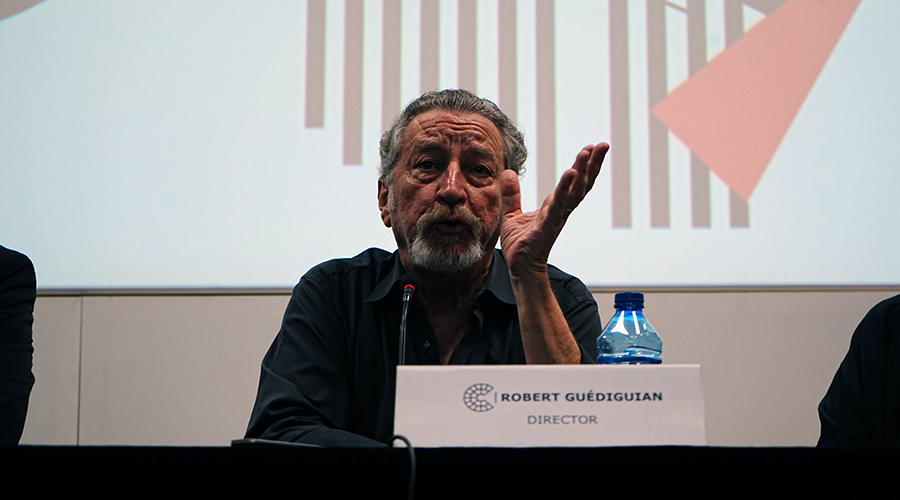
The French filmmaker Robert Guédiguian arrived at the Berlanga room of the Filmoteca de Valencia on the occasion of his Palme de Honor of the Mostra, for a meeting with the press that was less crowded than the occasion deserved. But although the modest attendance indicated the absent, For others, it gave us the opportunity to chat more freely with one of the most relevant filmmakers of the last decades of French cinema and, above all, of a certain social cinema whose sensitivity and clinical eye for human conflicts should be taken into account by some national filmmakers.
Set mostly in his native Marseille, Guédiguian's cinema is, Yeah, committed cinema, not only with political conflicts, economical, of class, that affect their characters, but with a look that does not hide the gaps and contradictions that affect them. With this brief reflection, the chronicler retires, for, in the following paragraphs, make way for the narrator, that is to say, al director, whose reflections regarding the questions we asked him are enough by themselves to satisfy our curiosity and need, maybe, to talk to someone who has thought, before us, what we think. I leave it there.
About social cinema.
“The first thing is that I don't like the expression social cinema. Because very often qualifiers disqualify. And I like to say that I make films. It is a cinema that sometimes talks about workers, of unemployed, of immigrants… We cannot say, For example, that a filmmaker who makes films about the bourgeoisie is a bourgeois filmmaker. O, For example, a peasant who makes films about the peasant world, be a peasant filmmaker. I make movies and that's it. And as I said yesterday (to thank you for that tribute from the Mostra for giving me the award), I would rather say that what happens is that the people, in the cinema, is reduced to a supporting role, of figuration. And what I have tried is to put it in the foreground, that is to say, somehow, do it justice. And show that great passions are also displayed with poor people. It is true that I start from absolute moral principles. I believe that the greatness of the world depends on each of us.. And that is the condition to make a cinema that I call popular.. that adjective, yes I admit it”.
The filmmaker and the audience.
“That's a good question, because I believe that in general filmmakers should care about the public. And there I go against these theories of art for art's sake. That is to say, that a filmmaker should strive to do in freedom, but understandable things. You have to teach understandable things, even if they are misunderstood, as Brecht said. And through that, let's put it like this, unveiling, we have access to the public. There is another quote that I also really like., this time from Mao Tse Tung, what does it say: the artist must walk ahead of the people, but only one step. A very strong statement. In fact, what is happening is that my films, that we could say that they are author's, that are independent, however, they are successful. In fact, apart from having an audience in movie theaters, my movies are then broadcast on television. And it happens [that are accepted] in all age groups. Maybe a little less below the 25 years, but in the stripes between 25 y 45 years, works. But I have to confess that it is not a movie for children.”.
The contradictions of the popular classes.
“I believe that you have to tell the truth about things. Being popular does not mean flattering the people all the time.. That's being populist., and I have said that I am popular. That is to say, that the people possess all the passions, also bad passions. Therefore, all the great stories of passion, of betrayal, of greed and meanness also exist within the people. Not only in the world of gods, the princes, princesses or queens”.
About current politics and cinema. Ukraine.
“It's hard to say, because fiction cinema always lags behind reality. In journalistic terms there is the report. There is the documentary, but the documentary comes later. To make a film about the war in Ukraine we would have to allow more time to pass, for the war to advance further in order to embody the film in characters. My view on war is that there are very few just wars.. And the exaltation of patriotism, which is quite close to nationalism, It's something that I dislike. In fact, There are very few wars in which the poor do not die for the rich.. Of course, It is clear that Russia has invaded Ukraine and, from that point of view, I am for Ukraine. And maybe in five or 10 years ago to make a film about young Ukrainians who are going to defend, maybe not so much the homeland, but certain characters who have taken advantage of this war. Regarding the First World War, that of 14 al 18, In every square in every town in France there is a monument that says: died for the country. And I think we should put: dead for nothing. Or maybe for certain benefits. The benefits of Peugeot's Citroen, etc. I'm still an anarcho-communist, I haven't changed”.
Ideological evolution.
“No, like i said before, regarding the principles, I haven't changed at all. But, about the ways in which these principles can be projected, yes I have changed a lot. I am very interested and moved by the so-called horizontal or micro-economic struggles that occur in a town., in a factory, in a neighborhood. I wrote a book this summer called: Can tomorrow still sing? What interests me right now is to look for communist moments. At the local level, those moments in which the collective and the individual are in harmony, That's the definition of communism to me.. This communist balance is desired, but it can't be eternal. I think we have to keep track of those types of moments., try to keep them, stir them up, and invent other new moments permanently. Yo, In fact, I am interested in communism that already exists, what is there. In fact, It is the succession of communist movements that interests me today, and not what interested me when I was young, which is this national change, International, the end of history, etc. That doesn't interest me anymore”.
Do we renounce official communism?
“Official communism, I don't really know what it means. But if what you mean is that what you have to do is nationalize the companies, end private property, that can't work, as you know very well in Spain. Maybe there is another way to do things”.
Cinema and the rise of nationalisms.
“There are my films in which some character has voted for the National Front. I believe these movements exist., like in Brazil, where I was for a retrospective, because there is no real left. In France we had, in Mitterrand's time, what we called the union of the left. And well, I continue with that fight. What has happened in France is that there has been a union of the left in the legislative elections, something that did not happen in the presidential elections. What we have now is a united left, but it must be constantly monitored so that it does not come apart. I hope that this united left will be the one that prevents the victory of the extreme right. It is the only possible wall”.
Cinema and Marseille.
“Always make movies in the same place [Marseilles], What first is that it gives a shape to what I do. The town in which I make the film is the way and, the background, it's the world. And what I do like this is, somehow, refer universality to the rest of the world. What he said about individuals, I can say it about the places. That is to say, that we can talk about all the stories in the world, in all places of the world. What it shows is that the abstract universal does not exist, but it is linked to a specific place. Y, in part, That's why I always make movies in the same place. Y, besides, there are many other reasons, more psychoanalytic. Rotate, somehow, is to expose yourself, and I feel safer in my place than outside. I also feel more legitimate, because filming is also appropriating a place, a story and that makes me feel more legitimate to do it when I am in my country”.
The actors.
“I always repeat with three actors: two men and a woman. Gérard Meylan, Jean-Pierre Darroussin y Ariane Ascaride, my wife. I think the important thing is that they are my age., we have grown together. In the part where I feel more author is with those actors. I need these actors. And we had to find children and grandchildren in fiction. Now a second troop of actors has arrived in this fiction. That second generation, the children of the first, They have already filmed six films with me. I'm like a troop leader from the 16th or 17th century”.
Is there a Mediterranean cinema?
“I wouldn't talk about identity, but rather a rapprochement between all these cinematographies [Mediterranean] As I said yesterday, they look alike, first of all, because of the weather. There are a whole series of elements, of vegetation, of a sea that is closed, by the way, from the outdoors, that gives all this a structure to our stories. That's why I said that filming in the same place gives a shape, through the weather, of geography, of geology… I watch movies shot in Algeria, In Italy, in Greece and I see a very similar thing. And I think it's there, with those elements, How to recognize a Mediterranean film”.
Next project.
“I just finished shooting my next movie, coming out in march. The movie will be called: And the party continues! Part of the tragic story of the sinking in 2018 of some properties in Marseille. This has created a popular movement, or what I call communist movement. This has led people who did not even speak to each other to have gestures of solidarity and mutual help and, also, to have a party. All this happened twenty meters from a statue of Homer, which is very ironic. Actually, It is Homer who tells us all this because, as mythology says, Homer was blind... but not deaf”.