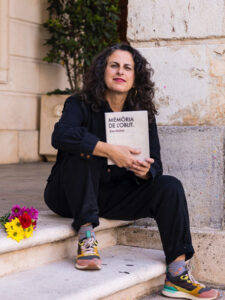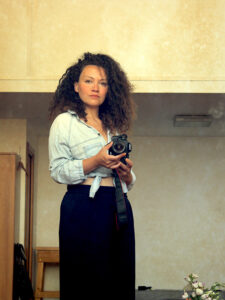
In this newly inaugurated year we interviewed the Valencian writer Mila Martínez. Graduate in Law, published in 2009 the novel I'm not going to apologize starting a series that was followed behind the wall (2010), Self-portrait with sea in the background (2011) y The Phoenician dagger (2013) awarded the Arena Foundation Prize for LGTBQ narrative in its eighth edition. with the story without touching you He has participated, along with eleven other authors, in the anthology titled Where you can't love, don't delay from Egales Publishing House. My nights in the Ideal Room (Egales) It is his first stand-alone novel in the series., and why we asked. GINÉS J. VERA
Photography and its universe are very present not only in the plot, also in the characters, on the cover and in your lapel photo. Is it a passion “hidden”, There are images that cannot be described with words even if they could be fictionalized.?
Indeed, I like photography and I live within that world since my partner is a photographer. In this novel I have tried to combine that passion for photography with the need to tell some historical events that, I think, should be stored in memory. In them there are images and circumstances that, sometimes, It is very difficult to describe with words. Besides, It has always been said that a picture is worth a thousand words, although I hope that this novel has created its own images that are difficult to forget.
At the beginning of the book, in the author's note, You tell us that you have taken literary license with two real characters: Gerda Taro and Ted Allan. You do it from admiration. Why did you decide to introduce this couple in your novel and what is the reason for that admiration you mention??
Ted Allan is an endearing character., although I have used it more as support for Gerda Taro, who is one of the important protagonists of the novel. It is to this woman that I wanted to pay tribute.. Gerda was one of the most important photojournalists who worked for French publications such as This evening o Regards what was happening in our war. Unfortunately, became a myth of photojournalism when he died with 26 years, victim of an accident in the battle of Brunete and his desire to always be on the front line of the action. I was riding on the side of a car, taking photographs of the retreat of the Republican army and a tank lurched and accidentally attacked the vehicle. His death occurred just a couple of months after the time in which the novel takes place.. Gerda is known mainly for having been the professional and romantic partner of photographer Robert Capa.. I wanted to do him some justice with this novel because his unfortunate death, along with the prevailing machismo of the time, caused the authorship of most of the photographs that the two took to be attributed to Robert Capa. The name Robert Capa was created by both to make their common work visible., giving it an American air. She was German and he was Hungarian.. Their real names were Gerda Pohorylle and André Friedmann.. Numerous investigations indicate that both worked together and exchanged cameras., Therefore, it cannot be ensured that rectangular photographs, made with a Leica, he did them alone, or the square ones, made with a Rolleiflex, they were Gerda's. In fact, In various photographs from the time, Gerda Taro is seen using the Leica.
One of the values of the time in which the story takes place is solidarity. It is highlighted several times even in contrast to the current era. Another is that of the ideals and the money for which “battle and die every day”, then and now, respectively. Tell us about this detail because I think it is also part of the deep reading of this novel..
The novel reveals the idea that we have gradually been dehumanizing the world. Things happened at that time that are very difficult to find today.. Families opened their homes to thousands of people who were sheltering in Valencia, since there was no accommodation or food for everyone. Solidarity was a way of survival. You see what is happening today with refugees. It cannot be denied that today the vast majority of actions have their engine in that monster that we have erected as a god.: the money. Fortunately, There are still people who have other main motivations in their lives and their solidarity actions demonstrate it..
My nights in the Ideal Room It is a novel with a strong historical component, Not in vain does history take us to the month of May 1937, in the middle of the Spanish Civil War in the city of Valencia. Tell us about the visible and invisible documentary work when fictionalizing this episode of our recent history..
Indeed, This novel has an intense work of documentation behind it, since I am not an expert on the Spanish civil war and I have had to study many aspects of that time to be as faithful as possible to history. One of the sources from which the novel has been nourished has been a research project that fell into my hands., prepared by Mª José Garrido to obtain the Diploma of Advanced Studies in Communication. The project was about the bombings in the city of Valencia during the Spanish civil war seen by the graphic magazines of the time., especially by Crónica magazine. When I read María José's research work I realized how little is known about what happened in Valencia during that time.. It could give the impression that the fact that Valencia was in the rearguard would guarantee a certain security, that people would live within normality, that there was that “happy Levante” that they talked about, but it wasn't like that. There were continuous bombings here during the war and the dead were very numerous.. They were all trying to continue with their lives outside of the war., but the terror was always present.
On the other hand, I wanted to reflect the events of that May 1937 in which the plot takes place. In this sense, apart from an extensive bibliography, I read the newspapers of the time day after day, especially “El Mercantil Valenciano, “Left Republican Journal”, of which I have all the scanned copies from the first day of the war to the last. I wanted to be absolutely rigorous, even hour by hour, with what happened during those 17 days in Valencia, and not only with political events, but with the small daily details. Within the bibliography used, I could highlight some publications published by the University of Valencia such as Valencia 1931-1939. Urban guide to the city in the 2nd Republic, The Valencian Country under the bombs (1936-1939), In defense of culture: Valencia, capital of the Republic (1936-37), o to Collection of the civil war in the Valencian Community, from the Valencian Press Editorial. On the other hand, and in the field of photography, should be highlighted war photography (Valencia 1937-1938), by Joaquín Sanchis Finezas, 1900 Valencia in images, by Rafael Solaz, Tour of ancient Valencia through postcards of the city, various photography books from the Magnum Agency, Gerda Question, the shadow of a photographer, by François Maspero, o The Mexican suitcase. Collection of rediscovered photographs from the Spanish Civil War, by Robert Capa, Chim and Gerda Taro.