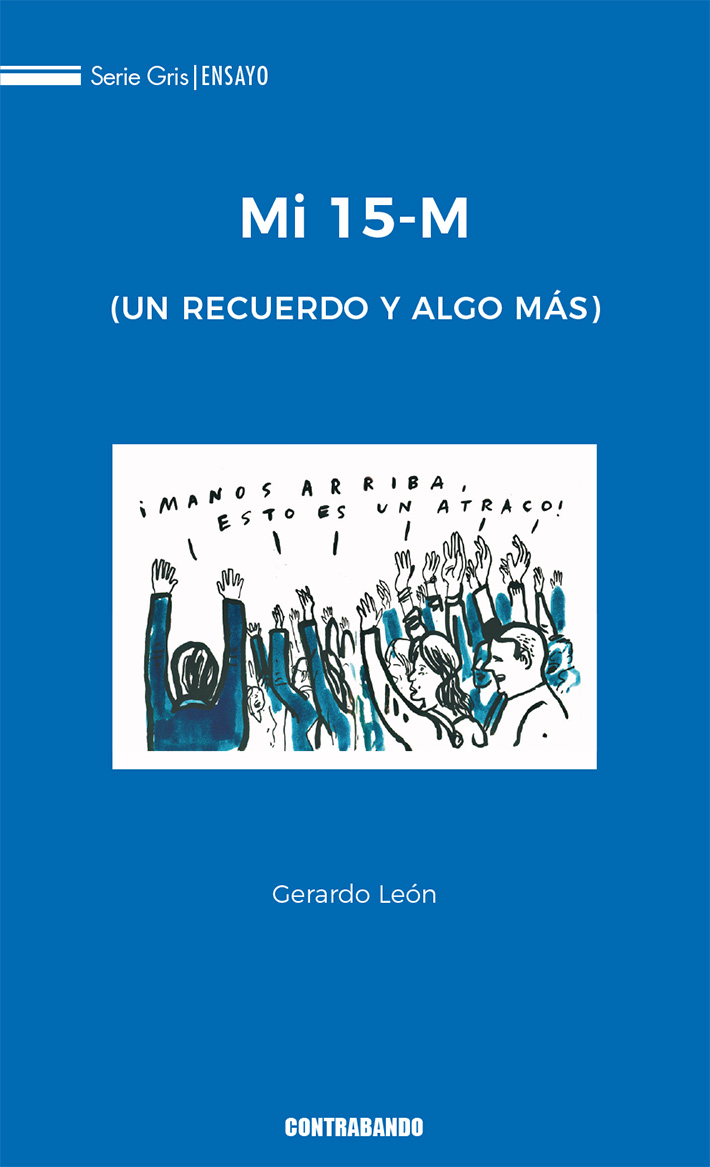
Gerardo León is a screenwriter, cultural journalist and a political enthusiast who follows his movements with the fervor of an analyst. Ten years ago he participated very actively in that 15M that led thousands of people to occupy neighborhood squares to express dissatisfaction and desire for change., and today he publishes a relaxed essay in which he recounts his experience in the heart of the movement from a neighborhood assembly and the conclusions he drew from it. In this interview we have talked with him about the successes and errors of 15M, of the role played by the media and the great evils of the left, with Orwell and Mafalda sitting at the table.
You say about the 15M that it was a movement that seemed nice but it wasn't that nice.. You do not regret having participated in this “human experience of the first order.”, but at the same time you accuse her of being childish, of lacking foundations and the desire to reason. Because?
There, a fairly common trend on the left was exposed in a very obvious way.. And it is the attitude of the activist. In an interview, The American writer Jonathan Franzen said that there was a difference between the activist and the writer. The activist assumes a decalogue of measures, ideas or conditions; the writer writes from doubt. That is to say, consider the possibility of not being right. And that's the problem with the activist's reasoning.: takes a measure as a solution to a problem, but he does not contrast it or meditate on it enough. That's where the lack of reasoning comes. It is true that this coheres, but it is a problem in the medium-long term if those ideas on which it is based are not well founded and well contrasted with reality..
Regarding infantilism, In the book, I review the last decades of the history of Spain, also experienced in the first person.. From the eighties until now, I believe that there is an infantilization of society induced by consumerism. We are children of consumer capitalism, especially on a cultural level. That, from my point of view, has created a society—my generation is also within that spectrum—that has distanced itself from real struggles. Trade unionism has been abandoned, not only because there is distrust with the big unions, if not because the commitment, if there ever had been, today is not there. And you see that in the jobs, in the submission that exists regarding working conditions. Even in cultural sectors, the lack of resistance to institutions when they do not comply with their programs. I am referring to that childishness, that political commitment that, in the background, it's mild.
Explain to us this clash between expectations and reality that was experienced within the 15M. What are you talking about?
One constant of the 15M was not being aware of who we were and how many we were.. In the 15M there was a spirit according to which, how we had had great media success, We represented the entire society. That is usually a premise of the left and it also happened there. Assuming that you are right and everything else is wrong, does not exist, or you don't have an opinion, or doesn't even think about the problems you're thinking about. So you think you represent everything, and you have to understand that you are not. That doesn't have to restrict your proposals., But if you believe that you are representative of the whole, you run the risk of moving forward following proposals that are not well thought out and that then, when faced with reality, They collide with it and you fall into a disenchantment that you don't know how to manage.. That happened in 15M. There was an inherent joy in the way they acted that seemed like the game had already been won and that was not real., and people were not very aware. In fact, Even when the movement was fraying, You raised it and there were those who didn't want to see it.. But you had to look outside to realize what was happening.
You hit the media very hard. You criticize his condescension, his changes of position and to demand solutions from the citizen movement when it is, maybe, I did enough to point out the problems. Explain this idea to us.
What happened was that, in the midst of a great economic crisis, people took to the streets unexpectedly. And the external appearance of those people who went out into the street, in the imagination of the media and political parties, It was similar to what was happening in the Arab Springs [2010-12]. The revolutions of the Arab Springs, reaching where they will arrive, with its good things and its bad things, They were a strong political movement, with an aspect of strong revolution and strong resistance against power. Suddenly these media outlets found that, in your country, where everything was a general calm, the same thing happened. So, faced with this fact that they could not value because they had not even analyzed it, everyone reacted the same. The right reacted against him because in his external appearance he had the appearance of those revolutions [arabs] with whom he did not agree ideologically, but the progressive media reacted exactly the same. And they reacted the same because there was a progressive government [Zapatero's]. Instead of analyzing what was happening, They dedicated themselves to thinking about how what was happening on the street was harming that progressive government without realizing that those people who were on the street were their own listeners and their own readers.. And what they did, among other things, was telling those people that it wasn't that big of a deal, that we lived in a democracy, that that democracy was very good and that there was no reason to question it. Therefore, there was collusion in the accusations of left-wing media and right-wing media, which implies a tacit agreement that was exposed. And that is the criticism I make of them..
tell us, What do you have against Àngels Barceló.
[Laughter] I have nothing against Àngels Barceló, What happens is that Àngels Barceló was a very significant case, especially for those of us who were listeners of SER and it was a reference for us. Reference in my case is not listening to someone with blind devotion, but within the national journalistic and political panorama, For many it was what we heard and heard every day. We take to the streets to say what is wrong through the media's own narrative because, the ordinary citizen, On what reality do you react?? About the one who reads and listens every day when she gets up in the morning. It turned out that some were corrupt, the others too, and those from beyond three quarters of the same. There was a great economic crisis and it seemed that nothing had to be done. It turns out that, when there is a rebellion against this, Àngels Barceló applies the same numbing sponge that the right-wing media tries to apply. That's where it fell. In fact, They quickly accused her on social media and that's where her vision of what was happening shook.. with a private: What was shown is that they spoke without knowing, that they had not gone to the squares to see what was happening. And that doesn't just question her., questions journalism in general.
and according to you, When he realizes that his speech goes against his listeners, that's when he lurches..
Of course, and it's not just that it lurches, is that she lurches denying what she herself has said in the first reactions. All this will have a consequence in retrospect. I maintain that she began to feel comfortable with that voice [del 15M] when she began to enter the fold and stopped responding to a question: ¿Oye, what do you want? Do you question democracy? Do you want the right to win?? That was not what was being proposed in the squares, but breathing that doubt into the movement created another movement that went against the initial reaction. So, the media felt comfortable. Because? Because the speech was beginning again, almost from the first moment, to return to the fold of blocks which is where the media feels comfortable.
You say that the 15M began to make true sense when it extended its arms through the city neighborhoods, that there was his true lung. Because?
Because one of the premises of 15M was citizen participation. If you had to move from where you lived, every day, to a square, to find out what was happening, you required a personal effort and a truly extraordinary disposition. Or you have nothing better to do, or are you so, tan, so committed that you have that motor to go. But of course, it's very difficult. In fact, the squares were gradually emptying. The neighborhood assemblies allowed you to participate from a much closer space.. You left your house, you went to a park or a square in your own neighborhood and you already had the 15M there and you could participate. That is why it was the great democratizing expansion. The 15M was an expression of more democracy compared to others and democracy is participation. The more participation and the more widespread, more democratic it was.
Did the movement lose its horizontal and assembly-oriented nature over time?? Or was it never really such a thing?
I maintain that the 15M, in the background, after many twists and turns, it ended up remaining in a stage of preposition. That is to say, in a first stage. It did not finally consolidate a structure. Evidently, 15M each one lived it in a different way, but if we look at it in time, in continuity, did not finish coordinating a stable structure. We could say that those who were in the square, they did it in a stable structure, but that had continuity in the neighborhood assemblies and in other structures. He failed to coordinate a structure that would last over time, in fact, ended up disappearing. Having said that, I believe that there was a horizontal and assembly structure. There was one at one time and I maintain in the book that it could have worked. The problem is that there were centralizing elements that when they saw that they were losing control, especially in Valencia, They began to bomb the structure until it was destroyed.. They had lost the center of the square; in the Valencian case, from the Town Hall Square, because it had been fraying due to natural and internal issues, and then they also tried to control those other spaces, What were the neighborhoods?. And they ended up blowing it up completely. But there was at one point. And in my assembly, For example, We tried to build it and it was very nice to try. There was a moment when we felt that we could do it.
 You talk about internal struggles in the book, Was there a new episode of the struggle of the Popular Jewish Front against the Popular Front of Judea within the left??
Neighborhood assemblies constituted, They were operating in their own space., what was the neighborhood. But it had to be questioned what its function was within the 15M. There are several drifts that I try to explain in the book: if they had to remain as 15M agents in the neighborhood or if they had to operate for the general 15M and its general measures. We thought that, since the 15M was a democratizing space, The neighborhood assemblies had to participate in the general 15M. But of course, a neighborhood organization that operates in the neighborhood, deep down he doesn't talk to anyone else. Then the BPU was formed, What were the neighborhood assemblies?, Towns and Universities. That is to say, after creating an outward expansive movement, another centralizing movement is created to share what we thought and our proposals. There came a time when the BPU remained the only centralizing element, although it had consistency problems similar to those of that one. That is to say, There was a core of very hard-working, faithful people., and there were people coming and going, but at the same time they did have a more stable consubstantial consistency than the General Assembly. When that BPU remained the only strong nucleus of the 15M in Valencia, the committees that had been making and breaking in the General Assembly and had been left without an agora to address attacked that BPU, They took control of it and ended up drowning the diversity of opinions and the multi-participation of the neighborhood assemblies..
But do you think it is possible that in a movement in which so many heterogeneous people participate, horizontality can be achieved and it really works??
I think it is very difficult. But what I propose is: If in a democratic system the citizen is outside the centers of participation, he ends up ceasing to be democratic.. And so, somehow, we must never forget it. In fact, I believe that democracies are in crisis precisely for that reason.. We had assumed the representation of parties, but the parties were so comfortable in the institutions that they had forgotten that they represented the citizen. In fact, When the media and parties attack these assembly-type organizations it is like telling the citizen that they cannot participate.. It's difficult, but think of all the associations there are: a sports association is an assembly, a failure is an assembly, a cultural association is an assembly… And with its many difficulties, They work.
But in all these examples you give there is a hierarchy.
There is a certain hierarchy, but participation is much more widespread. Here the debate is on the functioning of democracy. You probably can't govern a country with an assembly, that's clear, but maybe a neighborhood does. And that structure can be more open and participatory, especially with the digital media we have. But it must be truly open and we must accept it.. And that's what's complicated, why, When you assume that it is open, you have to understand that you may not always get the upper hand, that maybe you're not always right, and maybe you have to give in. And that is the greatest danger of assembly movements. And on the other hand, that can be taken over by strong leaders who seduce a larger part of the people and control that assembly. As? Provoking the disinterest of many others.
Introduce us to Orwell and Mafalda. What role do they play in your book??
They both play a fundamental role in my life.. Existential philosophy is found in Orwell and Mafalda. What I just said is outrageous., but, in part, it's there. They are two lifelong references.. Mafalda has wonderful wisdom about life experience that also encourages you to read and reread.. Mafalda you read it when you are little and some things amuse you, and when you are older you get a juice that has no end. Sometimes, even, If you have read Mafalda's cartoons many times, you end up incorporating phrases into your daily life.. Yo, For example, I say a lot something that Mafalda's mother said when she returned from the market after shopping: “It is a scandal and an abuse.!” (laughter). But there is a Mafalda joke, which is what I tell in the book, which I really liked and which referred me to something that 15M did. He 15 M, as it advances and enters the dialectic of the media, goes from being an actor in history to being a bottom player. What he does is want to be on all fronts, wanting to govern everything and wanting to be the protagonist of everything. And at the same time enters a trap: I couldn't be the protagonist of everything, on the one hand; and on the other, he was forgetting his primary objectives: that I had to be outside of that two-party system and what the media were saying. When you enter the dialectic of the media you have returned to the fold and become a passive actor in history.. And that happened to 15M.
Same thing with Orwell., It accompanies me all my life. It's one of those readings that upset you.. I read Farm Animal y 1984 when I was fourteen years old and nothing was the same. Orwell is an absolutely essential character, I am very Orwellian. He was a very convinced leftist man, so convinced that he did something I would challenge his critics to do: go to a war to risk your life, to fight against injustice. Orwell had a beginning, I was going to look at reality. Few people have read Broke in Paris and London, a book that talks about how restaurants in London and Paris function in the first half of the 20th century. How labor exploitation works, the very poor conditions of the kitchens of the restaurants of these two great European capitals. But he doesn't ask to be told, He works in restaurants in Paris and London, see what reality is like and then tell it. It's what makes Orwell great, there are no ideological prejudices. Examines reality from an ideological point of view, of course, but first he goes to reality and analyzes it from that framework, does not intend to project a prejudice or a pre-established idea onto reality without having contrasted it. Orwell is very purist about that., That's why they give it everywhere and everyone wants to take it over.. As it happens to Dickens, which I refer to in the essay. I think there is a relationship between Orwell and Dickens, everyone wants to appropriate Orwell but he probably wouldn't be with anyone.
During your story, nostalgia for something beautiful that made you feel that you were not alone intersects., with the regret of the traps and contradictions that led to the rapid deterioration of the movement. You say that he was not able to achieve his main objectives due to ego and lack of humility.. ten years later, what weighs more, nostalgia or sadness?
It was not my intention to create sadness or nostalgia.. If 15M had taken place ten years earlier in my life, If I had been in my twenties, Yes, I would have fallen into sadness and nostalgia.. But it catches me with 39, and already had accumulated political experiences, disappointments or surprises that had already rearranged a good part of my ideological spectrum with respect to reality. So, There is no total disappointment because my life experience no longer makes me project ALL my expectations onto something.. If you project everything, It can lead you to disappointment and disappointment is a total stoppage., and you don't have to stop. This is a permanent struggle over time., that probably won't end. Orwell says that after one dictator comes another, probably less bad, but dictator after all. You can't give in to that, you will have to continue. That doesn't happen to me because I have already reordered many things at that level..
ten years later, I don't know very well, and it goes to days. There are days when I think the left is reaching a stalemate., I think that it is moving away from the great revolutions and that it is being integrated into the liberal capitalist system without causing a change.; and there are others who wake up more optimistic and believe that we must continue fighting and that there are gaps to work on, but we must build those foundations better on reality. That the left has lost the vote of the popular classes is very dramatic and we have to ask why. It is not enough to caricature the opponent, you had to do something wrong. And if you analyze it, you will know why.
Does the left lack self-criticism?
The left lacks self-criticism. The left constantly appeals to critical thinking, But deep down, if we analyze what comes next, a criticism comes from the right, exclusively. And that's not critical thinking., that's dogmatism, but he doesn't realize. The left, in the background, and that is one of their mistakes, are afraid to really question themselves. That is to say, If Cuba is a failed experiment, it will have to be reported. I'm not saying it is, It is a complex problem, but yes it is, it will have to be reported. You can't hold it with tweezers so as not to give the other side the keys to the Seven Gates, when you end up giving them the same because the experiment is equally unsuccessful. And that is a constant on the left. It happened in 15M. —Let's propose referendums!! —What does that mean?? -Don't know; —Let's change the Constitution! —If you haven't read it! And why do you want to change a Constitution if the very principles of this, even the ones that interest you, they are not being fulfilled; —Let's change the electoral system!! —If you don't know how it works. You project an improvement on that change, but that improvement is an abstraction because you don't know if the change will produce that something you want., which is that you will rule eternally. But the way democracies are constituted, it is not possible, They are constituted so that there is alternation and you have to assume it. And if you don't accept it, you have to change it and you are going to have to explain it to others VERY well..
Does criticism that comes from within bother you more??
Yeah, of course. When Orwell writes Farm Animal They turn him around and accuse him of being a right-winger.. But that's a self-induced trap.. That is to say, Will it be true or not that Stalinism was as described, we can analyze it, but you cannot accuse someone who fought against fascism in the trenches of being a right-winger., on the front line, and he risked his life. A Orwell, that left, then institutionalized, who was a communist and pan-stalinist, he rejected it. How curious that Orwell was massively republished during 15M. But did we understand Orwell? Well I don't know…
I understand that, as you say in the book, idealism can cause you to neglect the formulation of solid foundations but, Isn't a little idealism good for facing life??
I am not against idealism, but I think that idealism taken to an extreme, for idealism itself, can lead you to a mirage. If you fall into the mirage, what comes next is pessimism, that is not the result of failure, It is the result of the mirage that you have built. When you are thirsty you see the mirage in the middle of the desert and there is no water. The effort to reach that mirage is enormous and what moves you is hope.. But there is nothing. It is much more physically and psychologically devastating than looking for a real water well.. Idealism is a great driving force, I speak of idealism and illusion as engines, they are, but if there is only that you will fall. And the left-wing political parties are appealing too much to that. He is in the electoral campaigns. We do not know what Yolanda Díaz's project is, For example, he hasn't explained it, we don't know if he has it, talks about hope. Hope about what? There are many steps to appeal only to that, you're going to have to base it much better.
In addition to shaking up the Spanish political landscape, What else did 15M achieve?? What's left today?
Mira, Now that this book is published there were people who told me “oh!, talk about 15M again?”As if the 15M were a closed process. And what 15M proposed continues to be an open process. Because the first 15M, that 15M that took to the streets effusively, it did have a common element: a criticism of the situation of political parties and the state of democracy. That criticism, not only follow, but it has spread and has penetrated much more. General media is doing today, not to mention 15M, the same criticism. And those who want us to return to the fold of bipartisanship today blame the 15M for what is supposed to be happening. A few weeks ago I read an interview with Antonio Caño, former director of The country, and he said that the rise of the extreme right is the fault of 15M because it broke the calm waters of that two-party system that was clearly in crisis. The shadow of 15M is very widespread, much more than it seems, but it is also very derivative. I believe that the original complaint and demand of the first 15M is actually very much alive..