
It may not seem easy to explain a book like Ronson, the first and brilliant graphic novel by Valencian César Sebastián. Inspired by memories of his father, more than a typical story, Ronson offers us a sentimental journey through an era, the late Franco regime, a vital moment, Childhood, and a landscape, one of those thousands of towns that are part of the Valencian and Spanish geography, and its complex social structures. Published by Autsider Comics publishing house, Ronson tells of a child's awakening to life. domestic customs, relationships with friends, with nature and animals, the family, the gossip and petty morality of the town and, of course, the awakening to an almost primitive sexuality, learned in fits and starts, often brutally, are some of the anchor points that support the structure of this sentimental journey, critical and, at the same time, understanding, towards our past. A work that listens to the nuances of a world to which, as we discussed with its author in this interview, we frequently direct our gaze, sometimes without understanding. A first work full of suggestive formal games, that enrich a work of great narrative maturity. The use of the first person voice, the extensive documentary work, the contrasts between lights and shadows, and the use of two-tone coloring, black and white with an evocative ocher as the only support, offers a very resource-rich job, who speaks face to face with some of the biggest names in the contemporary comic industry. Ronson It is turning out to be quite an editorial phenomenon. G.LEON
The first question I wanted to ask you has to do with the reception the book has had.. The truth is that it is almost an anomaly in the publishing world for a comic to receive so much attention from critics and, from what they tell me in bookstores, by the public and readers. Have you been surprised? How have you experienced this reception??
Yeah, The truth is that it surprised me a lot. I didn't have many expectations either., beyond the fact that people close to him read it. I didn't really know what to expect because it's my first graphic novel and, at the same time, It is a work that escapes a little from the themes that are usually treated in comics as a means of expression.. I'm super surprised because, from the first moment, both critics and the public have judged it very favorably. In that sense, I have met readers from all over and of all profiles, from people of the generation of the book's protagonist, that connects more directly with the stories I tell, like people of my generation, who knows these stories because you have heard them from family or people close to you. The truth is that it was liked a lot and I think people connected very well..
From what you have said in other interviews, Ronson part of conversations with your father, of your memories. But, At what point did you discover that there was interesting material there that could appeal to that reader we were talking about or to yourself?? At what point did you say, here is something.
Bueno, When I write a story I don't usually think much about whether the audience is going to like it or not.. I mean, For me the important thing is that I like it, that interests me, that there is the seed of something that I find interesting to tell. And in the case of this story, I guess all the stories my father told me, which are the germ of Ronson, they generated me, somehow, mixed feelings. I found some of those stories very funny., very endearing, very close, because they are things seen from the perspective of an adult, but lived as a child. Y, on the other hand, that innocence that my father told me, Sometimes he hid a cruel side that made me very uncomfortable.. So, instead of avoiding those sensations, I thought it was good material for fiction.. For me, fiction has to try to delve into the mysteries and contradictions of the human being., of the human condition, and these stories seemed to me to have a little of that. I was not able to judge them definitively., They were ambiguous, uncomfortable, and all that interested me especially.
In accordance with your career as an illustrator and although it is not your first foray into the language of comics, Ronson It is your first graphic novel written and drawn by you. Writing a long story involves facing a series of challenges, especially in terms of rhythm and narrative consistency. What do you think was the biggest difficulty you encountered when composing this story??
When I have tried to do a long work, many times my main obstacle has always been that I have lost, let's say, the enthusiasm. Others I have greatly doubted the quality of the work, of the topic, and I have ended up abandoning. In general, Making comics is very hard because it involves a very long-term commitment.. It took me more than three years to finish this work.. It's also true that I'm quite slow., but come on, which implies a very big commitment. That was the main obstacle. At first, It made me very insecure and very afraid to have to fill out this story because I thought it might not do it justice.. At the same time, I sensed that the base material was very powerful. Then, throughout the process, you have ups and downs, doubts, hesitations and that, sometimes, it's hard to face. But the truth is that, for the first time, For most of the process I was pretty convinced that I wanted to tell the story and, for me, That was already a sign that it was important..
The book recovers a time, but also a space, the rural space, to which attention has been directed lately from different disciplines. In cinema and literature, Of course, and now also in the comic. What were you looking for in that space?? What did that look at rural areas suggest to you??
Yeah, It is true that now there is a certain resurgence of these narratives in rural environments. I think this has to do with a certain crisis of our values., of our identity as a society. It has to do with the fact that we seem to have no handholds, that we are a society a little adrift, that we don't have permanent things, fixed, to hold on to. and there, both personal and collective memory, last, They seem like that thing that is permanent, that is fixed, that you may like or not, but what, at least, it's there, that something to hold onto and that gives you, at least, some minimal identity coordinates. In my case, although I have spent most of my life in the city, I spent my childhood in a small town like the one that appears in Ronson, and all my family, both maternal and paternal, comes from a similar rural background. So, For me, writing about these environments has not involved a kind of effort, but they are places that I know well and it has been as natural as the fact that, If I write about what I know and that is what I like to write about, In the end I end up writing about that rural world because it is part of my personal past and also of my roots..
When writing about that rural environment, We generally come up against the challenge of leaving a certain folklorism to offer a story that can be more universal., especially plastically. I tell you, in part, because it seems to me that we are very used to reading about other equally rural spaces in other countries and perhaps we think that ours cannot be material for a story. Have you had any difficulties in that regard??
I think that Spain is a country in which we are quite ashamed of ourselves, of our own culture, and we identify more easily with fictions from the United States, to tell you something. It seems that ours is crude, picturesque, a little primal, versus other things that seem more sophisticated. Of course, I don't think that way and I try to fight against it., But I also believe that in Spain we have a literary tradition and also a cinema tradition with works that have addressed our very own stories., and they have done it with depth, without that populace treatment, a little crude. I wanted to do something that was authentic, that was not paternalistic, that he did not try to approach the rural world to expose it simply as something exotic, like something a bit vulgar, but to do it with total honesty and with the closeness that I have the privilege of having. In that sense, both the narrative itself, the care of the texts and, even, the drawing, They were rowing in that same direction. I didn't want it to become a story that used the same tools as Hollywood stories or the most traditional comic., more mainstream. I wanted to take a step back, take some distance, but also reflect things faithfully, both visually and conceptually, and thus address emotions more authentically, not guide, do not blackmail the reader emotionally, but rather it was the reader who had to feel this story and make it their own..
Due to the socio-political context that we are experiencing today, It seems that the book maintains a very intense dialogue with the present., inducing you to raise a social debate or, even, very relevant politician. I wanted to ask you if, perhaps based on judging him so much, we have not stopped understanding that past that your book reflects. Was there an intention in that sense?
I think one thing we have, I wouldn't even tell you in Spain anymore, but it is a current trend throughout the world, It is that of judging everything from an ideological perspective. That is to say, that we are loaded with a series of ideas that do not even belong to us individually, but it seems that they are inherited from others. And there we judge the past and the people of the past as if they were our contemporaries. And I think that's a dangerous thing., first because you can't judge people from other times, who had moral codes from other times, who lived in other circumstances very different from yours, with current laws, of the present. We cannot live in such extreme presentism. And then, on the other hand, I also think that this can prevent us from understanding our recent history and make us think that our culture, that our current way of life is only a product of ourselves. On the contrary, I think that, In fact, It's like a big chain of events, of struggles, a story that comes from much further back in which we are almost an anecdote, for now. In that sense, the book does intend, on the one hand, vindicate a generation of people who lived in an environment, who belonged to subaltern classes, who were never the great protagonists of history, but they are the bulk of the population because, In Spain, although now we are all very urbanites, everyone comes from rural backgrounds, or almost everyone has families that migrated to the cities. In that sense, I believe that the book does establish a dialogue with the present because, somehow, What they are telling us is that there is a part of the collective memory that seems not to have been important or that has been somewhat erased or blurred.. And there, fiction also has a role when it comes to rescuing all these stories..
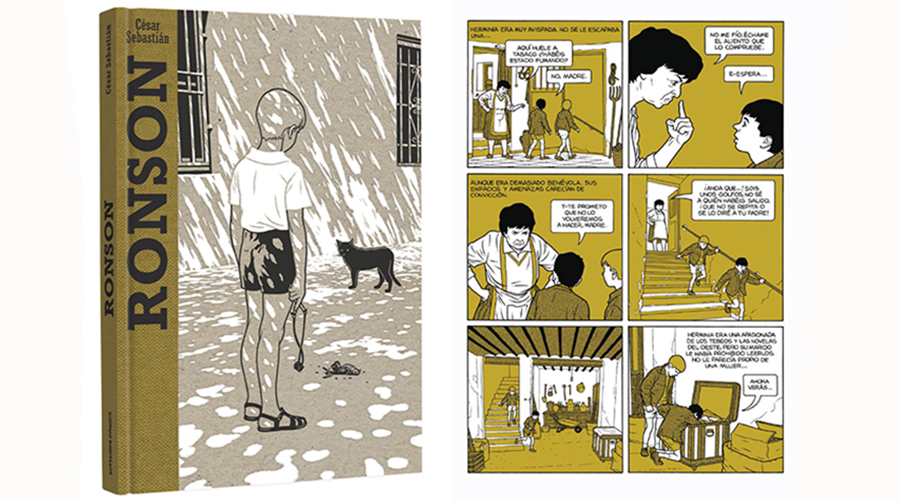
Getting into the subject a little with the book, The first thing that caught my attention is “the voice” of the narrator, that voice in the first person that speaks to us. I wanted to ask you how you dealt with building this voice.. On the one hand, Ronson It is a very authorial book, but you understand that, per generation, it's not your voice. On the other hand, It is a self that is not mentioned. How did you come up with that voice??
The truth is that it was a challenge because I had never written such abundant prose.. On the other hand, The challenge was to build a text that worked well within a comic., that is to say, that established a dialogue between the text and the image that was interesting. At the same time, I think what you mentioned was my main difficulty., because the character speaking is not me, It's not someone from my generation, and it had to be expressed in the way that someone of that generation would express themselves. In that sense, I suppose that the influence of the literature that I have been able to read by people who, more or less, may belong to that generation, or even to previous generations, It has helped me a lot to build a voice that was convincing. Besides, although the text is quite abundant, For me comics are always a visual medium. In that sense, what is really predominant is the image, and the text, simply, sometimes you have to support her, other times to deny it, contradict her... Comics are a very interesting medium that I try to take advantage of in that, how what you read is not exactly what you are contemplating. Sometimes, even, the character avoids not telling you certain things that are uncomfortable for him, but what you are seeing in the drawing.
One of the most difficult things when writing, I think, is not just deciding what it is that you want to tell., but the tone of that voice that speaks to the reader. At what point did you find the tone that was going to give you the way you were going to write the story?? That phrase he told you: “this is going to be like this”.
Well, the truth is that that was also a bit difficult for me.. I wanted it to be an evocative tone, that it was a very clean language, very rich, but that it was not an obstacle because, when one reads comics, is continually reading first a text and then an image, then a text, then a picture, and there must be continuity between the two. It had to be a text that had a certain literary flair, but it wasn't too baroque either because, but, I would have muddied the reading. For me that was the main difficulty, curb certain rhetorical excesses and, even, remove text. That was more important than adding for the sake of adding. At certain times, the language is merely descriptive, it is more functional, let's say, and on other occasions it appeals to certain emotions, others perhaps it becomes a bit more lyrical. In that conjunction of a more purely descriptive language and a more lyrical language, It's where I wanted to operate..
History is not exactly a story, something that may also be a surprise to the reader. I find it more like a succession of prints that have an emotional connection to generate a series of impressions in the reader.. Yes that's how it is, I wanted to ask you what the process of articulating this element was like.. That is to say, When did you give up the idea of a conventional story?, in which someone is affected by an event that they are going to resolve, and you decided to tell this in a different way?
Fully. In fact, That was also another thing that intimidated me a lot at first.. I had the memory of hearing all these stories from my father and, while the idea of making a graphic novel with all this flew over my head, the idea, very diffuse, what I had was: bueno, It's going to be a more or less linear story., that narrates the adventures of a character, a series of problems that confront, etc. but then, when I started recording my father and transcribing notes, I realized that what really interested me in that story was not that it had a linear structure, that it was a succession of concatenated events, but just the opposite, that they were scattered events, impressions, memories, sometimes connected by a very weak thread. So, I decided to give this shape to the story. This was also a great difficulty because you have to spin a narrative that does not have a very clear common thread.. There you have to turn, as you said before, how the text unites the different moments, how to structure the page, etc. Much of the book is told in small one-page pieces. For me, The page is the narrative unit of the comic, something that I have continually tried to use in this work. In fact, the sequences sometimes do not go beyond a page or, at most, of three or four, but they are always very short sequences. Somehow, I wanted the comic, which is a language by nature quite fragmentary, exploit this virtue of the story, which has a lot to do with, also, with the fragmentation of memories.
The book starts with some first pages in which, curiously, there are no characters. Then those characters enter the entire central part, and finally they disappear again, staying in an evocative moment. Maybe it's my madness, but it reminded me of The wild detectives by Roberto Bolaño, which has a similar block structure. There is something that is told at the beginning that is interrupted by a central story, and which is taken up again at the end. That gives a formal unity to the story that is not just narrative., but it almost creates a shape, a figure.
Yeah, Yeah. Mira, This influence that you draw from me has not been conscious at all, but it could be. I care a lot, as you say, the plastic form, the structural aspect that stories have. That's something that, in my favorite stories, I always try to analyze. It's not just that I say if I like it or I don't like it, but why I like it, exactly. Many books or movies that I like escape that type of traditional three-act structure.. These more heterodox works have their interest, precisely, because they find coherence in places where other works would not dare to go.. From the beginning, The difficulty of finding the form of the story had to do with it not ending in a series of scattered chapters.. There arises that beginning like a walk, I don't know if I would say psycho-geographic, of the character for his present and his past, and how the two connect. That already grounded the book and also gave me a justification to close it in the same way., with a similar epilogue. Besides, Those parts are counted with the four-vignette grid, instead of six, which is the bulk of the story that already takes place in the past.
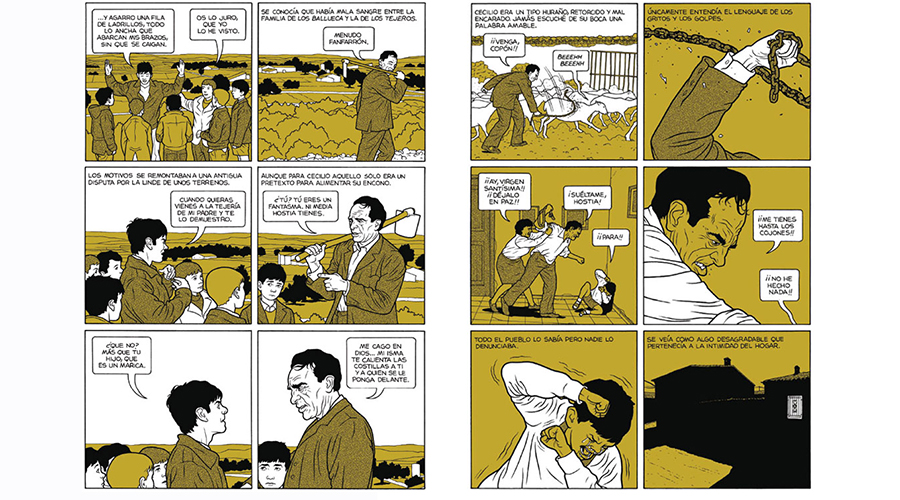
I also wanted to ask you about your influences.. I have seen in a project of yours that you mention authors like Art Spiegelman, Daniel Clowes o Carlos Gimenez. I don't know if this is very bold, but your drawing reminded me of Geof Darrow from Hardboiled. He is very detailed, especially in fund work, you clean the page a lot, but in the drawing of the characters, in the line work of faces and the human figure, if I see any similarity. What or who have you had most in mind when doing this first job??
Well look, It's super curious that you tell me this about Geof Darrow, because I don't think anyone would have thought of relating to him, but he is a cartoonist that fascinates me. In fact, I usually quote Hardboiled like one of my favorite comics. Many people see it as a very crazy nonsense., But I think it's much more than that.. Regarding influences, The truth is that I have a lot. In the world of comics, authors like the ones you mentioned, like Carlos Giménez or Art Spiegelman, they have influenced me a lot. I usually really like naturalistic drawing, clear line, the narrators who are very crystalline. I am very interested, For example, the work of Emmanuel Guibert. I am also very interested in classic American cartoonists., like Alex Toth or people like that. There are tons of authors like, For example, Late, which also interest me a lot. And then, the literature of, the same. When you have read Ronson, It has reminded many people a lot of Miguel Delíbes, who is also another of my favorite writers. All of them have included me in one way or another. But the thing about influences is that, when you've been working for a while, you have them assimilated, They are part of you in some way, and sometimes they come out without you foreseeing it, It's not something you're consciously thinking about., or at least not so much. At first, when I started drawing, when I was younger, Yeah. I was constantly with the work of your idols at my side, copying it, studying it, etc. But, then, with the passage of time, maybe you disengage a little, although there is always something left.
One thing that also catches your attention is the use of color., this monochromatic element that, as far as i know, It was a suggestion from your editor.. I'll tell you something else that may seem outrageous to you., but it reminded me a lot of Asterios Polyp by David Mazzucchelli or Pirouettes by Tillie Walden who are using this line to not color everything, but use only one color or two, as a plastic element. What did this element contribute to the story?? Or did you just use it as something purely decorative?
Mazzucchelli is also an author that I love. I teach a master's degree and I use it a lot as a reference. The entire catalog of possibilities of the comic language is present in Asterios Polyp, and color is a very important element there. When I started testing the first pages using this two-tone, it is ocher, I thought it was simply going to be a way to give the comic a more attractive appearance.. but then, when I started trying, to simply shed as flat spots of color, I realized that it helped me a lot to facilitate reading, to separate elements, to separate plans, to give a certain consistency, a certain solidity and, many times, also to cast some shadow, to give a certain sensation of light. On the one hand, I would say that this color has a narrative component, that is to say, reading aid, and on the other hand, It's also evocative., because color is the most purely emotional component in the visual arts. This color places you in a specific period of history, in a landscape, a specific light, And all of that also helped to get the reader into the story..
We were talking at the beginning about the reception your work has had.. It is always said that, In Spain, Except for that golden age of 80, the comic does not have, like in France or Belgium, so much acceptance. But, at the same time, seeing how your work has been received or thinking about people like Paco Roca, yes it seems that, when certain works are presented, there is a reaction on the part of the reader or a higher number of readers than we could assume. To finish, How do you see this issue??
In front of certain people a little apocalyptic, I do think that in Spain it is read. Obviously, one always wishes it were read more. Or maybe, the more it was read the more, that it should be read better because the problem is that it is read a lot, but it is also published a lot, and in the end, That a book works is very unlikely on a commercial level, at the level of profitability for the author, because it has to be competing with millions of news every week, which makes it almost possible. For that part, I feel incredibly lucky because it could have been that my beginning came out and, after a month, no one remembered him, something that, on the other hand, it is most likely. I am aware of how lucky I have been. But I think there is interest in reading. It's hard to find a space, that they give you the attention that compensates for the titanic effort that is making a comic, but my perception is that there is a growing interest in comics that go a little outside of what comics have usually been as a medium., more aimed at a children's audience or more genre works, decisions that are already a little more trite. So, when one does a different work, I'm not saying in general because they are themes or approaches that are already seen in other means of expression., but they are new to the comic, It is somewhat refreshing and there is an audience that is interested, who wants to read this story.