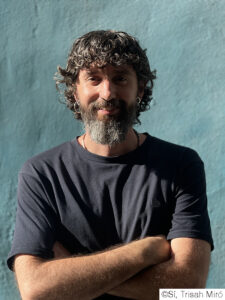
These days he is promoting his novel Lions of Hannibal (Edhasa) the Valencian writer Javier Pellicer (Benignim,1978). He began his literary career with the publication of stories. He has participated in many anthologies, highlighting: Phantasmagoria, Illusionary 2 o Chronicles of the Eastern Mark. His leap into long narrative came in 2012 con The spirit of the lynx (Pamiés), historical novel for which he was chosen as a finalist novel author in the IV Hislibris Historical Literature Awards. His second novel was Legacies (holodeck) in 2013. In this case, I ask him about the current Lions of Hannibal. GINÉS J. VERA
You return to the 3rd century BC to revisit a historical moment as fascinating as it is transcendental.. Was it too tempting to leave Anibal Barca like this?, at the end of your novel The Spirit of the Lynx?
Yeah, although they are totally independent works, It is not necessary to read 'The Spirit of the Lynx', although it is true that I was left with that little thing of wanting to tell what happens next. Y, bueno, Hannibal's journey is a fascinating and epic journey, and it seemed interesting to me to return to it. Y, besides, from a different point of view than that of most authors, that of the majority of novelists who have dealt with the subject, because instead of focusing on the character of Hannibal or Scipio or some charismatic historical figure, I have decided to give the point of view to the people who followed Anibal to see what the experience was like for them.. To give a voice to those people to whom no one normally gives a voice.
Yeah, in fact, in Lions of Hannibal we see more characters than in the aforementioned, more developed, without losing narrative force, neither epic nor the dose of adventure. Maybe these characters, their mixing as individuals within the same army, They are a kind of reflection on the coexistence of cultures and identity?
Yeah, Yeah, indeed, That is one of the key points of the novel., Keep in mind that Hannibal's army was a multicultural army, there were soldiers from all kinds of towns, there were very few Carthaginians, most were mercenaries. The majority were Iberians, celtiberians, North Africans… then, subsequently, Gauls too. My interest was also to describe a little how these different towns came to connect., although there were some at odds with each other, There were Celtiberian peoples fighting among themselves, but in this case, on this trip, everyone followed the same leader, to a leader who was not even from his own people. It was very interesting to explore the motivations of those people and develop it and see how that trip changed their lives and their way of seeing the world., and that is reflected in these main characters.
Precisely, although the great backbone character of Lions of Hannibal It's Anibal Barca, the great general who unites and leads the Carthaginian armies, as you mentioned, against the almighty army of Rome, I would like you to tell us briefly about Leukón, Alcon and Tabnit.
Yeah, because actually, Anibal is the unifying figure of all of them, It is the pivot on which all the characters rotate, and these three characters are three different points of view. On the one hand we have Leukón, What is a Celtiberian?, We could say that it is a slightly less civilized culture., They are a very closed town, the sorian forts, who have little contact with Greco-Roman culture. Then we have Alkon, what is a saguntine, that he is influenced above all by Greek culture, a hellenized iberian, because there, in Sagunto, there was a greek colony. And then we have Tabnit, who is one of the few Carthaginians in the army. I express different points of view and, in a way, opposites. The interest was that, It was seeing how three very different characters came to establish a relationship and even establish a friendship and see the connections between them and how the experiences changed their own dramas and personal conflicts..
Definitely Lions of Hannibal It is an epic novel with several historical feats among its pages. Crossing the Alps with an army of elephants is a, that of defeating Scipio and his legions, other. Precisely, in line with this, I wonder what would have happened if Hannibal had defeated Rome in the Punic Wars..
Anibal only fought in the second, the first one was fought by his father. In the second he had the opportunity to reach Rome, The decision was made whether to besiege Rome or not.. In my opinion, It's true that I'm not a historian., I lack a little context and knowledge, What failed in my opinion is that Carthage did not support Hannibal. Anibal was seen in Italy, He found himself in enemy territory without the necessary resources to besiege Rome, which was a much more complicated city to besiege than Saguntum.. It lacked machinery, He had lost almost all his elephants and was a bit isolated. We also have to take into account that the reinforcements he had in the Iberian Peninsula from his brother, who had stayed to defend the Iberian Peninsula, they did not arrive. The supply failed, so, He found himself a bit alone in enemy territory and Carthage did not support him., and had to make the decision not to siege Rome. It was his turning point, if he had besieged Rome, Could I have conquered her?? we don't know.