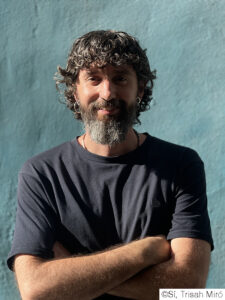


Brenda Chávez gives us an interview, Graduate in Law and Journalism who began her professional career in the magazine Vanity, first as editor and then as editor-in-chief. He also held this last position in the magazine Vogue and has been deputy director of Cosmopolitan. He has collaborated in media such as The country, XL Weekly, Four, Woman Today, I Donate, Elle, Neo2 and Street 20, among others. He currently works on culture and sustainability projects while carrying out tireless journalistic work and has just published On the brink of a shopping spree. 73 keys to conscious consumption (Debate). GINÉS J. VERA
Since consumption also affects health, even silently, Tell us about the macabre relationship between the production and consumption of plastics. And this one with the appearance of microplastics in fishing for human consumption. Are we slowly poisoning ourselves?
But not only with plastic, with many products. The book contains. We take a lot of pesticides and herbicides with conventional fruits and vegetables, antibiotics and hormones with meat, petroleum derivatives in beauty products, home or fashion... The book tells in a simple way how our health and that of the planet are intrinsically linked, take care of him, is to take care of everyone's health.
His book also talks about the fact that we are a society where fear is a common stimulus., inoculated. They sell us fear and we crave the feeling of security, control, that we buy in the form of political parties, cosmetics, clothes, technology, etc. Is this so? Is there a solution?
It's usually like this, generating fear and insecurity is a common resource to mobilize our purchases or our vote. Being informed, By consuming judiciously and being skeptical we stay safer from these manipulations.. The book is made precisely for that, to empower us as consumers and not let ourselves be influenced like this.
Title one of the chapters ¡Cocina! It sounds like an imperative, but I think it's more of a call to rationality. To stop the nonsense we have entered into when it comes to feeding ourselves. Example: A Valencian supermarket chain has incorporated a food section into its establishments ready to go and consume. Is that what we tend towards?, not to cook, to perhaps feed ourselves on a single mass-manufactured product such as soylent in the futuristic novel Make room! Make room! by Harry Harrison?
Cooking is the easiest way to know what we are eating and is a fundamental act to take care of our health and our life.. The industry takes care of its profits, not about our health, Let's keep it clear. Besides, if we cook and buy fresh products, Our budget is not disrupted if we choose to consume organic or agroecological products.. Besides, cooking reconnects us with the seasons, with seasonal foods, brings us together around the table, allows you to learn about our agro-gastronomic cultures, and it can be a transformative act for our health and our planet if we are aware of it..
Tell us about the relationship between wealth and happiness from the perspective of unconscious consumerism, that which sometimes seeks to make up for dissatisfaction or sublimate psychological problems of self-realization. Compulsive shopping as psychological therapy instead of facing our fears, phobias or personal conflicts.
The first keys of the book address market logic that induces us to consumerism, that we have many times incorporated without knowing it, and who advocate a paradigm of “having” and “appearance”, more than that of “being” and inviting to consume uncritically, emotionally and irrationally, something that does not even suit our pocket, nor to the planet, nor to the health of both. Besides, there are very famous studies, like Esterling's paradox that was already published in 1974, which confirmed that money influences happiness up to a certain level of income, beyond, I don't know they produce significant increases, among others that I am commenting on in the book.
There is also room in On the brink of a shopping spree to address the issue of hidden costs. Tell us about them, of that which is not reflected in the final sales price of the products we acquire.
In general, we do not usually pay attention to the hidden costs of our products., in what those who manufactured it suffer. For example, In fast fashion manufactured in Cambodia or Bangladesh you can pay between thirty and sixty euros per month for twelve and fourteen hours a day, when to live with dignity in those latitudes you require some 250 o 280 euros per month. We also fail to notice the hidden cost to the environment of the countries where our items are produced., often subject to more lax laws.
Nor the fiscal cost that underlies them., because large and transnational companies, that often offer these very low prices, They have strategies to pay the minimum taxes possible wherever they operate., or decide to operate where they are taxed as little as possible, leaving few benefits redistributable among these populations (through tax or labor means), since the majority end up concentrated in an economic and industrial elite.
If all the social and environmental costs of supposed bargains were added to their final price, would turn those temptations into the most expensive items and services, because those responsible and/or ecological, by lacking those harmful impacts, or by reducing them, They would be the most affordable. But since many companies today are not responsible for them, and even compensates them if they are fined for bad practices, for the succulent benefits they have obtained. And since most of these abuses occur far from our vision, we think that they do not affect us or that they do not exist, when in the end we really pay for them all, because precarious salaries, beyond the seas, They end up lowering our salaries in the West by competing in the same global labor market.
Because unfair taxes impoverish us all, It doesn't matter what part of the world we live in.. And because health, as well as the well-being of the planet, is intrinsically linked to ours, so when the waters are contaminated, the ground, air or employees in any region, sooner or later, will influence what we breathe, where we bathe, in the species (vegetables, animals, etc.) that we ingest and will poison the consumer goods that so cheerfully, and innocently, we acquire oblivious to all this. Llamémoslo karma, or globalization, but cheap ends up being expensive for most of us.