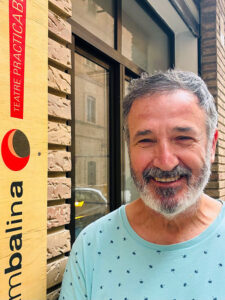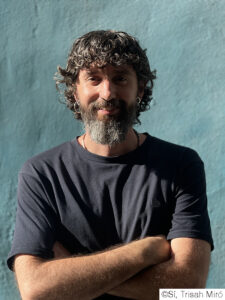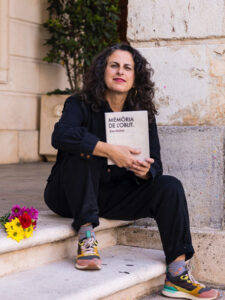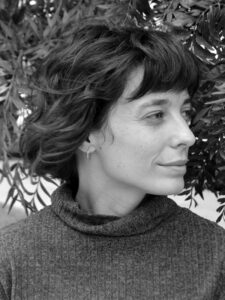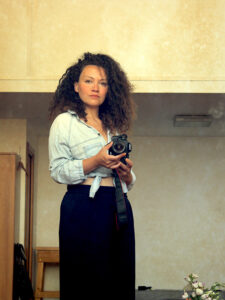
Plus many other things, Pilar Almenar is the director of the Impresas project, which for a year has been accompanying fifteen women inmates in the Picassent prison so that they can create from the ground up a magazine in which they have decided absolutely everything.. We sat down with her to tell us a little more about Impresas, feeling the passion she feels for the project and the deep respect she professes for all the women with whom she has shared this project., those inside and those outside. She is clear that journalists like her are there to continue looking at people to whom no one ever asks anything..
Who is part of the project?? How did the idea come about??
The idea arose because I have been working in journalism for several years and one of the areas of journalism that has always interested me is social journalism.. I had realized that when I interviewed people who were not normally interviewed and who had no presence in society, a kind of empowering effect was generated in them. The fact that suddenly someone gave them a space where they could define themselves as they wanted beyond the labels that had usually been given to them or what society itself had imposed on me that they are or should be.. So I wanted to be able to apply the tools of journalism and communication that I use in my daily life so that these people could build a communicative space in which they could say and define themselves as they wanted.. What should be, that each one defines himself, not to be defined by others.
Then I knew Javi Vilalta from Ambit [director del Humans Fest], which is an association that carries 25 years working with prisoners, ex-prisoners and people with mental illnesses and there was a very cool connection because I think he is a very creative guy and a fantastic person. And then I realized that in the community of prisoners this could be extremely useful, due to the fact not only of their lack of freedom of movement, if not a lack of freedoms of many types. From the lack of fluid communication with the outside, even the freedom to choose what you eat. Because there is a relatively closed menu. That's why it could be very useful in this area.. Furthermore, it is a group that is highly stigmatized., and whom society deliberately does not want to look at.
I looked for a group of colleagues with whom I had never worked before but whom I greatly admire.: Laura Bellver (journalist) and Estrella Jover (photojournalist, degree in philosophy and master's degree in comparative literature). I wanted this project not to remain a simple leisure workshop – which is very good and necessary –, I wanted this to go a little further.. I spoke with Patricia Blanco, who is a social project manager and has worked for the La Caixa Foundation for many years in Barcelona, Thanks to which I had understood that for a project to have a social impact, what is needed is to create a mixed team of people who are specialists in the social field and specialists in the cultural field.. With her we have just completed a social team in which Rus Martínez was (psychologist who works in prisons) and Cristina López (Occupational therapist specializing in group management). With this team of six, that first crazy idea of “hey, What do you think if we make a magazine with women prisoners?!” began to mature, We started to build the project well and for a year we were developing the idea until we could execute it.

What exactly was the project about??
We hold workshops from the end of October to the end of January, once a week on Friday afternoons for two hours. We worked with them under the prism of creative accompaniment. We have not trained them strictly in literature, but in the first sessions what we did was a process of recognition of knowledge. Some thought they didn't know anything, and we said “yes”, yes you know things, you have things to contribute, you have a lot of oral culture, you have a lot of your own stories, a lot of its own culture – each one their own, because they are super diverse–, you even know languages, such as caló... Your culture serves, Your culture is interesting and you can contribute”.
That was in the first sessions, Then we explain the different literary and journalistic genres: poetry, the short story, the stories, the news, the report… The most formal records, the most creative records… From there, the creative seed was sown in them, Each one began to contribute ideas and we immediately started writing.. They wrote from day one. At first things are a little more modest because it is difficult to let go and then, Well, there were women who one night had insomnia and did not sleep and spent hours writing. And the following week they brought you a brutal story that you said “but my God., but this...!”. From women who write much better and have won literature contests, even those who find it a little more difficult but have recovered their oral culture and have written proverbs, poems, even jokes. We have found a very great diversity simply by accompanying them to do whatever they want, That's something that doesn't happen in prison..
How were you received when you arrived?, when proposing the project first? What feelings do you think they were left with at the end??
We have asked. The workshops are a safe group in which they know that what happens in the workshop, or what they tell us, of their personal lives, he's not going to get out of there. At first they arrived with great curiosity, with a little shyness (There were women who didn't know each other.), two girls from other modules came (It is also not common for women from another module to enter a third to receive a workshop). A very relevant thing that also happened was that a mother came. The mothers live in a closed regime and cannot go out to any activity because they have to be in charge of their children all day.. But this woman on Friday afternoons left her son in someone else's care and came to the workshop.. She has not missed practically any session and has almost felt like an ambassador for mothers due to the fact that she is the first who can go out to do a workshop like this.
From that initial curiosity, I don't really know how to start or what to contribute., They ended up saying wonderful things about the workshop, recommending other women to do it... What they have told us - it seems a bit risky to be the one who repeats what they say, because I would like them to have a direct voice more times – they have felt valued, valid, They don't believe they are going to see the magazine, which makes them very happy… they have been super grateful, emotional, empowered... Some have even changed their perspective on what they want to do in their life later. Then in their personal lives it has had a brutal positive impact..

What topics are covered in the magazine?
The topics covered in the magazine are super diverse.. Hay, from literary creation with poems, Tales, short story, etc., even interviews. There are three very interesting interviews.
Whom? To people inside?
I just don't want to tell you. [laughter]
Ah, vale, okay… surprise.
But if, to people related to the penitentiary environment, who are in touch with their daily lives. and there is, from criticism of very current topics, up to eight differences, jokes, riddles, sayings... of everything, absolutely everything. There is an editorial that explains the project.
What do they write themselves...
Yeah, Yeah, we have not put a single letter in the magazine. But not one. Not one. Absolutely everything has been approved by them and decided by them.. To the point that the spelling corrections we made in the stories were returned to them so they could approve whether or not they wanted us to make those corrections.. Absolutely nothing, there is nothing that they have not authorized. Because the magazine is not ours, is yours.
In what format can the magazine be viewed??
In principle, there will be a print run that will be relatively short because in Picassent they live 2.100-2.300 personas. you imagine, only with the people who are in there... They will stay in there because they cannot access digital tools. I wish we could do a second run. But we want to be cautious and do what is possible rather than what is desirable.. So that from that step we grow to the second. We are still waiting to see whether or not they approve us to publish the magazine in PDF on the internet..
I mean, It is not clear that everyone will be able to see it...
At this moment in which I am responding to the interview I do not have confirmation. I still can't say yes to you.
But do you have hope?
Yeah, of course. They have done a brutal job and I am convinced that this will be possible. Especially because I tell you that the institution has been asking questions and has been making protocols more flexible that were necessary for this project to be successful and I am convinced that with the result, which is brutal, They are going to end up authorizing us to publish it. and you will see it.

Have you made the administration rethink certain aspects of how prisons work?? Have they tripped you up when doing the work??
At the bureaucratic level the process has been very slow. It is true that we have had very great support from the management of the Picassent penitentiary center, from the beginning. Even Penitentiary Institutions have been relatively flexible within what is a rigid institution because it manages the state prisons.. It is very interesting that, both the center, as Penitentiary Institutions, They have been asking themselves questions that they had not asked before and that the project has made them wonder. As: – “Can we upload the magazine in PDF?”. We have always found a certain flexibility and a certain desire to do. And that's fair to say. Of course, with this, Yes, I would like to emphasize that I am not trying to sugarcoat the fact of being in prison., nor soften the penitentiary institution. Not at all. Being in prison is horrible, I don't wish it on anyone, It is not a very favorable place for creative freedom, but in this case we have found that they have been permeable and, really, with complete sincerity, We could not have had more support from you..
We have not found any tripping. In fact, We have found allies wherever we have gone. We were very clear that this had to be communicated, precisely to generate an impact and reflection outside, to break stereotypes about who these people are. They have value, they have culture, have capabilities. Total, What was difficult was seeing how we were going to communicate that because it is a very delicate topic., that has tended towards sensationalism for many years, It's a somewhat taboo topic., which is not talked about, that if it is it is hidden among the hidden, annoying among the annoying, and on top of that women. I mean, of, earth swallow me. But even in the media we have found brutal allies. Not a single one of the news that has come out has been sensational., nor have they violated the veracity of the project... The penitentiary center has asked itself questions, has made protocols more flexible and has given us all the facilities, and I know that this has been the case because I have met other people who work there and for these other entities it has not been so simple.. And for us it has been very easy.
Have you experienced any personal story that has especially marked you??
I have experienced ultra-intense emotionally situations, There were things that I had never experienced before and I have spent moments in class emotionally swallowing and holding back tears from the pure emotion of seeing what was happening in front of me.. I have experienced very powerful things, to see a super powerful change in them and to realize, although I already knew it and the intention of the project was that, to realize that there is really only one difference between them and me, what is extreme poverty. And that's it. That's it. One of the things that has impacted me the most is that the vast majority of women who are in prison are in prison for being poor.. Extremely poor. You see it clearly. With the women we have worked with, through their stories, through what they tell about how the center functions, I realize that. That prison is a place that collects people who have reached the point of maximum desperation and have had no other option than to commit a crime or to make mistakes that are a crime to escape their situation of extreme poverty.. That is something that has personally disturbed me a lot..
I have reflected on the loneliness of women and the silence of women. About how no one has ever asked them “what do you have to say?”? what do you want to say about yourself? What things do you have to contribute?? What things do you want to contribute??"This kind of space that we have opened has generated in them a brutal effervescence to define themselves.". to say: “Oysters, is that now I can say what I want. And now I have to go through a process of studying what I want to say, what is valuable about me. And then identifying what is valuable about me, communicate it". There are many women on the street who have never experienced this process alone., never. And you only need to look at a lot of women who have been housewives for many years, my grandmother, or millions of women who have lived in that situation.