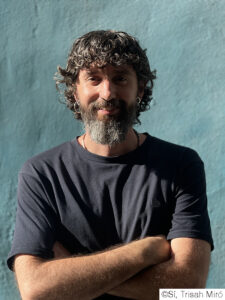

The writer and expert in management training and development Fernando Botella gives us an interview after the publication of How to train the mind? Botella has collaborated in some prestigious universities and business schools such as the University of Central Florida, Harvard University, ESADE or ICADE. In this book, he reviews topics such as generative listening, the power of the question, he feedback, the nature of imperfection, the force of imagination, disruptive thinking, fears or new leadership. GINÉS J. VERA
How to train the mind? makes us aware that things can be different from how they were in the past. Y, since everything is yet to be done, can (and it must) train in the now. Tell us about that concept of mental training. (exponential) versus pseudolearning.
Exponential learning is that which is based on a continuous learner mind., and it only comes to the extent that you have the ability to surprise yourself with everything that is to come. Here the concept of ignorance becomes very important.. As I say in my book, The magnitude of my ignorance is infinitely exponential. Fortunately! Because that starting point is what puts me in exponential learning mode.. Socrates and Plato already said that ignorance has a lot to do with the ability to learn and focusing, not in what I already know, but in what I still don't know. The secret of human development lies much more in discovering what we still know because it is what connects us to the future.. Exponentiality proposes living by constantly questioning the present, the established. Pseudolearning, instead, It is the justification of what I already know, is to continue hovering comfortably around what is no longer a challenge.
When and how did the idea for the book come about?? In the prologue, Álex Rovira mentions the concept of unlearning to relearn and links it to the focus of the book Total leadership. Who is this “skills gym to be better professionals” aimed at??
Àxlex, In addition to being a friend and a person I admire a lot, It played a relevant role in an important moment in my life.. For me it is a luxury to have your participation. Regarding the book, It is aimed at anyone who wants to become a better version of themselves and thus improve the environment in which they operate.. When I talk about leaders here, I am not referring to organizational leaders but to each person's own personal development.. The ability to self-lead and self-manage ourselves. This has to do with the way we use our inner language., with the way we respond to stimuli through imagination to provoke the future and generate alternatives. All those workouts, that have to do with the ability to listen better, knowing how to talk to yourself and dialogue with others through good questions, They are valid for anyone.
Another of the terms that appear in the first pages of the book is “connective intelligence.”, I think that a little in line with the concept of exponential growth so important in How to train the mind? Do you tell us?
The Formula Industry 1 discovered many years ago that if they created a collaborative work environment among team members, The cars didn't need to spend so much time in the pits.. Each of the engineers and mechanics were specialists in something, but everyone could collaborate with each other to save time and be more productive and efficient. years later, Ferrari reinvented its own model and moved to a cooperative system, where everyone was able to work interconnectively, thanks to shared talent. That step from one point to another is what we have to understand to understand exponentiality.. This is not in the capacity to provide solutions, propose alternatives or action plans. Exponentiality is in focusing, in addition to the change itself, in the speed with which that change occurs.
We read that within the 4C model, “The so-called humanities will have absolute relevance in the development of people.” How does this fit into school curricula?? Latin and Greek seem doomed to disappear within the Humanities branch of the current curricular model.
If we talk about those 4Cs, one of those Cs is Culture. And that is where the humanities fully come in.. Knowing the culture means understanding the environment, and understanding the environment is essential to be able to think disruptively. There are always anthropologists on the teams of disruptive companies, historians etc., because these types of profiles generate impressive value when it comes to generating questions, to question the status quo of reality. Humanistic disciplines will have more value and will be more relevant to be able to manage environments where data analysis and automation will be implemented by AI., not us. Why not teach this in school?? I don't know if Latin, but know about history, biology, of philosophy etc.. absolutely yes.
“Our mind visualizes reality incompletely”, We read. Does not use all the information it receives, even affords the luxury of throwing away data; filters and leaves us only a part of the truth, the one that suits you best. Our mind seems to always tell us an incomplete story of the story we live.. Tell us about it, of that apparent enemy that lives with us since we are born.
Our mind uses a series of filters to function that are responsible for a series of cognitive biases.. These are shortcuts that allow us to react more quickly to certain potentially threatening stimuli.. The counterpart is that they “steal” part of our information and take away our potential.. Those filters are assumptions, negative predictions of the future, emotion as a response, the exaggeration, the generalization. These biases play a role, They save us resources and make us more efficient in certain situations, but you have to know when to use them. The problem comes when we are unable to dominate them and we let them take control of our mind all the time..
“Most of our actions are determined by emotions”. It is, apparently, They support each of our decisions. Let's not forget that our brain is biologically pessimistic. Tell us about it in the thread of the so-called pre-decision or pre-rational state… and “tonsillar kidnapping.”
We are emotion and even when we believe that we are making the most rational of decisions, it is completely impregnated by emotions.. An emotion is nothing more than a response to the environment. It is a survival tool, That's why our pessimistic brain gives it so much importance. Our first reaction is always emotional, that state of “predecision” or “prerational” in which emotions take control. Ojo, We are not saying that emotions are negative.; quite the opposite. They are absolutely essential, Without them we would not go very far as a species.. They are the gasoline that moves the machinery of Humanity. The key is to learn to modulate that emotion and introduce a dose of logic and rationality into the equation.. Because together, emotion and reason, They form that virtuous cocktail that will allow us to make the best decisions. Applying reason is what allows us to respond instead of simply reacting..
The last question has to do with the formulas that appear in the book. In the prologue of history of time, de Stephen Hawking, This one talked about the risk of including formulas because there were fewer readers. In How to train the mind? there are a few. Aren't you afraid that someone, when flipping through the book, gets uncomfortable even if the ones that appear are simple… and none relate matter to the speed of light?
Hawking, as almost always, I was right about this too.. What happens is that while Hawking's are pure mathematical formulas that are extraordinarily complex and, therefore, counterproductive from a didactic point of view, and that's why he didn't use them in his books, My mathematical formulas are simple metaphors that I use to visually explain a concept and, somehow, challenge the reader. I wouldn't even call them “formulas.”, sino, rather, “games or “winks”.